Every atom of carbon-14 in your body is slowly decaying. Every gram of uranium in Earth's crust is undergoing spontaneous nuclear transformation. Radioactive decay is the process by which an unstable nucleus spontaneously emits radiation and transforms into a different nucleus — a process governed by quantum mechanics and characterised by a fixed probability per unit time. It is inherently random at the level of individual atoms, yet completely predictable statistically for large samples. Understanding radioactive decay is essential to nuclear medicine, carbon dating, nuclear power, radiation safety, and the geology of Earth's interior.
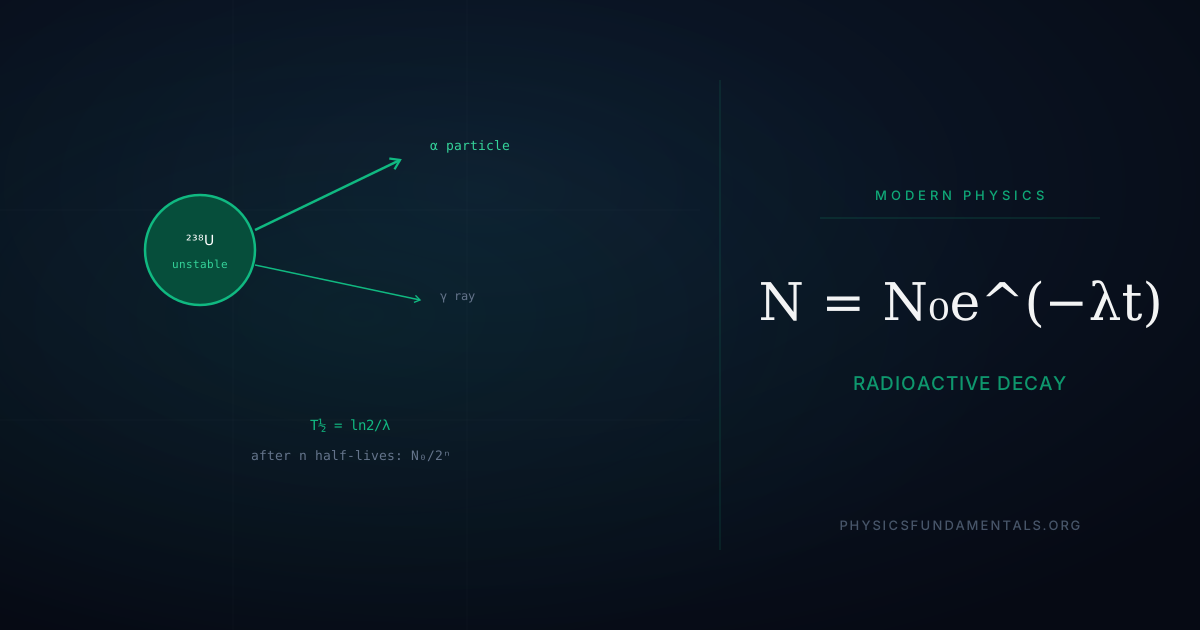
Radioactive decay is the spontaneous transformation of an unstable atomic nucleus into a more stable configuration by emission of radiation. The three principal types are alpha (α), beta (β), and gamma (γ) decay. The process is random for individual nuclei but follows a precise exponential law for large populations: N(t) = N₀ e^(−λt), where λ is the decay constant.
Why Nuclei Decay
Nuclear stability depends on the ratio of protons to neutrons and on the total number of nucleons. Light stable nuclei tend to have roughly equal proton and neutron numbers (N ≈ Z). Heavy nuclei require more neutrons than protons to offset proton-proton electrostatic repulsion. Beyond bismuth-209 (Z = 83), no stable nuclei exist — all nuclei with Z > 83 are radioactive.
A nucleus decays when it can reach a lower energy state by doing so. The excess energy is carried away by the emitted radiation. Which type of decay occurs depends on what imbalance exists in the nucleus.
Alpha Decay (α)
An alpha particle is a helium-4 nucleus: two protons + two neutrons, written ⁴₂He or α. Alpha decay occurs in heavy nuclei (typically A > 200) where the nucleus can reduce both its proton-proton repulsion and total mass by ejecting a tightly bound helium-4 cluster.
The daughter nucleus has Z reduced by 2 and A reduced by 4. Alpha particles are emitted with discrete kinetic energies (typically 4–8 MeV) and have very short range in matter: a few centimetres in air, stopped by a sheet of paper or skin. However, alpha emitters inside the body are extremely dangerous — the dense ionisation they produce in tissue causes severe radiation damage.
Alpha decay is explained by quantum tunnelling — classically, the alpha particle cannot escape the nuclear potential well (the Coulomb barrier is too high). Quantum mechanically, the wavefunction has a non-zero probability of extending beyond the barrier, giving a finite tunnelling probability per unit time. This explains why alpha decay has a characteristic half-life that can vary from microseconds to billions of years depending on the barrier height.
Beta Decay (β)
Beta decay converts a neutron to a proton (β⁻) or a proton to a neutron (β⁺), emitting a fast electron or positron.
Beta-minus decay (β⁻): a neutron transforms into a proton, emitting an electron (e⁻) and an anti-neutrino (v̄_e):
Example: ¹⁴₆C → ¹⁴₇N + e⁻ + v̄_e (carbon-14 → nitrogen-14)
Beta-plus decay (β⁺): a proton transforms into a neutron, emitting a positron and a neutrino:
Unlike alpha particles, beta particles have a continuous energy spectrum (the energy is shared between the electron and neutrino). Beta particles have greater range than alpha particles — several metres in air, stopped by a few mm of aluminium — but are less ionising.
Beta decay is mediated by the weak nuclear force — one of the four fundamental forces. The discovery of the neutrino in beta decay (postulated by Pauli in 1930, confirmed in 1956) was a triumph of particle physics.
Gamma Decay (γ)
Gamma rays are high-energy photons emitted when a nucleus in an excited state drops to a lower energy state — exactly analogous to atomic emission of visible light photons, but with much higher energies (typically 0.1–10 MeV). Gamma decay usually follows alpha or beta decay, which often leave the daughter nucleus in an excited state.
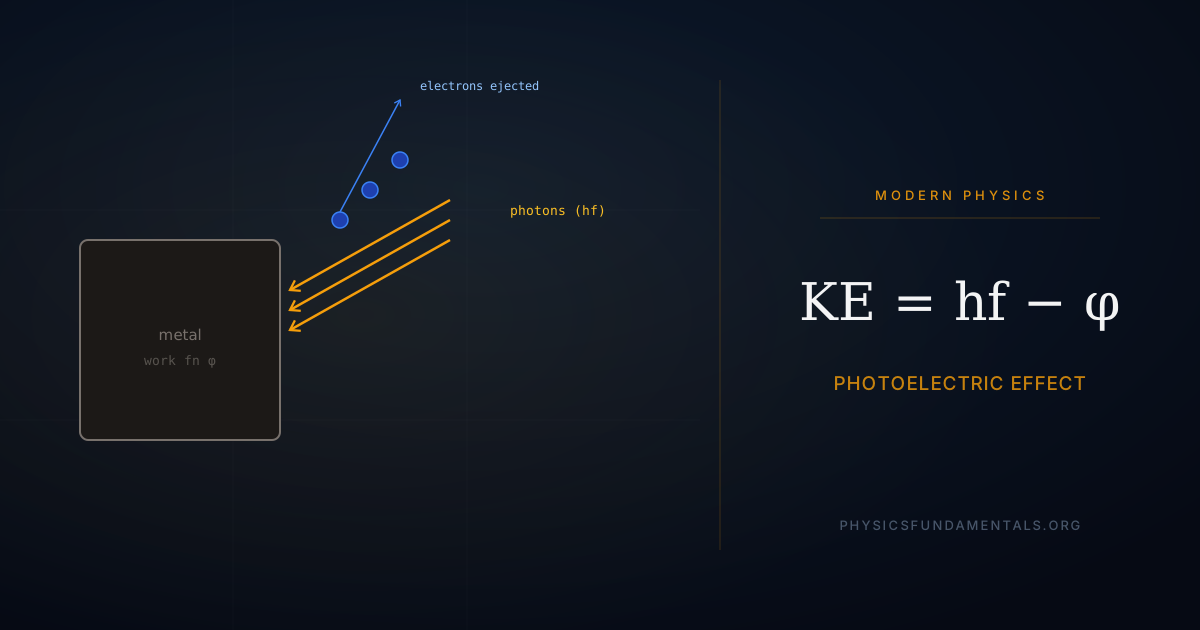
Gamma decay does not change Z or A — only the nuclear energy state changes. Gamma rays are the most penetrating radiation: they require centimetres of lead or metres of concrete to reduce intensity significantly. They interact with matter through the photoelectric effect, Compton scattering, and pair production.
| Type | Particle | Charge | Range in air | Stopped by |
|---|---|---|---|---|
| Alpha (α) | ⁴He nucleus | +2 | ~3–7 cm | Paper, skin |
| Beta (β⁻) | Electron | −1 | ~1–3 m | Aluminium (few mm) |
| Gamma (γ) | Photon | 0 | Hundreds of metres | Lead (cm), concrete (m) |
The Decay Law and Half-Life
Radioactive decay is a random quantum process: each nucleus has a fixed probability λ (the decay constant) of decaying per unit time, independent of its history or the presence of other nuclei. For a large population N of identical nuclei, the rate of decay (activity A) is:
Solving this differential equation gives the exponential decay law:
where N₀ is the initial number of nuclei and λ is the decay constant (s⁻¹). The half-life T½ is the time for half the nuclei to decay:
After n half-lives: N = N₀ × (½)ⁿ. After 1 half-life: N₀/2. After 2: N₀/4. After 10: N₀/1024 ≈ 0.1% of N₀.
| Isotope | Half-life | Decay type | Application |
|---|---|---|---|
| Carbon-14 | 5,730 years | β⁻ | Radiocarbon dating |
| Iodine-131 | 8.0 days | β⁻, γ | Thyroid cancer treatment |
| Technetium-99m | 6.0 hours | γ only | Medical imaging (SPECT) |
| Uranium-238 | 4.47 billion years | α | Geological dating |
| Polonium-214 | 164 microseconds | α | Part of uranium-238 decay chain |
Worked Examples
Example 1: Remaining activity after multiple half-lives
A sample of iodine-131 (T½ = 8 days) has initial activity 400 MBq. What is its activity after 24 days?
Example 2: Using the exponential law
Carbon-14 has T½ = 5,730 years. What fraction remains after 17,190 years?
(Equivalent to 3 half-lives: (½)³ = 1/8 = 12.5% ✓)
Example 3: Radiocarbon dating
A wood sample has 25% of the C-14 activity of living wood. How old is it?
(Two half-lives: (½)² = 0.25, so 2 × 5,730 = 11,460 years ✓)
Activity and the Becquerel
Activity A measures the number of decays per second:
Unit: becquerel (Bq) = 1 decay per second. 1 curie (Ci) = 3.7 × 10¹⁰ Bq (the activity of 1 gram of radium-226). The activity of a radioactive source decreases exponentially at the same rate as N: A(t) = A₀ e^(−λt).
Applications of Radioactive Decay
Radiocarbon dating: living organisms maintain C-14 at atmospheric equilibrium (~1 part in 10¹²). After death, no new C-14 is incorporated — the ratio of C-14 to C-12 decreases with T½ = 5,730 years. Measuring the residual ratio dates organic material up to ~50,000 years old with high precision.
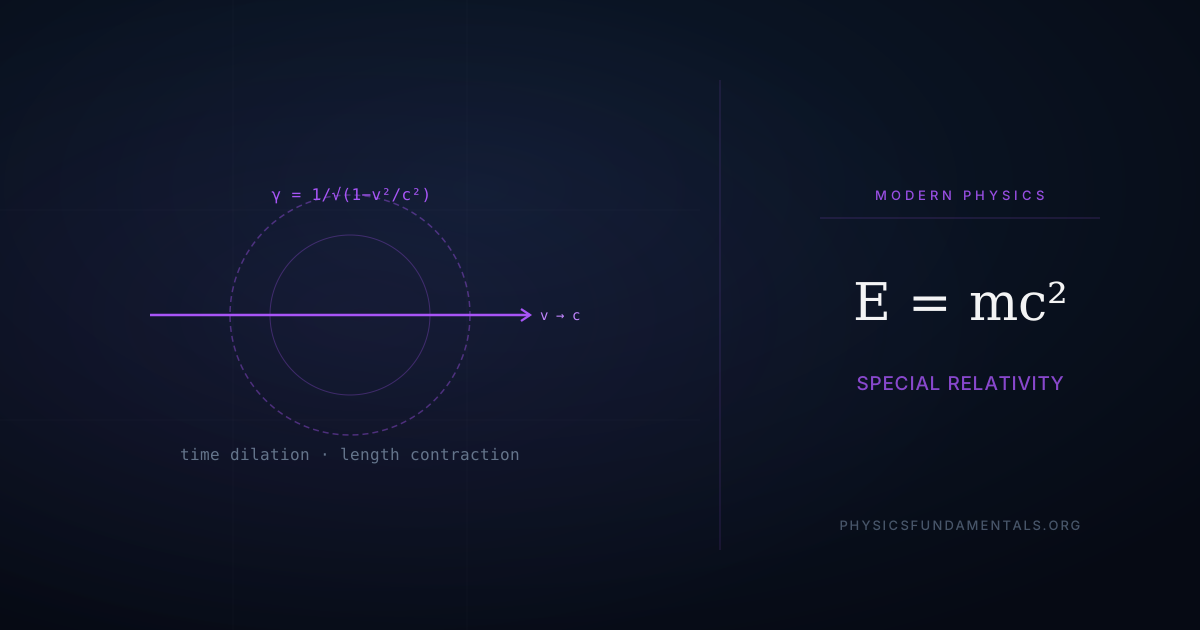
Nuclear reactions and radioactive decay are both governed by the same mass-energy equivalence from special relativity. Nuclear medicine: Tc-99m emits gamma rays detectable outside the body and has a 6-hour half-life — long enough for imaging, short enough to minimise radiation dose. It is used in ~40 million medical scans per year worldwide. I-131 treats thyroid cancer: it is preferentially absorbed by the thyroid, where its beta radiation destroys tumour cells.
Smoke detectors: americium-241 (T½ = 432 years) emits alpha particles that ionise air between two electrodes, allowing a small current to flow. Smoke particles interrupt this current, triggering the alarm.
Geological dating: uranium-238 decays to lead-206 with T½ = 4.47 billion years — comparable to Earth's age. The ratio of U-238 to Pb-206 in ancient rocks gives their age. This method confirmed Earth's age at ~4.54 billion years.
Frequently Asked Questions
Types of Radioactive Decay
| Type | Particle emitted | Change in Z | Penetrating power |
|---|---|---|---|
| Alpha (α) | ⁴₂He nucleus (2p + 2n) | Z − 2, A − 4 | Stopped by paper/skin; most ionising |
| Beta-minus (β⁻) | Electron (n → p + e⁻ + ν̄_e) | Z + 1, A unchanged | Stopped by a few mm Al; moderately ionising |
| Beta-plus (β⁺) | Positron (p → n + e⁺ + ν_e) | Z − 1, A unchanged | Stopped by a few mm Al; annihilates with electrons |
| Gamma (γ) | High-energy photon | Z unchanged, A unchanged | Requires cm–m of lead/concrete; least ionising per unit path |
The Decay Law and Half-Life
Radioactive decay is random at the individual nuclear level but follows a precise statistical law for large numbers:
where N₀ is initial number of nuclei, N(t) is the number at time t, λ is the decay constant (s⁻¹), and A = λN is activity (decays per second, measured in becquerels Bq). The half-life T½ is the time for half the nuclei to decay:
Worked Examples
Example 1: Carbon-14 has T½ = 5,730 years. What fraction remains after 11,460 years?
11,460 years = 2 × T½. After 1 half-life: ½ remains. After 2: ¼ remains. → 25% of original C-14 present.
Example 2: Iodine-131 (T½ = 8.0 days) has initial activity 400 MBq. Find activity after 24 days.
24 days = 3 half-lives. A = 400 × (½)³ = 400/8 = 50 MBq.
Example 3: Find decay constant for radon-222 (T½ = 3.82 days = 3.82 × 86400 s = 330,048 s).
Frequently Asked Questions
What is radioactive decay?
Radioactive decay is the spontaneous disintegration of an unstable atomic nucleus, emitting radiation (alpha particles, beta particles, or gamma rays) to reach a more stable configuration. It is a random quantum process — you cannot predict when any individual nucleus will decay, but for large numbers of nuclei, the decay rate follows N(t) = N₀e^(−λt), where λ is the decay constant. Energy is released in each decay, arising from the mass difference between parent and daughter nuclei (E = Δmc²). Radioactive decay is the source of Earth's internal heat (via U-238, Th-232, and K-40) and the basis of nuclear medicine and carbon dating.
What is half-life?
Half-life (T½) is the time required for half the nuclei in a sample to decay. T½ = ln2/λ = 0.693/λ, where λ is the decay constant. After one half-life: ½ remain. After two: ¼. After n half-lives: (½)ⁿ remain. Half-lives range from 10⁻²² seconds (beryllium-8) to 10¹⁹ years (tellurium-128, essentially stable for practical purposes). Carbon-14 (T½ = 5,730 years) is used for archaeological dating up to ~50,000 years. Uranium-238 (T½ = 4.47 × 10⁹ years) is used to date rocks billions of years old. The half-life is constant — independent of temperature, pressure, or chemical environment.
What is the difference between alpha, beta, and gamma radiation?
Alpha radiation consists of helium-4 nuclei (2 protons + 2 neutrons) emitted from heavy nuclei. It is the most ionising but least penetrating — stopped by a sheet of paper or a few centimetres of air. Beta radiation is electrons (β⁻) or positrons (β⁺) emitted from nuclei. More penetrating than alpha — stopped by a few mm of aluminium. Gamma radiation is high-energy electromagnetic photons emitted after alpha or beta decay leaves the nucleus in an excited state. Least ionising but most penetrating — requires cm–m of lead or concrete for effective shielding. All three can damage biological tissue; alpha is most dangerous if inhaled or ingested (internal exposure).
What is carbon dating?
Carbon-14 dating (radiocarbon dating) determines the age of once-living organic material. Atmospheric CO₂ contains a known, approximately constant ratio of C-14 to stable C-12 (about 1 part per trillion by mass). Living organisms absorb CO₂ and maintain this ratio. On death, C-14 uptake stops and the C-14 decays with T½ = 5,730 years. Measuring the remaining C-14/C-12 ratio gives the time since death. Accurate to ~50,000 years (10 half-lives of C-14). Calibration against tree rings (dendrochronology) corrects for past variations in atmospheric C-14 concentration. This technique revolutionised archaeology and is one of the most powerful tools for absolute dating of ancient organic materials.
Why is radioactive decay random?
Radioactive decay is fundamentally random due to quantum mechanics. There is no internal "clock" in a nucleus counting down to decay — each nucleus at any instant has a fixed probability per unit time of decaying (the decay constant λ), regardless of how long it has existed. This is analogous to a radioactive nucleus being like a coin that has a fixed probability of coming up heads on each flip — previous flips don't affect future ones. The randomness is intrinsic to quantum mechanics, not a result of hidden classical variables (Bell's theorem rules this out). For large numbers of nuclei, the randomness averages out to give the precise exponential decay law N(t) = N₀e^(−λt).
What is radioactive decay?
Radioactive decay is the spontaneous transformation of an unstable nucleus into a more stable one by emitting radiation. The three main types are alpha (α — helium nucleus), beta (β — electron or positron), and gamma (γ — high-energy photon). The process is random for individual nuclei but follows an exponential law for large numbers: N(t) = N₀ e^(−λt).
What is half-life?
Half-life (T½) is the time taken for half of a radioactive sample to decay: T½ = ln2/λ = 0.693/λ. After n half-lives, the fraction remaining is (½)ⁿ. Half-life is a constant property of each isotope — unaffected by temperature, pressure, or chemical state. It ranges from microseconds to billions of years.
What is the difference between alpha, beta, and gamma radiation?
Alpha (α): helium-4 nucleus, charge +2, short range (~cm in air), stopped by paper. Highly ionising. Beta (β): electron or positron, charge ±1, longer range (~m in air), stopped by mm of aluminium. Moderately ionising. Gamma (γ): high-energy photon, no charge, very long range, stopped by cm of lead. Least ionising per unit path length but most penetrating.
How does radiocarbon dating work?
Living organisms maintain C-14 at atmospheric levels (~1 in 10¹² carbon atoms). After death, C-14 decays with T½ = 5,730 years without replenishment. The ratio of C-14 to C-12 decreases exponentially. Measuring this ratio and applying N(t) = N₀ e^(−λt) gives the time since death. Accurate for organic material up to ~50,000 years old.
Why is radioactive decay exponential?
Each nucleus has a fixed probability λ of decaying per unit time, independent of time or surroundings. The rate of decay is proportional to the number present: dN/dt = −λN. This differential equation has the solution N(t) = N₀ e^(−λt) — exponential decay. The same mathematics describes population decline, capacitor discharge, and drug elimination from the body.
Share this article
Written by
Physics Fundamentals Editorial Team
Written and reviewed by our team of physics educators. Content is aligned with A-Level, GCSE, AP Physics, and undergraduate curricula.
About Physics Fundamentals →