Newton's Laws of Motion
The three laws governing every force and acceleration. Foundation of all classical mechanics — from billiard balls to rocket trajectories.
Read the guide →From Newton's laws and energy conservation to transverse waves and quantum mechanics — a free, comprehensive physics education platform built to make every concept click.
Free forever — no account, no paywall, no login required
Core Concepts
Physics fundamentals are precise descriptions of how everything moves, stores energy, and interacts. Every branch of science and engineering builds on these foundations.
The three laws governing every force and acceleration. Foundation of all classical mechanics — from billiard balls to rocket trajectories.
Read the guide →Definition, labeled diagram, wavelength, amplitude, frequency, polarization — with real examples from light to guitar strings. 6,800 words.
Read the guide →Kinetic, potential, and thermal energy explained. The conservation of energy law and why it is the most important principle in all of physics.
Read the guide →Range, max height, time of flight equations with full worked examples. Why 45° maximises range and common exam mistakes corrected.
Read the guide →The universal wave equation v = fλ explained from first principles. From sound waves to light — worked examples and Doppler effect.
Read the guide →The principle behind every collision. Elastic vs inelastic collisions, centre of mass, worked examples, and why momentum never disappears.
Read the guide →Why Physics Fundamentals
More than a website — a complete learning environment where physics fundamentals become intuitive through interaction, not memorization.
From classical mechanics through electromagnetism to quantum physics — every fundamental concept explained with depth and clarity by working physicists.
Manipulate variables, observe outcomes, build intuition. Our physics games let you experiment in ways a textbook never could.
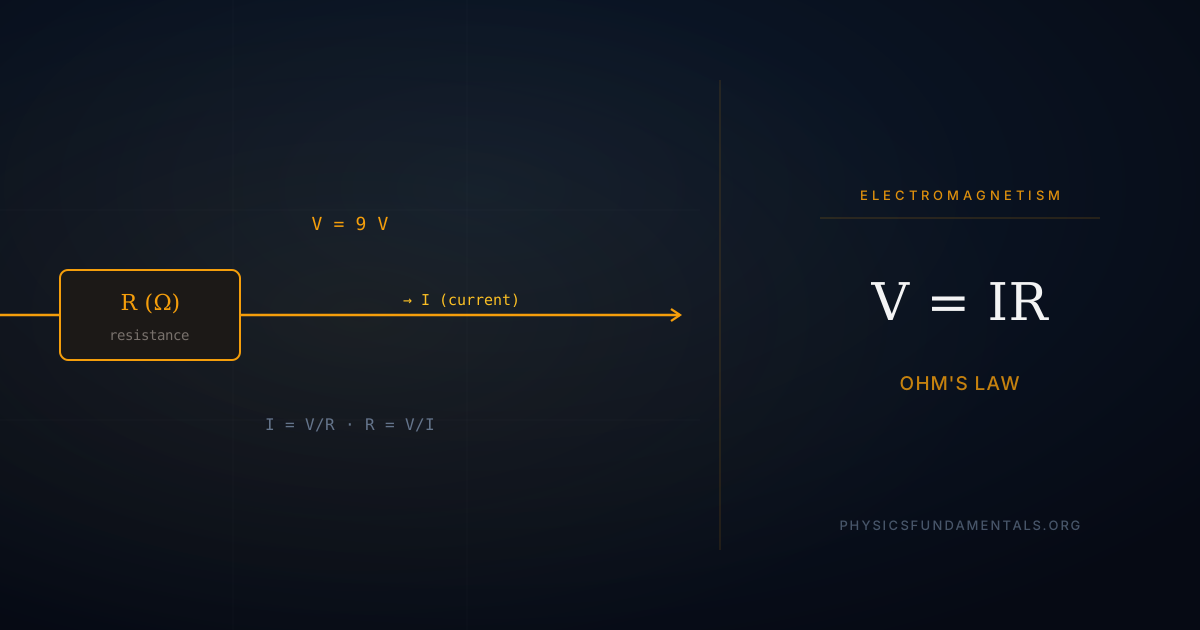
From projectile motion to Ohm's Law, every calculator shows the formula, the worked substitution, and the final answer — not just a number.
We don't just hand you formulas. Every topic starts with the physical intuition — the 'why' — before introducing the mathematics.
Complex ideas like vector fields, wave interference, and orbital mechanics become clear through carefully designed diagrams and animations.
Quality physics education should never sit behind a paywall. Every article, calculator, and game we build is completely free.
Comprehensive Curriculum
Our curriculum covers all physics fundamentals — from the classical mechanics of Newton to the strange world of quantum theory. Each topic is built for genuine understanding, not exam prep alone.
Newton's Laws, Kinematics, Forces, Momentum, Energy
Conservation Laws, Heat Transfer, Entropy, Gas Laws
Transverse Waves, Sound, Light, Interference, Doppler
Electric Fields, Circuits, Ohm's Law, Magnetic Forces
Special Relativity, Quantum Mechanics, Nuclear, Radioactivity
SUVAT Equations, Velocity, Acceleration, Graphs of Motion
Available now
Latest Articles
 Physics Fundamentals Editorial Team
 Physics Fundamentals Editorial Team
 Physics Fundamentals Editorial Team
 Physics Fundamentals Editorial Team
 Physics Fundamentals Editorial Team
 Physics Fundamentals Editorial Team
Physics fundamentals are the core laws and principles describing how the universe behaves at every scale. Mastering them is the single most effective investment any science or engineering student can make.
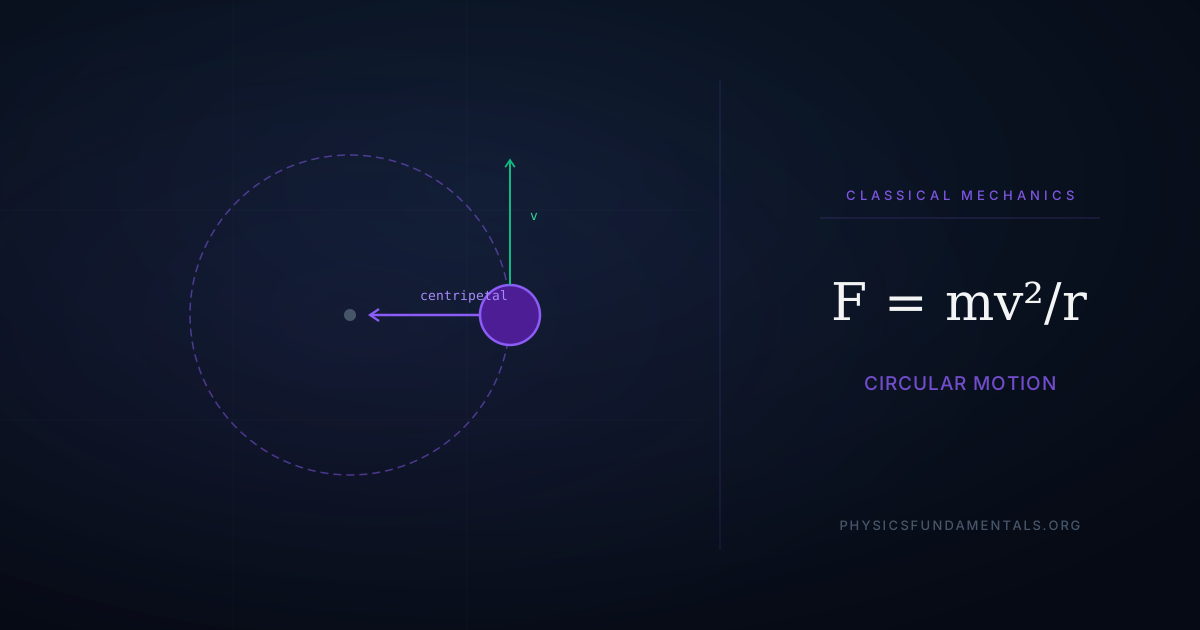
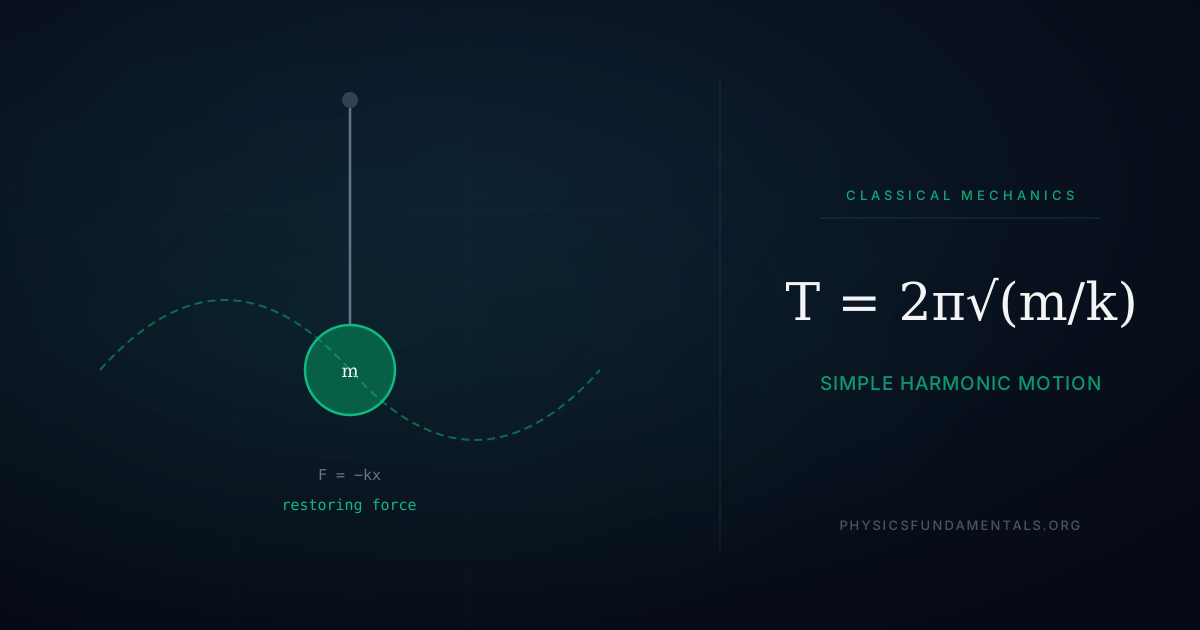
Classical mechanics begins with Newton's three laws. The first establishes inertia. The second (F = ma) quantifies how force produces acceleration. The third explains action–reaction pairs. Together they predict projectile trajectories, satellite orbits, and forces in every engineered structure.
All Mechanics Articles →Wave physics governs how energy propagates. Transverse waves — oscillation perpendicular to propagation — include all electromagnetic radiation. The wave equation v = fλ connects speed, frequency, and wavelength for every wave type in the universe.
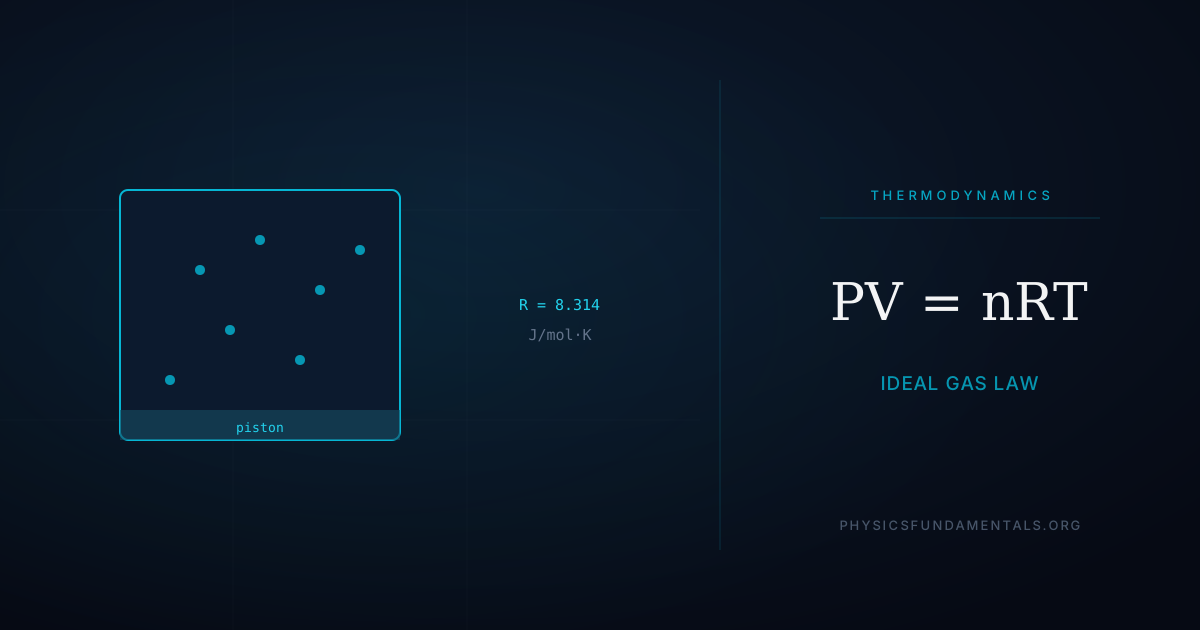
All Waves Articles →Energy is the central concept connecting all physics. Conservation of energy — it cannot be created or destroyed, only transformed — is one of the deepest truths in science. The first law of thermodynamics applies this to heat and work. The kinetic theory of gases links molecular motion to pressure.
All Thermodynamics Articles →Conservation laws are the deepest principles in physics. Conservation of momentum governs every collision. Newton's law of gravitation describes the force between any two masses — from dropping a ball to the orbit of the Moon. These are exact laws with no known exceptions.
All Articles →Concise, insight-driven updates when we publish something worth reading — a new article, calculator, or tool. No filler. No noise. Just the good stuff.
Free forever · No spam · Unsubscribe in one click
Join on WhatsApp
Quick bites of physics — no number shared, ever
Your number is never visible to other members · Channel broadcast only
Explore
Every article, topic, author, and resource — all in one place for easy discovery.
Frequently Asked Questions
The fundamentals of physics encompass the core principles governing how the universe works: classical mechanics (Newton's laws, motion, forces, energy), thermodynamics (heat and entropy), electromagnetism (electric and magnetic fields), waves and optics (light and sound behavior), and modern physics (quantum mechanics and relativity). These branches form the foundation for understanding everything from how a ball rolls down a ramp to how stars generate energy through nuclear fusion.
Yes, Physics Fundamentals is completely free and always will be. We believe quality physics education should be accessible to every student regardless of financial circumstances. All lessons, simulations, practice problems, and study guides are available at no cost.
Our content is developed by physicists and experienced educators who hold advanced degrees in physics and related fields. Every article, simulation, and problem set undergoes rigorous review to ensure scientific accuracy and pedagogical effectiveness.
We cover the full spectrum of introductory to intermediate physics: kinematics, Newton's laws, energy and momentum, rotational dynamics, thermodynamics, fluid mechanics, transverse and longitudinal waves, sound, optics, electricity, magnetism, circuits, and modern physics including special relativity, quantum mechanics, nuclear physics, and radioactive decay.
Unlike a traditional textbook, Physics Fundamentals emphasizes conceptual understanding through interactive simulations, step-by-step visual explanations, and immediate feedback on practice problems. We prioritize building physical intuition before introducing mathematical formalism, which research shows leads to deeper and more lasting comprehension.
The most effective approach combines conceptual understanding with mathematical practice. Start by grasping the physical intuition behind each concept before memorizing equations. Work through solved examples, then attempt problems independently. Use visual aids and simulations to build spatial and quantitative intuition. Consistency matters more than intensity: short daily sessions outperform cramming.
Physics Fundamentals
👋 Get concise physics updates — new articles, calculators, and tools. Your number stays private. No spam. No group chats. Just worthy content.
Your number is never shared or visible to others
Join the Channel