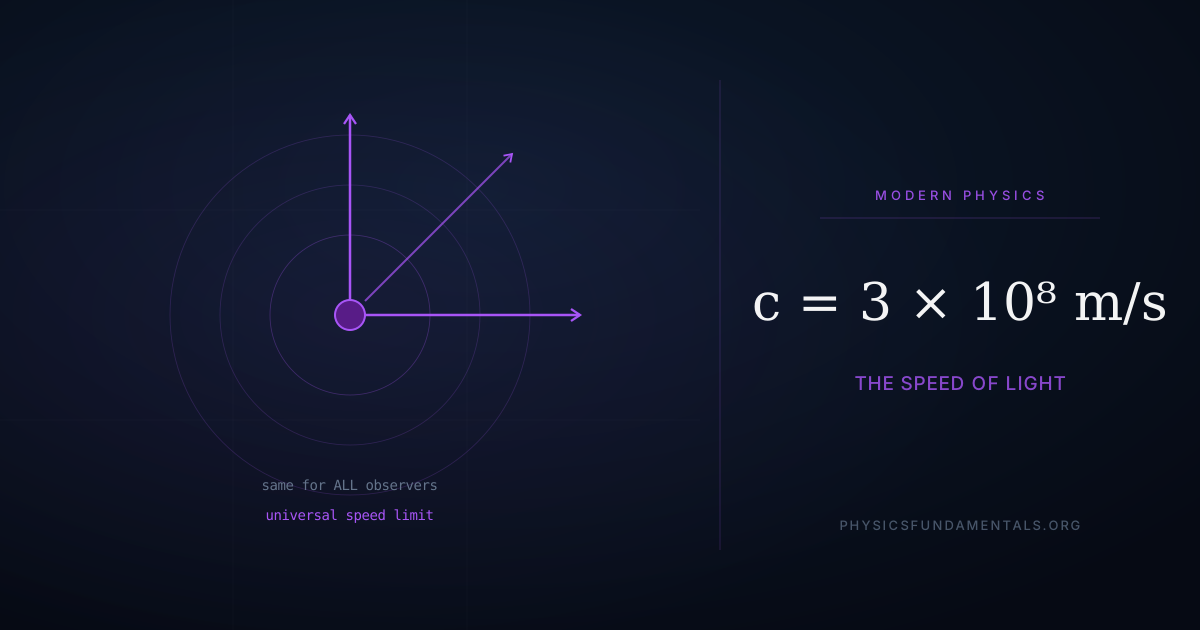
c = 299,792,458 m/s — that number is not an approximation. Since 1983, the speed of light has been fixed by definition, and the metre is derived from it. The speed of light is the most fundamental constant in physics: it's the universal speed limit, it appears in E = mc², it determines how electricity and magnetism work together, and it shapes the geometry of spacetime itself. Nothing in the universe moves faster.
c = 299,792,458 m/s (exact, by definition)
≈ 3 × 10⁸ m/s (to 1 significant figure)
≈ 300,000 km/s
≈ 1,079,252,849 km/h (approximately 1.08 × 10⁹ km/h)
≈ 186,282 miles per second
≈ 670,616,629 miles per hour
1 light-second = 299,792 km
1 light-minute = 17,987,547 km
1 light-year = 9.461 × 10¹⁵ m ≈ 9.5 trillion km
What Is the Speed of Light in m/s?
The speed of light in a vacuum is exactly c = 299,792,458 m/s. This is not a measured approximation — since 1983, the General Conference on Weights and Measures fixed c at this exact value and redefined the metre accordingly. One metre is now defined as the distance light travels in exactly 1/299,792,458 of a second.
In scientific notation: c = 2.99792458 × 10⁸ m/s. For most physics calculations, the approximation c ≈ 3 × 10⁸ m/s is accurate to 0.07% — sufficient for almost all problems at A-Level, GCSE, and AP Physics level.
What Is the Speed of Light in km/h?
Converting from m/s to km/h: multiply by 3600 (seconds per hour) and divide by 1000 (metres per kilometre):
In other words, light travels roughly 1.08 billion kilometres per hour. In one hour, light would circle the Earth 26,940 times (Earth's circumference ≈ 40,075 km).
What Is the Speed of Light in km/s?
Simply divide by 1000:
Light covers approximately 300,000 km every second. The Moon is about 384,400 km from Earth — light takes about 1.28 seconds to reach it. The Sun is 149.6 million km away — light takes about 8 minutes 20 seconds to reach Earth from the Sun.
What c Actually Represents
c is not just the speed of visible light. It is the speed of all electromagnetic radiation in a vacuum: radio waves, microwaves, infrared, visible light, ultraviolet, X-rays, and gamma rays all travel at exactly c. It is also the speed of gravitational waves, confirmed when LIGO detected the gravitational wave signal from two colliding black holes in 2017, simultaneously with a gamma-ray burst detected by the Fermi space telescope — the two signals arrived within 1.7 seconds of each other after travelling 1.3 billion light-years, confirming the speeds match to better than one part in 10¹⁵.
c appears in Maxwell's equations as:
where ε₀ = 8.854 × 10⁻¹² F/m is the electric permittivity of free space and μ₀ = 4π × 10⁻⁷ H/m is the magnetic permeability of free space. When Maxwell worked this out in 1865, he found that his calculated electromagnetic wave speed matched the measured speed of light exactly. He concluded that light is an electromagnetic wave — one of the great unifications in physics.
How the Speed of Light Was Measured Through History
Rømer (1676) — 2.2 × 10⁸ m/s: First measurement ever. Ole Rømer noticed that the timing of Jupiter's moon Io going into eclipse was consistently late when Earth was moving away from Jupiter, and early when Earth approached. The delay is light taking longer to cross the extra distance. His estimate was ~26% too low, but proved that light travels at a finite speed.
Bradley (1728) — 3.01 × 10⁸ m/s: James Bradley explained stellar aberration — the apparent annual wobble of star positions caused by Earth's orbital velocity. The angle of aberration equals v_Earth/c, giving a more accurate c.
Fizeau (1849) — 3.13 × 10⁸ m/s: First terrestrial measurement. Hippolyte Fizeau shone light through gaps in a rotating toothed wheel, reflected it off a mirror 8 km away, and measured the wheel speed at which the returning light was blocked by the next tooth. Clean, elegant, and reproducible.
Michelson (1926) — 299,796 km/s: Albert Michelson used a rotating mirror over a 35 km baseline between Mt. Wilson and Mt. San Antonio in California. Accurate to within 4 km/s of the true value. Michelson dedicated his career to measuring c and won the 1907 Nobel Prize in Physics (primarily for this work and the Michelson-Morley experiment).
Modern laser methods (1972–1983): Measuring c precisely by timing laser pulses over known distances. The result — 299,792,458 m/s — was so well-established that it became the definition.
The Speed of Light in Different Materials
Light slows down in matter. The ratio of c to the actual speed in a material is the refractive index n:
| Medium | Refractive index n | Speed in m/s | % of c |
|---|---|---|---|
| Vacuum | 1.000 | 2.998 × 10⁸ | 100% |
| Air (STP) | 1.0003 | 2.997 × 10⁸ | 99.97% |
| Water | 1.333 | 2.25 × 10⁸ | 75% |
| Crown glass | 1.52 | 1.97 × 10⁸ | 66% |
| Diamond | 2.42 | 1.24 × 10⁸ | 41% |
This slowing is why light bends (refracts) at the boundary between materials — explored in the reflection and refraction article. Note: it's the photons that are absorbed and re-emitted by atoms in the material, which creates the apparent slowing. Between atoms, light still travels at c.
When particles travel through a medium faster than light does in that medium (but still below c in vacuum), they produce Cherenkov radiation — a blue electromagnetic shockwave. This is the blue glow seen in nuclear reactor cores: fission products travel through the cooling water at speeds exceeding the speed of light in water (2.25 × 10⁸ m/s), creating the optical equivalent of a sonic boom.
Why c Is Constant for All Observers
The Michelson-Morley experiment (1887) tried to detect variation in light speed as Earth moved through space. It found none. Light arrived at the same speed regardless of Earth's direction of motion — stunning, and completely at odds with classical wave theory.
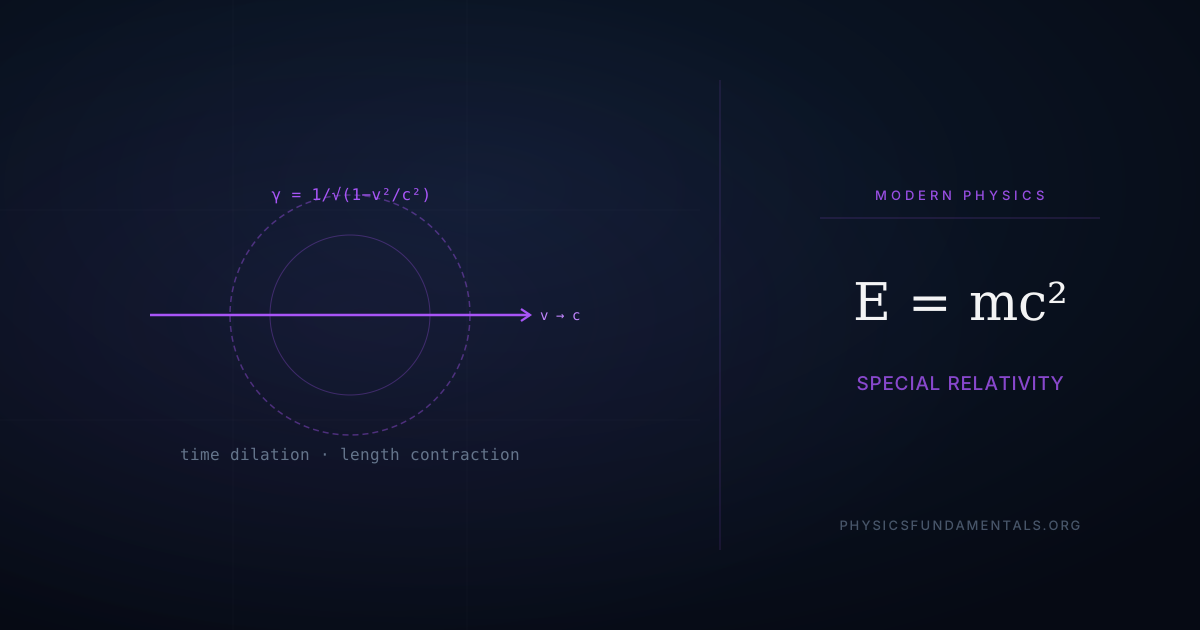
Einstein's 1905 solution: rather than light adapting to the observer, space and time adapt. He postulated that c is the same for all inertial observers. The consequences — time dilation, length contraction, E = mc², the relativity of simultaneity — follow mathematically and have all been experimentally confirmed to extraordinary precision.
Relativistic velocity addition prevents speeds exceeding c. A rocket at 0.9c firing a missile at 0.9c relative to the rocket does not produce 1.8c:
No matter what sub-light speeds you combine, the result stays below c.
c and E = mc²
Einstein's mass-energy equivalence E = mc² follows directly from special relativity. The c² tells you the exchange rate: 1 kg of mass is equivalent to c² = (3 × 10⁸)² = 9 × 10¹⁶ joules. That's roughly the energy output of a large nuclear power plant running for three years — from one kilogram of mass.
Nuclear fission doesn't convert all mass to energy — only about 0.1% of the fuel mass becomes energy. Thermonuclear fusion converts about 0.7% for hydrogen → helium. Even so, the c² factor makes these tiny mass changes yield enormous energy.
The Scale of c in Everyday Life
Light from a lamp reaches you in nanoseconds (1 ns = 10⁻⁹ s; light travels 0.3 m per nanosecond). Signals in a computer's processor travel at roughly 0.5c to 0.7c through copper wires — this is why processor clock speeds plateaued around 3–5 GHz in the 2000s: at 5 GHz, each clock cycle lasts 0.2 ns, and signals can only travel 6 cm in that time. The physical size of circuits began to limit clock speed.
GPS satellites must correct for both special relativity (satellite clocks run slow due to orbital speed, by ~7 μs/day) and general relativity (satellite clocks run fast because they're at higher gravitational potential, by ~45 μs/day). Without these corrections — both involving c — GPS would accumulate errors of ~10 km per day.
Frequently Asked Questions
Common Mistakes When Working with c
Using c = 3 × 10⁸ m/s when the question expects precision. The approximation c ≈ 3 × 10⁸ m/s is fine for most problems but introduces a 0.07% error. Questions asking for 4+ significant figures, or those involving very precise timings, require the full value c = 299,792,458 m/s or at least c = 2.998 × 10⁸ m/s.
Confusing light-year with a unit of time. A light-year is a distance — the distance light covers in one year. It is not a unit of time. "The star is 4 light-years away" means the distance, not that it takes 4 years to see it (though both are true: it does take 4 years for light to reach us from there, so we see it as it was 4 years ago).
Thinking the "speed limit" means everything travels at c. Only massless particles (photons, gluons, gravitons if they exist) travel at exactly c. Everything with mass travels at less than c. The speed of electrons in a wire, for example, is millimetres per second as a drift velocity — the electromagnetic signal propagates at close to c, but individual electrons barely move.
Misunderstanding faster-than-light apparent effects. Phase velocity of waves can exceed c in some media. Quantum entanglement appears instantaneous. The expansion of the universe can make distant galaxies recede faster than c. None of these violate Einstein's relativity because none involve the transfer of information faster than c. The key constraint is information velocity, not all possible velocities.
c in Everyday Technology
GPS satellites demonstrate both special and general relativistic effects of c with economic consequences. The satellite clocks run slow by ~7 microseconds per day due to their orbital speed (special relativity: moving clocks run slow). They also run fast by ~45 microseconds per day due to lower gravitational potential at altitude (general relativity: clocks run faster far from mass). Net effect without correction: +38 μs/day. At c = 3 × 10⁸ m/s, 38 μs corresponds to a position error of 38 × 10⁻⁶ × 3 × 10⁸ = 11.4 km per day. GPS would be useless for navigation without these relativistic corrections — a practical demonstration that the constancy of c has real engineering implications.
Fibre optic cables transmit data as light pulses. The speed of light in glass fibre (n ≈ 1.47) is c/1.47 ≈ 2.04 × 10⁸ m/s. The round-trip time from London to New York (distance ≈ 5,500 km via undersea cable) is about 2 × 5,500,000 / (2.04 × 10⁸) ≈ 54 ms. That ~54 ms latency is the fundamental physical limit set by the speed of light in fibre — no engineering advance can eliminate it, only reduce it by choosing a more direct route or switching to a lower-n medium.
What is the speed of light in m/s?
The speed of light in a vacuum is exactly c = 299,792,458 m/s — not an approximation, but a defined value. Since 1983, the metre has been defined so that c is precisely this number. For calculations, c ≈ 3 × 10⁸ m/s (accurate to 0.07%) is sufficient for most physics problems at GCSE, A-Level, or AP Physics level.
What is the speed of light in km/h?
c = 299,792,458 m/s × 3600 ÷ 1000 = 1,079,252,849 km/h, approximately 1.08 × 10⁹ km/h. Light covers roughly 1.08 billion kilometres every hour. To put that in perspective: the distance from Earth to the Moon (384,400 km) would be covered in about 1.28 seconds. Light travels the Earth-Sun distance (150 million km) in about 8 minutes 20 seconds.
Why is the speed of light the same for all observers?
This is an experimental fact, first rigorously established by the Michelson-Morley experiment in 1887, which showed no variation in light speed as Earth moved through space. Einstein elevated it to the second postulate of special relativity in 1905. It means space and time are not absolute — they adapt so that every observer measures the same c. This leads to time dilation, length contraction, and E = mc².
Does light slow down in water or glass?
Yes. Light travels at c only in a vacuum. In a medium with refractive index n, light travels at v = c/n. In water (n = 1.33), light travels at 2.25 × 10⁸ m/s — 75% of c. In diamond (n = 2.42), at 1.24 × 10⁸ m/s — about 41% of c. This is why light bends (refracts) when it enters a new medium: it's changing speed. Between atoms, photons always travel at c; the apparent slowing is due to absorption and re-emission by atoms in the material.
Why can't anything travel faster than light?
Accelerating a massive object to c would require infinite energy: the relativistic kinetic energy KE = (γ−1)mc² → ∞ as v → c, where γ = 1/√(1−v²/c²) diverges. Massless particles like photons travel at exactly c by necessity — the Lorentz transformation is only consistent for massless particles at v = c. Relativistic velocity addition also ensures that no combination of sub-light speeds produces a total speed ≥ c.
What is a light-year and how far is it?
A light-year is the distance light travels in one Julian year (365.25 days): 1 ly = c × 1 year = 9.461 × 10¹⁵ m ≈ 9.46 trillion km. It is a unit of distance, not time. The nearest star, Proxima Centauri, is 4.24 light-years away; the Milky Way is ~100,000 light-years across; the observable universe is about 93 billion light-years in diameter. Because light takes time to reach us, looking at distant objects means looking back in time.
Share this article
Written by
Physics Fundamentals Editorial Team
Written and reviewed by our team of physics educators. Content is aligned with A-Level, GCSE, AP Physics, and undergraduate curricula.
About Physics Fundamentals →