Friction is the contact force that opposes relative motion between surfaces. It is why you can walk without slipping, why cars can brake, and why you need to keep pushing a box to keep it moving. Without friction the world would be an uncontrollable surface where nothing grips anything else — yet friction also wastes energy in engines, wears components, and generates heat. Understanding friction is fundamental to all of classical mechanics and engineering design.
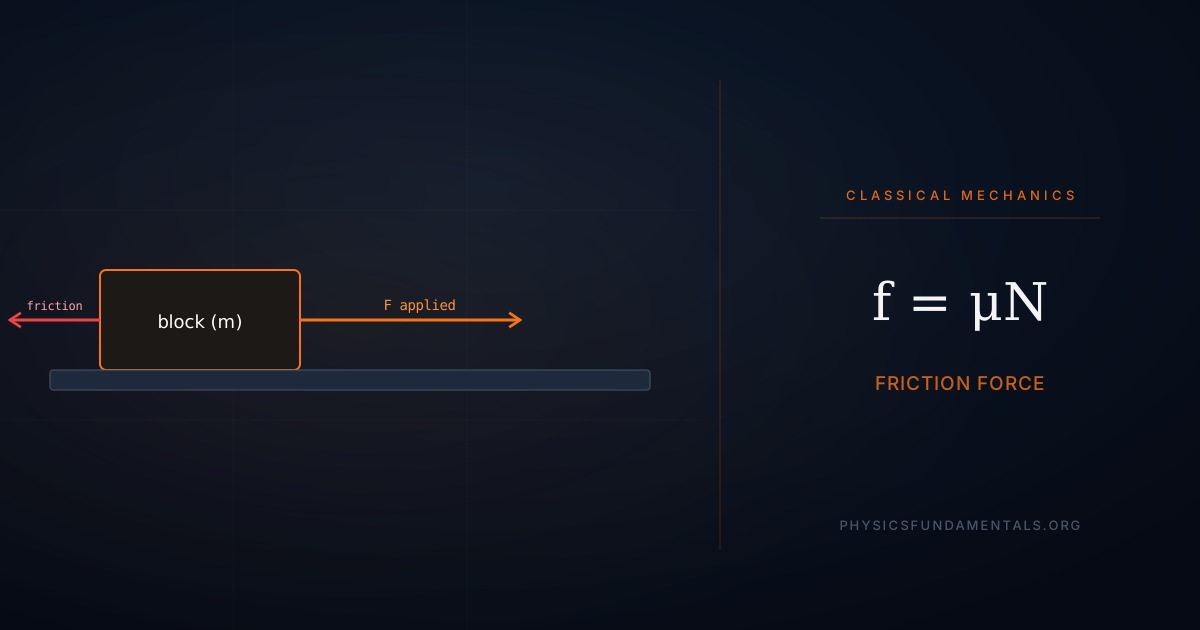
Friction is a contact force that acts parallel to two surfaces in contact, opposing their relative motion (or tendency to move). Its magnitude is proportional to the normal force pressing the surfaces together: f = μN, where μ is the coefficient of friction (dimensionless) and N is the normal force (N).
Static vs Kinetic Friction
Static friction (f_s) prevents motion from starting. It adjusts to match the applied force up to a maximum:
The ≤ matters: static friction only reaches μ_s N at the point of impending motion. Below that it equals whatever force is required for equilibrium.
Kinetic friction (f_k) acts between surfaces already sliding. Unlike static friction, it is a fixed value:
Kinetic friction is always less than maximum static friction: μ_k < μ_s. Starting an object sliding requires more force than keeping it sliding — a fact everyone has felt pushing heavy furniture.
Coefficients of Friction
| Materials | μ_s | μ_k |
|---|---|---|
| Rubber on dry concrete | 0.6–0.8 | 0.5–0.7 |
| Rubber on wet concrete | 0.45 | 0.35 |
| Wood on wood | 0.25–0.5 | 0.2–0.4 |
| Steel on steel (dry) | 0.74 | 0.57 |
| Lubricated steel | 0.15 | 0.06 |
| Ice on ice | 0.10 | 0.03 |
Worked Examples
Example 1: Will the box slide?
A 20 kg wooden box on a wooden floor (μ_s = 0.40). Applied force = 70 N horizontal.
70 N < 78.4 N → box does not move. Static friction = 70 N exactly.
Example 2: Sliding box
Same box now sliding with μ_k = 0.30. Applied force = 80 N.
Example 3: Inclined plane
5 kg block on 30° slope, μ_k = 0.20.
Friction opposes relative sliding between surfaces — but this can propel objects forward. When you walk, friction from the ground on your foot acts forward, propelling you. When a car accelerates, friction from road on drive wheels acts forward. Without friction, neither walking nor driving is possible.
The Angle of Repose
The angle at which a block just starts to slide on a slope:
For wood on wood (μ_s ≈ 0.40): θ_r ≈ 22°. Used in geotechnical engineering to predict landslide risk — slope angle vs angle of repose determines stability.
Friction and Energy
Kinetic friction converts kinetic energy to thermal energy irreversibly. Energy dissipated:
This non-conservative nature of friction is why perpetual motion machines are impossible. Heat from friction explains brake heating, meteorite glowing on atmospheric entry, and fire-starting by rubbing sticks.
Rolling Friction
Rolling friction (coefficient ~0.001–0.01) is far smaller than sliding friction (~0.2–0.8 for same surfaces). Wheels replace sliding with rolling friction — reducing resistance 20–100×. This is the reason the wheel was transformative technology.
Frequently Asked Questions
The Friction Force Formula
The maximum static friction force and kinetic friction force are given by:
where μ_s is the coefficient of static friction, μ_k is the coefficient of kinetic friction, and N is the normal force. Typically μ_s > μ_k — it takes more force to start something moving than to keep it moving. The coefficients are dimensionless and depend on the two surface materials in contact.
| Surfaces | μ_s | μ_k |
|---|---|---|
| Rubber on dry tarmac | 0.7–0.8 | 0.5–0.7 |
| Rubber on wet tarmac | 0.4–0.5 | 0.3–0.4 |
| Steel on steel (dry) | 0.6–0.8 | 0.4–0.6 |
| Ice on ice | 0.1 | 0.03 |
| Teflon on Teflon | 0.04 | 0.04 |
Worked Example 1: Will It Move?
A 20 kg box sits on a floor (μ_s = 0.4). A horizontal force of 60 N is applied. Will it move?
Normal force N = mg = 20 × 9.8 = 196 N
Applied force (60 N) < f_s(max) (78.4 N) → the box does not move. Static friction provides 60 N opposing the applied force, net force = 0.
Worked Example 2: Acceleration with Friction
A 5 kg block is pushed along a floor (μ_k = 0.3) with a force of 25 N horizontally. Find the acceleration.
N = 5 × 9.8 = 49 N; f_k = 0.3 × 49 = 14.7 N
Worked Example 3: Friction on an Incline
A 3 kg block on a 25° incline has μ_k = 0.2. Find the acceleration down the slope.
Component of gravity along slope: F_g = mg sin 25° = 3 × 9.8 × 0.423 = 12.4 N (down)
Normal force: N = mg cos 25° = 3 × 9.8 × 0.906 = 26.6 N
Friction (opposing motion, up the slope): f_k = 0.2 × 26.6 = 5.32 N
Applications and Real World
Braking distance: f = μmg provides braking force. From F = ma: a = μg. Using v² = u² + 2as with v = 0: stopping distance s = u²/(2μg). At 30 m/s with μ = 0.7: s = 900/(2 × 0.7 × 9.8) = 65.5 m. Wet roads (μ = 0.4) give s = 114.8 m — 75% longer. Walking: friction between shoe and floor provides the horizontal force that accelerates you forward. On ice (μ ≈ 0.03), this force is tiny and movement is very difficult. Lubrication: engine oil reduces μ between moving parts from ~0.5 (dry steel) to ~0.05–0.1, reducing wear and power loss to friction.
Frequently Asked Questions
What is friction force?
Friction is a contact force that opposes relative motion (or the tendency for relative motion) between surfaces in contact. It acts parallel to the surfaces and perpendicular to the normal force. Static friction prevents stationary objects from starting to slide; kinetic friction acts on sliding objects. Both are proportional to the normal force: f = μN, where μ is the coefficient of friction. Friction is caused by microscopic surface interactions — asperities (tiny bumps) interlocking and forming brief adhesive bonds at the nanoscale.
What is the difference between static and kinetic friction?
Static friction acts when surfaces are not sliding relative to each other. It adjusts to exactly oppose any applied force up to its maximum value f_s(max) = μ_s N. If the applied force exceeds this maximum, the surfaces begin to slide. Kinetic friction acts when surfaces are already sliding. It is approximately constant at f_k = μ_k N regardless of sliding speed. Because μ_s > μ_k for most material pairs, it takes more force to start an object moving than to keep it moving — which is why it's harder to get a heavy box sliding than to keep it sliding.
Does friction depend on the area of contact?
No — for dry solid surfaces, friction force is approximately independent of contact area. This is one of Amontons' laws (1699). A brick lying flat and the same brick standing on end both have the same friction force (same weight, same μ, same N). Wider tyres don't provide more friction — they provide a larger contact patch at lower pressure, which improves heat dissipation and compound grip, but the fundamental friction force is F = μN regardless of area. This seems counterintuitive but is well established experimentally for macroscopic dry surfaces.
How do you calculate friction force?
For kinetic friction (sliding surfaces): f_k = μ_k × N, where N is the normal force perpendicular to the surfaces. For static friction (not sliding): f_s ≤ μ_s × N — the actual static friction equals the applied force parallel to the surface, up to the maximum μ_s N. On a horizontal surface, N = mg (weight). On an incline at angle θ: N = mg cos θ, and the friction force is f = μ × mg cos θ. The coefficient μ must be looked up for the specific pair of materials in contact.
Is friction always harmful?
No — friction is essential for most everyday activities. Without it, you couldn't walk, cars couldn't brake or steer, screws and nails couldn't hold structures together, and you couldn't hold a pen. Friction is harmful mainly in machines where it wastes energy as heat and causes wear. Engineers lubricate bearings, use ball bearings, and choose low-friction materials (PTFE/Teflon, ceramic coatings) to reduce unwanted friction. But intentional friction — brake pads, clutch plates, non-slip surfaces — is deliberately engineered to be as high as needed.
Angle of Friction and Limiting Equilibrium
For a block on an incline, as the angle θ increases from 0°, the component of weight along the slope increases and the normal force decreases. The block begins to slide when the gravitational component exceeds maximum static friction: mg sin θ > μ_s mg cos θ → tan θ > μ_s. The critical angle θ_c = arctan(μ_s) is called the angle of friction. For μ_s = 0.5: θ_c = 26.6°. Any incline angle below this keeps the block stationary; above it, the block slides. This principle is used to measure μ_s experimentally — simply tilt the surface until the object just starts to slide and measure the angle.
Historical Context and Microscopic Explanation
Leonardo da Vinci discovered the basic laws of friction around 1500 — that friction is proportional to load and independent of contact area — but didn't publish them. Guillaume Amontons rediscovered and published these laws in 1699. Charles-Augustin de Coulomb (better known for his law of electrostatic force) extended the theory in 1781, distinguishing static and kinetic friction. The microscopic explanation came later: surfaces appear smooth but are actually covered with microscopic asperities (bumps). True contact occurs only at these peaks, giving a real contact area far smaller than geometric area. At asperity contacts, cold welding and van der Waals forces create adhesive junctions. Friction is the force needed to shear these junctions as surfaces slide.
Common Mistakes
Forgetting that friction ≠ constant — it adjusts. Static friction is not always μ_s N — that's the maximum. If you push with less than maximum static friction force, friction equals your push force exactly (so net force = 0 and the object stays still). Only when you exceed μ_s N does the object start moving. Using the wrong normal force. On a horizontal surface, N = mg. On an incline at angle θ: N = mg cos θ, not mg. The normal force is always perpendicular to the surface, which reduces it on inclines.
What is friction force?
Friction is a contact force opposing relative motion or tendency to slide between surfaces. It acts parallel to the surfaces, opposite to motion direction. Magnitude: f = μN, where μ is the coefficient of friction and N is the normal force.
What is the difference between static and kinetic friction?
Static friction prevents motion starting — it adjusts up to f_s max = μ_s N. Kinetic friction acts between sliding surfaces at a fixed value f_k = μ_k N. Static is always greater (μ_s > μ_k), so starting motion requires more force than maintaining it.
Does friction depend on contact area?
No. Friction force is independent of contact area — a fundamental result of the Amontons-Coulomb laws. Larger area means more contact points but less force per point; the effects cancel. Only normal force and the coefficient of friction determine the friction force.
What is the coefficient of friction?
A dimensionless constant characterising how easily two surfaces slide against each other. Higher μ means more friction. Depends on materials and surface condition (dry, wet, lubricated) but not on speed or area. Typical values: rubber on dry concrete 0.6–0.8; ice on ice 0.03–0.10.
Is friction a non-conservative force?
Yes. Kinetic friction is non-conservative: it converts mechanical energy irreversibly to thermal energy. Work done by friction depends on the path taken, not just start and end points. This distinguishes friction from conservative forces like gravity or spring force, where energy is stored and fully recoverable.
Share this article
Written by
Physics Fundamentals Editorial Team
Written and reviewed by our team of physics educators. Content is aligned with A-Level, GCSE, AP Physics, and undergraduate curricula.
About Physics Fundamentals →