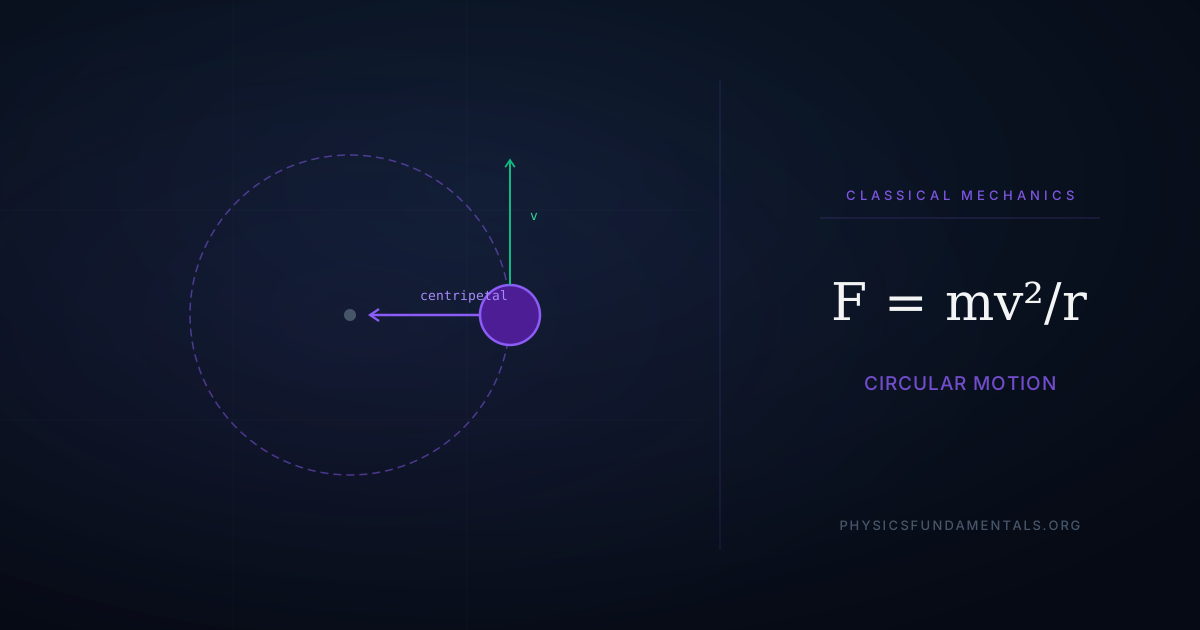
A ball whirled on a string, a car rounding a bend, the Moon orbiting Earth, an electron in a magnetic field — all are in circular motion. Despite moving at constant speed, every object in uniform circular motion is continuously accelerating. This apparent contradiction resolves when you recall that velocity is a vector: continuously changing direction means continuously changing velocity, which by definition means acceleration. The force producing this acceleration — always directed toward the centre of the circle — is the centripetal force.
Centripetal acceleration: the acceleration of an object moving in a circle, directed toward the centre. Formula: a_c = v²/r.
Centripetal force: the net force directed toward the centre of a circular path that maintains circular motion. Formula: F_c = mv²/r = mω²r.
"Centripetal" means "centre-seeking." Centripetal force is not a new type of force — it is always provided by an existing force such as tension, gravity, friction, or a normal force.
Why Circular Motion Requires a Net Force
Newton's first law states that an object continues in a straight line at constant velocity unless a net force acts on it. A circling object is not travelling in a straight line — so there must be a net force. Newton's second law (F = ma) confirms this: if there is acceleration, there is a net force in the direction of that acceleration.
The velocity vector of a circling object is always tangent to the circle. As the object moves, this tangent direction rotates — meaning velocity is always changing direction. The rate of change of this velocity vector always points toward the centre, giving centripetal acceleration:
where v is the speed (m/s) and r is the radius of the circle (m). The centripetal force is then:
Angular Velocity and Period
For circular motion, it is useful to describe the speed in terms of angular velocity ω (omega, rad/s) — the angle swept per second:
where T is the period (time for one full revolution, in seconds) and f is frequency (revolutions per second, Hz). The centripetal acceleration and force in terms of ω:
| Quantity | Formula | Unit |
|---|---|---|
| Centripetal acceleration | a_c = v²/r = ω²r | m/s² |
| Centripetal force | F_c = mv²/r = mω²r | N |
| Angular velocity | ω = 2π/T = v/r | rad/s |
| Speed | v = ωr = 2πr/T | m/s |
Worked Examples
Example 1: Ball on a string
A 0.5 kg ball is whirled in a horizontal circle of radius 0.8 m at 4 m/s. Find centripetal acceleration and the tension in the string.
The tension in the string must be 10 N — it is the centripetal force. If the string breaks (or tension is removed), the ball flies off in a straight line tangent to the circle — as Newton's first law predicts.
Example 2: Car on a circular road
A 1,200 kg car takes a circular bend of radius 50 m at 15 m/s. What friction force is needed?
The friction between tyres and road must provide 5,400 N of centripetal force. If friction is insufficient (icy roads, excessive speed), the car skids outward — not inward. It "flies off" in a straight line tangent to the curve.
Example 3: Moon's orbit
The Moon orbits Earth at radius r = 3.84 × 10⁸ m with period T = 27.3 days = 2.36 × 10⁶ s.
This centripetal acceleration is provided by Earth's gravitational pull. Newton used this calculation — comparing the Moon's centripetal acceleration to the gravitational acceleration at Earth's surface — to verify that gravity follows an inverse-square law.
There is no centrifugal ("centre-fleeing") force in an inertial reference frame. When a car turns sharply, you feel pressed against the outer door — but this is inertia, not a force pushing you outward. In the car's rotating (non-inertial) reference frame, a "centrifugal force" is a useful fiction. In the ground frame, there is only the centripetal force (from the seat and door) pushing you inward to change your direction of motion. The feeling of being "pushed outward" is your body's resistance to being accelerated inward.
What Provides the Centripetal Force?
Centripetal force is not a new, independent force — it is always the net result of one or more existing forces directed toward the centre:
String tension: ball on a string, conical pendulum.
Gravity: Moon orbiting Earth; planets orbiting Sun; satellites in orbit. The gravitational force IS the centripetal force — F_gravity = mv²/r gives the orbital speed directly.
Friction: car rounding a bend on a flat road. Friction from the road on the tyres provides the centripetal force toward the centre of curvature.
Normal force (banked road): roads banked at angle θ allow the horizontal component of the normal force to provide centripetal force, reducing reliance on friction. F_c = mg tan θ for the designed speed.
Magnetic force: a charged particle moving perpendicular to a magnetic field experiences a force F = qvB perpendicular to its velocity — exactly centripetal. This causes charged particles in magnetic fields to move in circles. Particle accelerators and mass spectrometers exploit this.
Orbital Motion: Gravity as Centripetal Force
For a satellite of mass m orbiting Earth at radius r:
where G = 6.67 × 10⁻¹¹ N·m²/kg² and M is Earth's mass (5.97 × 10²⁴ kg). Notice the orbital speed does not depend on the satellite's mass m — it depends only on the radius of the orbit. At the International Space Station's orbit (~400 km altitude, r ≈ 6.77 × 10⁶ m), the orbital speed is approximately 7,660 m/s (27,600 km/h).
Frequently Asked Questions
Circular Motion of a Charged Particle in a Magnetic Field
One of the most important applications of circular motion is the path of a charged particle in a magnetic field. When a charge q moves with velocity v perpendicular to a magnetic field B, the magnetic force F = qvB acts perpendicular to the velocity — exactly the condition for circular motion.
Setting the magnetic force equal to the centripetal force:
This is the radius of circular motion of a charged particle in a magnetic field. Key results:
- Larger mass → larger radius (harder to deflect)
- Larger charge → smaller radius (stronger magnetic force)
- Larger speed → larger radius (more inertia)
- Stronger field → smaller radius (stronger centripetal force)
The period of circular orbit T = 2πr/v = 2πm/(qB) is independent of speed — this is the cyclotron frequency principle. It means all particles of the same charge-to-mass ratio orbit at the same frequency regardless of their speed, which is what makes cyclotrons work.
Worked Example: Proton in a Magnetic Field
A proton (m = 1.67 × 10⁻²⁷ kg, q = 1.6 × 10⁻¹⁹ C) moves at 2.0 × 10⁶ m/s perpendicular to a 0.30 T field. Find the radius of its circular path.
Cyclotron frequency: f = qB/(2πm) = (1.6 × 10⁻¹⁹ × 0.30) / (2π × 1.67 × 10⁻²⁷) = 4.57 MHz
Mass Spectrometry and r = mv/(qB)
The radius formula r = mv/(qB) is the foundation of mass spectrometry. Ions are accelerated through a known potential difference V, giving them kinetic energy KE = qV = ½mv². This fixes their speed: v = √(2qV/m). Entering a magnetic field, they curve with radius r = mv/(qB). Substituting the expression for v:
Measuring r precisely (from where ions hit a detector) reveals m/q, which identifies the ion. Modern mass spectrometers can measure atomic masses to one part in 10⁸, enabling identification of trace compounds in blood samples, dating of archaeological samples by carbon-14 ratios, and quality control of pharmaceuticals.
Worked Examples — Centripetal Force
Example 1: Car on a Curved Road
A 1,200 kg car travels at 20 m/s around a flat curve of radius 80 m. Find the centripetal force required and the minimum coefficient of friction to prevent skidding.
This centripetal force is provided by friction: f = μmg → μ = F_c/(mg) = 6000/(1200 × 9.8) = 0.51
Dry tarmac has μ ≈ 0.7 — safe. Wet tarmac μ ≈ 0.4 — the car would skid at this speed on a wet road.
Example 2: Satellite Orbital Speed
A satellite orbits Earth at height h = 400 km (ISS orbit). Earth's radius R = 6,371 km, so orbital radius r = 6,771 km = 6.771 × 10⁶ m. g at that height ≈ 8.7 m/s². Find orbital speed.
Gravity provides centripetal force: mg = mv²/r → v = √(gr) = √(8.7 × 6.771 × 10⁶) = 7,670 m/s ≈ 7.7 km/s
The ISS completes one orbit every 92 minutes at this speed — travelling at 27,700 km/h. It's in continuous free fall, with the centripetal acceleration (8.7 m/s²) provided entirely by gravity.
Banked Curves and Vertical Circles
Banked curves: Roads and race tracks are banked (tilted inward) to reduce the friction needed for circular motion. On a banked curve of angle θ, the horizontal component of the normal force provides centripetal acceleration: tan θ = v²/(rg). The ideal banking angle for speed v and radius r requires no friction at all — the geometry alone provides the centripetal force. The 33° banking on the Indianapolis Motor Speedway allows cars to take turns at ~320 km/h with reduced reliance on tyre friction.
Vertical circles: For a ball on a string moving in a vertical circle, centripetal acceleration is provided by the tension minus (or plus) the component of weight. At the top of the loop, both tension and weight point toward the centre: T + mg = mv²/r. Minimum speed at the top (T = 0): v_min = √(gr). At the bottom, tension points toward the centre, weight away: T − mg = mv²/r → T = m(v²/r + g) — why you feel heaviest at the bottom of a roller-coaster loop.
What is centripetal force?
Centripetal force is the net force directed toward the centre of a circular path that keeps an object moving in that circle. Its formula is F_c = mv²/r. It is not a separate type of force — it is always provided by an existing force such as gravity, tension, friction, or a normal force, depending on the situation.
What is centripetal acceleration?
Centripetal acceleration is the acceleration directed toward the centre of a circular path: a_c = v²/r = ω²r. It is always present in circular motion because the direction of velocity is continuously changing, even when speed is constant. By Newton's second law, this acceleration requires a centripetal force F = ma_c = mv²/r.
Is centrifugal force real?
Centrifugal force is not a real force in an inertial (non-rotating) reference frame. It is a "fictitious force" that appears when you describe motion in a rotating reference frame. The feeling of being pushed outward in a turning car is actually the inertia of your body resisting the centripetal acceleration directed inward. In the ground frame, only the centripetal force (inward) exists.
What happens if centripetal force is removed?
If the centripetal force is suddenly removed (e.g., a string breaks), the object flies off in a straight line tangent to the circle at the point of release. This is Newton's first law: without a net force, an object continues in a straight line at constant velocity. The object does not fly radially outward — it flies tangentially.
What provides the centripetal force for a car on a bend?
On a flat road, friction between the tyres and road provides the centripetal force. The maximum friction force limits the maximum speed for a given radius — exceed this and the car skids outward. On a banked road, the horizontal component of the normal force provides (some or all of) the centripetal force, allowing higher speeds without relying on friction.
How does gravity provide centripetal force in orbits?
For a satellite in circular orbit, Earth's gravity is the centripetal force: GMm/r² = mv²/r. Solving for orbital speed: v = √(GM/r). The satellite's mass cancels — orbital speed depends only on orbit radius. Lower orbits are faster (ISS at 400 km altitude: 7,660 m/s); higher orbits are slower (geostationary orbit at 35,786 km: 3,070 m/s).
Share this article
Written by
Physics Fundamentals Editorial Team
Written and reviewed by our team of physics educators. Content is aligned with A-Level, GCSE, AP Physics, and undergraduate curricula.
About Physics Fundamentals →