Heat spontaneously flows from hot objects to cold ones — the direction dictated by the second law of thermodynamics and the concept of entropy. But how does it actually transfer? There are exactly three mechanisms by which thermal energy transfers: conduction (through direct molecular contact), convection (carried by moving fluids), and radiation (transmitted as electromagnetic waves without requiring any medium). Every heating system, every cooling strategy, every thermal insulation design exploits some combination of these three processes. Understanding how they work — and how to quantify them — is fundamental to thermodynamics, engineering, and even climate science.
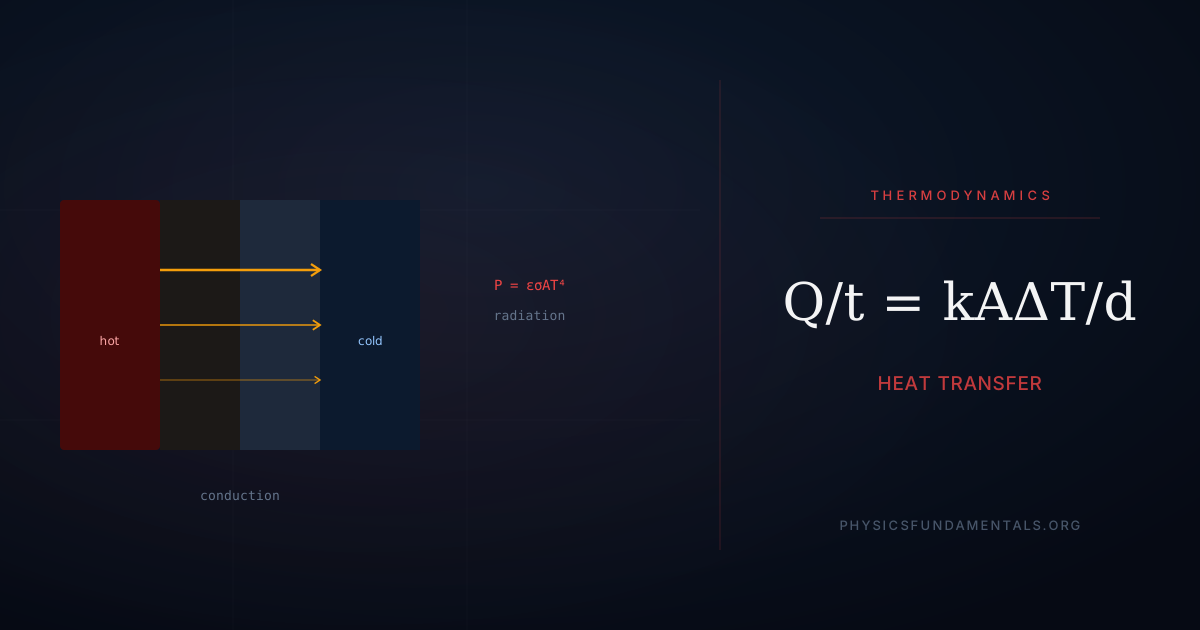
Conduction: energy transfer through direct molecular collisions without bulk material movement. Occurs in solids and slow-moving fluids. Rate governed by Fourier's Law: Q/t = kAΔT/d.
Convection: energy transfer by the bulk movement of a fluid (liquid or gas). Natural (free) convection is driven by density differences; forced convection uses pumps or fans.
Radiation: energy transfer as electromagnetic waves, requiring no medium. All objects emit thermal radiation. Rate governed by the Stefan-Boltzmann Law: P = εσAT⁴.
Conduction: Fourier's Law
In conduction, faster-moving (hotter) molecules collide with slower-moving (cooler) neighbours, transferring kinetic energy without bulk material flow. The rate of heat flow by conduction through a material is:
where Q/t is the rate of heat transfer (W), k is the thermal conductivity (W/m·K), A is the cross-sectional area (m²), ΔT is the temperature difference (K or °C), and d is the thickness (m). This is Fourier's Law of heat conduction.
Materials with high k are good conductors (metals); materials with low k are good insulators:
| Material | Thermal conductivity k (W/m·K) |
|---|---|
| Silver | 429 |
| Copper | 401 |
| Aluminium | 237 |
| Glass | 1.0 |
| Brick | 0.6–1.0 |
| Wood | 0.1–0.5 |
| Fibreglass insulation | 0.04 |
| Air (still) | 0.025 |
Still air is one of the best thermal insulators (k = 0.025 W/m·K) — the basis of double glazing (trapped air layer), wool clothing (traps air between fibres), and cavity wall insulation. Metals conduct heat so well because free electrons carry energy as well as charge — the same electrons responsible for electrical conductivity explain why good electrical conductors are also good thermal conductors (Wiedemann-Franz Law).
Worked example: Heat loss through a window
A single-pane glass window (k = 1.0 W/m·K, thickness 4 mm = 0.004 m, area 1.5 m²) has indoor temperature 20°C and outdoor −5°C (ΔT = 25 K).
Nearly 10 kW through one window — which is why double glazing (with an air gap) reduces this dramatically. With a 16 mm air gap: Q/t = 0.025 × 1.5 × 25 / 0.016 = 58 W — 160× less heat loss.
Convection: Bulk Fluid Movement
Convection transfers heat by the mass movement of a fluid carrying thermal energy. Two types:
Natural (free) convection: driven by buoyancy. Hot fluid expands, becomes less dense, rises. Cool fluid sinks to replace it, creating convection currents. Examples: hot air rising above a radiator, ocean thermohaline circulation, atmospheric weather patterns, Earth's mantle convection driving tectonic plates.
Forced convection: a pump, fan, or external pressure drives fluid movement, enhancing heat transfer far beyond natural convection rates. Examples: car cooling systems (water pump circulating coolant), fan-assisted ovens (even heat distribution), heat exchangers in power stations.
Newton's Law of Cooling approximates convective heat loss from an object at temperature T to surroundings at T_∞:
where h is the convective heat transfer coefficient (W/m²·K) — which depends strongly on fluid velocity, fluid properties, and surface geometry. Typical values: natural convection in air h ≈ 5–25 W/m²·K; forced convection in water h ≈ 500–10,000 W/m²·K. This is why blowing on hot food cools it fast — forced convection dramatically increases h.
Radiation: Stefan-Boltzmann Law
All objects at temperatures above absolute zero emit electromagnetic radiation — primarily infrared for everyday temperatures. This radiation requires no medium and travels at the speed of light. The total power emitted by a surface:
where ε is the emissivity (0 ≤ ε ≤ 1, dimensionless), σ = 5.67 × 10⁻⁸ W/m²·K⁴ is the Stefan-Boltzmann constant, A is the surface area (m²), and T is the absolute temperature (K). The T⁴ dependence means radiation increases steeply with temperature — doubling T increases power by 16×.
Emissivity measures how efficiently a surface radiates relative to a perfect blackbody (ε = 1). A polished metal mirror has ε ≈ 0.02 (poor radiator); matte black paint has ε ≈ 0.97 (near-perfect radiator). Good absorbers are good emitters — and poor absorbers (reflective surfaces) are poor emitters. This is why space suits are silver (low ε, minimises radiative heat loss in space) and solar thermal collectors are matte black (high ε, maximises absorption).
The net radiation heat transfer between an object (temperature T) and its surroundings (temperature T_s):
Worked example: Human body radiation
A person (ε = 0.97, skin area A = 1.8 m², T = 310 K) in a room at T_s = 293 K:
A resting person radiates ~100 W of net heat — which is why a room full of people warms up quickly, and why thermal radiation is important in building energy calculations.
Wien's Displacement Law: Peak Wavelength
The peak wavelength of thermal radiation shifts with temperature:
At room temperature (293 K): λ_peak = 9.9 μm — mid-infrared, invisible. At the Sun's surface (5,778 K): λ_peak = 502 nm — green-yellow visible light. This is why incandescent light bulbs glow orange-white (filament at ~2,700 K peaks in near-infrared, with some visible); why stars' colours reveal their surface temperatures; and why thermal cameras detect people at night (body heat peaks in the infrared).
Frequently Asked Questions
The Three Mechanisms
Heat transfers from hot to cold by three mechanisms: conduction (through direct contact, molecule to molecule), convection (via bulk fluid movement), and radiation (electromagnetic waves requiring no medium). In practice, all three often occur simultaneously.
Conduction: Q = kAΔT/d
Fourier's Law of conduction: the rate of heat flow through a material is:
where k = thermal conductivity (W/m·K), A = cross-sectional area (m²), ΔT = temperature difference (K), d = thickness (m). Thermal conductivity values: copper 401 W/m·K, aluminium 237, glass 1.0, wood 0.1–0.2, air 0.026, aerogel 0.015. Poor conductors (low k) are good thermal insulators. U-values for building materials (W/m²·K) are derived from this formula: U = k/d.
Worked Example: Heat Loss Through a Window
Single-glazed window: A = 2 m², d = 4 mm = 0.004 m, k_glass = 1.0 W/m·K, ΔT = 15°C (inside 20°C, outside 5°C).
Double glazing with a 10 mm air gap: k_air = 0.026 W/m·K → P = 0.026 × 2 × 15/0.010 = 78 W. Nearly 100× less heat loss — explaining the dramatic energy saving from double glazing.
Convection
Convection transfers heat through bulk fluid movement. Natural convection: warm fluid rises (lower density), cool fluid sinks, creating circulation cells. Forced convection uses fans or pumps to move fluid past a surface. The rate depends on fluid velocity, viscosity, and thermal properties — quantified by the Nusselt number and heat transfer coefficient h: P = hAΔT. Central heating radiators use both: radiation (lower contribution than the name implies) and convection as warm air rises from the surface.
Radiation: Stefan-Boltzmann Law
All objects above 0 K emit thermal radiation. The power radiated by a perfect black body:
where σ = 5.67 × 10⁻⁸ W·m⁻²·K⁻⁴ (Stefan-Boltzmann constant), A = surface area, T = absolute temperature. The T⁴ dependence means small temperature increases give large power increases: doubling T increases radiated power 16-fold. Net radiation between an object at T and surroundings at T_0:
where ε is emissivity (1 for a perfect blackbody, <1 for real surfaces). Human skin ε ≈ 0.98 (near-perfect radiator). The Sun (T ≈ 5,778 K) radiates most intensely in visible light; Earth (T ≈ 288 K) radiates in infrared — the basis of the greenhouse effect.
Frequently Asked Questions
What are the three types of heat transfer?
Conduction transfers heat through direct molecular contact without bulk movement of matter — vibrating molecules pass energy to neighbours. Convection transfers heat through bulk movement of a fluid (liquid or gas) — warm fluid rises, cool fluid falls, creating circulation. Radiation transfers heat via electromagnetic waves (primarily infrared) without requiring any medium — the only mechanism that works through a vacuum. The Sun heats Earth by radiation; the ocean distributes heat by convection; a metal spoon in hot soup heats your hand by conduction.
What is thermal conductivity?
Thermal conductivity k (W/m·K) measures how well a material conducts heat. High k means heat flows easily through the material (good conductor — metals). Low k means heat flows poorly (good insulator — air, aerogel, wool). Copper has k ≈ 401 W/m·K; air has k ≈ 0.026 W/m·K. The rate of conductive heat flow is P = kAΔT/d — proportional to k, area, and temperature difference, inversely proportional to thickness. This formula underlies U-value calculations for building insulation and thermal resistance concepts in electronics.
What is the Stefan-Boltzmann law?
The Stefan-Boltzmann law states that a perfect blackbody radiates power P = σAT⁴, where σ = 5.67 × 10⁻⁸ W·m⁻²·K⁻⁴, A is surface area, and T is absolute temperature in kelvin. The T⁴ dependence is dramatic — doubling temperature increases radiated power 16×. Real objects radiate P = εσAT⁴, where ε (0–1) is emissivity. Earth maintains temperature by balancing incoming solar radiation with outgoing infrared radiation — greenhouse gases reduce outgoing radiation, raising the equilibrium temperature.
Why does metal feel colder than wood at the same temperature?
At room temperature, metal and wood are at the same temperature. But metal has much higher thermal conductivity (~200 W/m·K for aluminium vs ~0.15 W/m·K for wood). When you touch metal, it rapidly conducts heat away from your finger — the fast heat loss makes your skin temperature drop quickly, which your nerves interpret as cold. Wood conducts heat so slowly that your finger stays warm. This is entirely a perception effect — both materials are at room temperature. It's the same reason a bathroom tile floor feels colder than a carpet, even though both are at room temperature.
How does a vacuum flask (thermos) work?
A vacuum flask minimises all three heat transfer mechanisms. The double-walled glass structure with a vacuum between the walls eliminates conduction and convection (no medium for either in a vacuum). The inner surfaces are silvered (high reflectivity, low emissivity ε ≈ 0.02) to minimise radiation — σεAΔ(T⁴) is reduced by the factor ε. The cork or plastic stopper minimises conduction at the opening. The result: heat transfer rate is reduced by more than 99% compared to an uninsulated container, keeping hot drinks hot or cold drinks cold for many hours.
What are the three types of heat transfer?
Conduction (heat flow through direct molecular contact in solids — no bulk movement), convection (heat carried by moving fluid — liquid or gas), and radiation (heat transmitted as electromagnetic waves requiring no medium). Most real heat transfer involves all three simultaneously.
What is Fourier's Law of heat conduction?
Q/t = kAΔT/d, where Q/t is the heat flow rate (W), k is thermal conductivity (W/m·K), A is cross-sectional area, ΔT is temperature difference, and d is thickness. More conductivity, more area, greater temperature difference, or thinner material all increase the rate of conductive heat transfer.
What is the Stefan-Boltzmann Law?
P = εσAT⁴. All objects emit thermal radiation at a rate proportional to the fourth power of absolute temperature. σ = 5.67 × 10⁻⁸ W/m²·K⁴ and ε is emissivity (0–1). Doubling temperature increases radiated power 16-fold. It governs stellar luminosity, infrared cameras, building energy loss, and climate science.
What is the difference between conduction and convection?
Conduction transfers heat through molecular vibration without bulk movement — it occurs in all states of matter but most effectively in solids (especially metals). Convection requires bulk fluid flow (liquid or gas) to carry thermal energy from one location to another. Convection is typically faster than conduction in fluids because it moves hot material directly rather than transferring energy molecule-by-molecule.
Can heat transfer occur in a vacuum?
Yes — by radiation. Conduction and convection both require a material medium. Radiation is electromagnetic waves that travel through vacuum at the speed of light. This is how the Sun's energy reaches Earth across 150 million km of empty space, and how a vacuum flask (thermos) works — the evacuated jacket prevents conduction and convection, leaving only radiation to transfer heat.
Share this article
Written by
Physics Fundamentals Editorial Team
Written and reviewed by our team of physics educators. Content is aligned with A-Level, GCSE, AP Physics, and undergraduate curricula.
About Physics Fundamentals →