Put an equal mass of water and sand in the sun. The sand gets scorching hot in minutes; the water barely warms. Same energy input, same mass — completely different temperature rise. The property responsible is specific heat capacity: how much energy a substance needs to raise one kilogram of its temperature by one kelvin. It's why coastal towns have milder climates than inland cities, why water dominates industrial cooling systems, and why metals heat up so quickly on a stove.
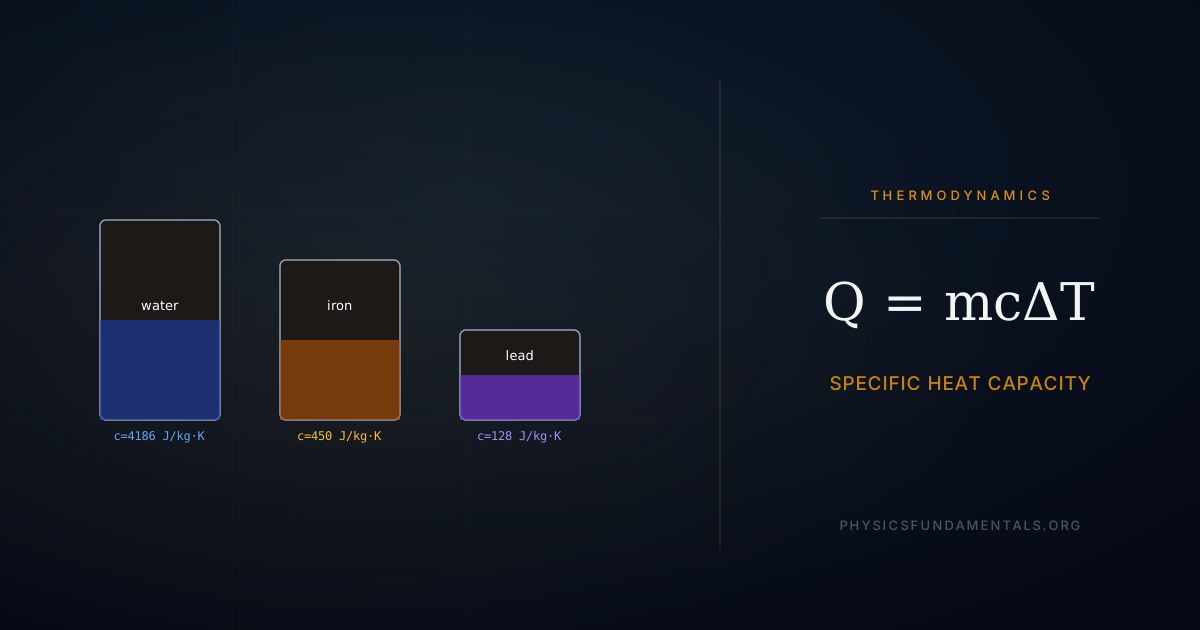
Q = mcΔT
Q = heat energy transferred (joules, J)
m = mass (kilograms, kg)
c = specific heat capacity (J kg⁻¹ K⁻¹)
ΔT = change in temperature (kelvin, K, or equivalently °C)
Specific heat capacity c is the energy needed to raise 1 kg of the substance by 1 K.
What Is Specific Heat Capacity?
The specific heat capacity of a substance (symbol c) is the amount of energy required to raise the temperature of 1 kilogram of that substance by 1 kelvin (or equivalently 1°C). The SI unit is J kg⁻¹ K⁻¹.
A high specific heat capacity means the material can absorb a lot of energy before its temperature rises — it's "thermally buffered." A low specific heat capacity means a small energy input produces a large temperature change.
| Material | c (J kg⁻¹ K⁻¹) | Notes |
|---|---|---|
| Water | 4,181 | Exceptionally high — why it's used as a coolant |
| Ice | 2,090 | About half that of liquid water |
| Aluminium | 897 | Used in heat sinks and cookware |
| Iron / steel | 450–500 | Heats quickly — why pans get hot fast |
| Copper | 385 | Good thermal conductor, low specific heat |
| Lead | 128 | Very low — heats up dramatically with small energy |
| Air (at const. pressure) | 1,005 | Key in atmospheric thermodynamics |
Deriving Q = mcΔT
If c is the energy needed per kg per K, then for a mass m, the energy needed to raise it by 1 K is m × c. For a temperature change ΔT kelvin, multiply by ΔT:
This is linear in all three quantities: double the mass, double the energy needed. Double the temperature change, double the energy. Use a material with double the specific heat capacity, double the energy. The formula is sometimes written as Q = mcθ or Q = mcΔθ depending on textbook notation — they all mean the same thing.
Worked Example 1: Heating Water
How much energy is needed to heat 2.0 kg of water from 20°C to 100°C? (c_water = 4,181 J kg⁻¹ K⁻¹)
ΔT = 100 − 20 = 80 K (or 80°C — the difference is the same in both scales)
A typical kettle uses about 2,000–3,000 W. At 2,500 W, this would take 669,000 / 2,500 = 268 seconds ≈ 4.5 minutes — consistent with experience.
Worked Example 2: Finding Temperature Change
A 0.5 kg block of iron (c = 450 J kg⁻¹ K⁻¹) absorbs 9,000 J. Find the temperature rise.
The iron block heats up by 40°C. If the same 9,000 J went into 0.5 kg of water: ΔT = 9000 / (0.5 × 4181) = 4.3 K — just 4.3°C. Water resists temperature change roughly 9× more than iron.
Worked Example 3: Calorimetry — Finding Specific Heat Capacity
A 0.2 kg metal block at 95°C is placed in 0.3 kg of water at 20°C in an insulated calorimeter. The final equilibrium temperature is 28°C. Find the specific heat capacity of the metal.
Energy lost by metal = Energy gained by water:
This value is close to that of aluminium (897) or titanium (520), so the metal could be an alloy. Real calorimetry also accounts for heat lost to the container and surroundings, which this simplified example ignores.
Why Water Has Such a High Specific Heat Capacity
Water's specific heat capacity of 4,181 J kg⁻¹ K⁻¹ is exceptionally high compared to almost any other common liquid or solid. The reason is its molecular structure. Water molecules (H₂O) form extensive networks of hydrogen bonds — weak but numerous intermolecular attractions. When you add energy to water, most of it goes into breaking and rearranging hydrogen bonds rather than speeding up the molecules (which would raise temperature). Only the energy that increases molecular kinetic energy raises the temperature.
Metals have low specific heat capacities because energy goes directly into increasing the vibrational kinetic energy of atoms in the lattice — there are no bonds like hydrogen bonds to absorb energy first.
Real-World Applications
Coastal climates: oceans act as thermal buffers. The high specific heat capacity of seawater (≈ 3,900 J kg⁻¹ K⁻¹) means the sea absorbs enormous amounts of solar energy while changing temperature only slowly. Coastal areas experience milder temperatures year-round — cooler in summer, warmer in winter — than inland regions at the same latitude.
Radiators and central heating: hot water (c = 4,181 J kg⁻¹ K⁻¹) carries large amounts of thermal energy per kilogram. A 70°C temperature drop in 10 kg of circulating water releases 10 × 4,181 × 70 = 2.9 MJ — enough to heat a room for hours. This is why water-based central heating is so efficient.
Engine cooling systems: car engines use water-ethylene glycol mixtures as coolant precisely because of water's high c. The coolant absorbs combustion heat without its temperature rising to dangerous levels, carrying the heat to the radiator where it is released to the air.
Thermal energy storage: some industrial facilities and buildings store thermal energy in large tanks of water, which acts as a thermal battery. A 1,000-litre tank cycled through a 20°C temperature swing stores 1 × 4,181 × 20 × 1000 ≈ 83.6 MJ — substantial energy for heating or cooling systems.
Cooking: cast-iron pans have low c (~450 J kg⁻¹ K⁻¹), so they heat up quickly to high temperatures from a small energy input — ideal for searing. Copper (c = 385 J kg⁻¹ K⁻¹) heats even faster and responds quickly to temperature changes, which is why copper is favoured for precision cooking. The heat transfer article covers conductivity and convection in cooking in more detail.
Specific Heat Capacity vs Heat Capacity
Specific heat capacity (c) is per unit mass — it's a property of the material itself. Heat capacity (C, no "specific") is for a particular object: C = mc. If you need to raise a specific 2 kg iron block by 1 K, its heat capacity is C = 2 × 450 = 900 J/K. Specific heat capacity is more useful for comparing materials; heat capacity is more useful for calculating energy for a specific object.
Frequently Asked Questions
Measuring Specific Heat Capacity — Practical Method
The standard method for measuring c in a school lab uses an electrical calorimeter: a known mass m of the material is heated by an immersion heater of known power P for time t. The energy supplied is Q = Pt (assuming negligible heat loss). Measuring the temperature rise ΔT then gives:
For example: 0.5 kg of aluminium heated by a 50 W heater for 5 minutes (300 s). Temperature rises from 20°C to 57°C (ΔT = 37 K).
The true value is 897 J kg⁻¹ K⁻¹, so this gives a 9.6% underestimate — because some energy escaped as heat to the surroundings and the container absorbed some. Improving the result requires: better insulation, accounting for the calorimeter's own heat capacity, and plotting temperature vs. time to correct for cooling.
Common Mistakes with Specific Heat Capacity
Using the wrong temperature scale. In Q = mcΔT, the temperature change ΔT can be in either kelvin or Celsius because a change of 1°C = a change of 1 K. However, if you need absolute temperature (e.g. in gas law problems), use kelvin. The confusion arises in combined problems — stay alert to which form is needed.
Forgetting to account for the calorimeter. In real experiments, the container (calorimeter) absorbs heat too. For an accurate measurement: Q = m_substance × c_substance × ΔT + m_calorimeter × c_calorimeter × ΔT. Exam problems often state "assume no heat is lost to the container" — check for this explicitly.
Confusing specific heat capacity and latent heat. Q = mcΔT governs temperature changes within a single phase. During a phase change (melting, boiling), temperature stays constant but energy is still required: Q = mL (where L is latent heat). A heating curve (temperature vs. energy) shows flat sections at melting and boiling points where all energy goes to phase change rather than temperature increase.
Use the thermal expansion calculator for related thermal properties, and see heat transfer for conduction, convection, and radiation — the mechanisms by which thermal energy moves.
What is specific heat capacity?
Specific heat capacity (symbol c) is the energy required to raise the temperature of 1 kilogram of a substance by 1 kelvin. It is measured in J kg⁻¹ K⁻¹. A high specific heat capacity means the material needs a lot of energy per kg per degree of temperature rise — it heats and cools slowly. Water has one of the highest specific heat capacities of any common substance (4,181 J kg⁻¹ K⁻¹), which is why it's used in cooling systems and why oceans moderate coastal climates.
What is the specific heat capacity formula?
The formula is Q = mcΔT, where Q is the heat energy transferred in joules, m is the mass in kilograms, c is the specific heat capacity in J kg⁻¹ K⁻¹, and ΔT is the temperature change in kelvin (or equivalently in Celsius, since a change of 1°C equals a change of 1 K). Rearranging: c = Q/(mΔT) to find specific heat capacity from measurements, and ΔT = Q/(mc) to find the temperature change from a known energy input.
What is the specific heat capacity of water?
The specific heat capacity of liquid water is approximately 4,181 J kg⁻¹ K⁻¹ at 25°C. This is exceptionally high compared to most substances. It arises from water's extensive hydrogen bonding network, which absorbs most input energy into bond rearrangement rather than temperature increase. This high c is why water is used in cooling systems, why coastal climates are mild, and why boiling a kettle takes relatively longer than heating the same mass of metal would.
What is the unit of specific heat capacity?
The SI unit is joules per kilogram per kelvin: J kg⁻¹ K⁻¹ (also written J/(kg·K)). Since a temperature change of 1 K equals a temperature change of 1°C, the unit can equally be written J kg⁻¹ °C⁻¹ without numerical change. In older texts and some engineering contexts you may see cal/(g·°C), where 1 cal/(g·°C) = 4,186 J kg⁻¹ K⁻¹ — very close to the specific heat capacity of water, since the calorie was originally defined around water's thermal properties.
Why does a high specific heat capacity mean slower heating?
From Q = mcΔT, rearranged as ΔT = Q/(mc): for the same energy input Q and same mass m, a higher c gives a smaller ΔT. The material needs more energy per kilogram to achieve the same temperature rise, so with a fixed power source (fixed rate of energy input), it heats more slowly. Water heats about 10× slower than iron of the same mass under the same heat source, because water's c (4,181) is roughly 9× higher than iron's (450).
What is the difference between specific heat capacity and latent heat?
Specific heat capacity governs temperature changes within a single phase (solid, liquid, or gas): Q = mcΔT. Latent heat governs phase changes (melting, boiling, freezing) where energy is added or removed with no temperature change. During a phase change, energy goes into breaking or forming intermolecular bonds rather than increasing kinetic energy. The latent heat of fusion of water is 334,000 J/kg (melting ice at 0°C) and latent heat of vaporisation is 2,260,000 J/kg (boiling water at 100°C).
Share this article
Written by
Physics Fundamentals Editorial Team
Written and reviewed by our team of physics educators. Content is aligned with A-Level, GCSE, AP Physics, and undergraduate curricula.
About Physics Fundamentals →