Springs are among the most studied objects in physics — not because springs themselves are special, but because the spring restoring force is the simplest and most important type of restoring force in all of mechanics. Hooke's Law — that spring force is proportional to extension — underlies simple harmonic motion, elastic potential energy, and every oscillating system from guitar strings to shock absorbers to molecular bonds in a crystal.
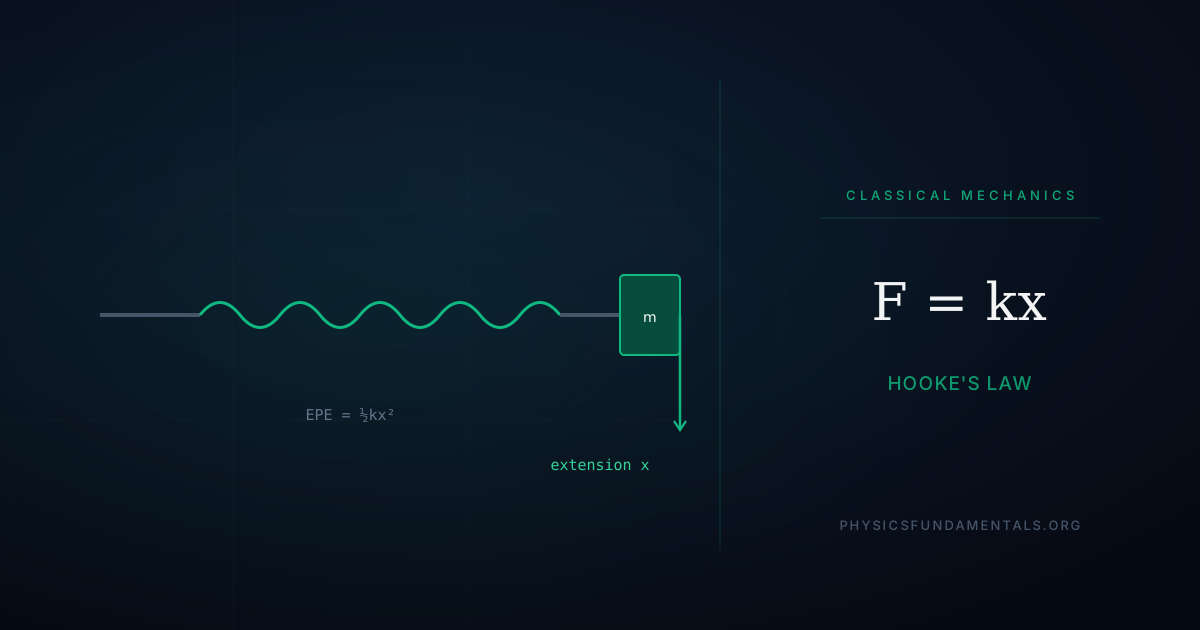
The force exerted by a spring is proportional to its displacement from the natural length and directed toward equilibrium:
F = −kx
where k is the spring constant (N/m) and x is displacement (m). The negative sign indicates the restoring direction — the force always opposes the displacement.
The Spring Constant k
Large k = stiff spring (large force for small extension). Small k = soft spring. k is determined by the spring's material, wire thickness, coil diameter, and number of coils.
| Spring type | Typical k (N/m) |
|---|---|
| Slinky toy | ~1 |
| Mattress spring | ~10,000 |
| Car suspension | 15,000–30,000 |
| Stiff engineering spring | >100,000 |
Elastic and Plastic Deformation
A graph of force vs extension is linear in the elastic region (Hooke's Law holds). Beyond the elastic limit, the graph curves. Beyond the yield point, permanent (plastic) deformation occurs — the spring does not return to its natural length.
Elastic: material returns to original shape when force removed. Hooke's Law applies within the elastic limit.
Plastic: permanent shape change — material does not return to original dimensions. Occurs beyond the elastic limit. Stretching a spring past its elastic limit, bending metal, or squashing clay are examples.
Worked Examples
Example 1: Finding extension
k = 400 N/m, F = 60 N applied.
Example 2: Finding spring constant
2 kg mass extends spring 8 cm (0.08 m).
Example 3: Car suspension
k = 25,000 N/m. Force to compress 3 cm:
Elastic Potential Energy
A stretched/compressed spring stores energy equal to the area under the F-x graph (a triangle):
EPE scales with x² — double the extension, four times the energy. When released from extension A, all EPE converts to kinetic energy:
Springs in Series and Parallel
Series (same force, extensions add): 1/k_eff = 1/k₁ + 1/k₂ → k_eff less than smallest.
Parallel (same extension, forces add): k_eff = k₁ + k₂ → k_eff greater than largest.
Connection to Simple Harmonic Motion
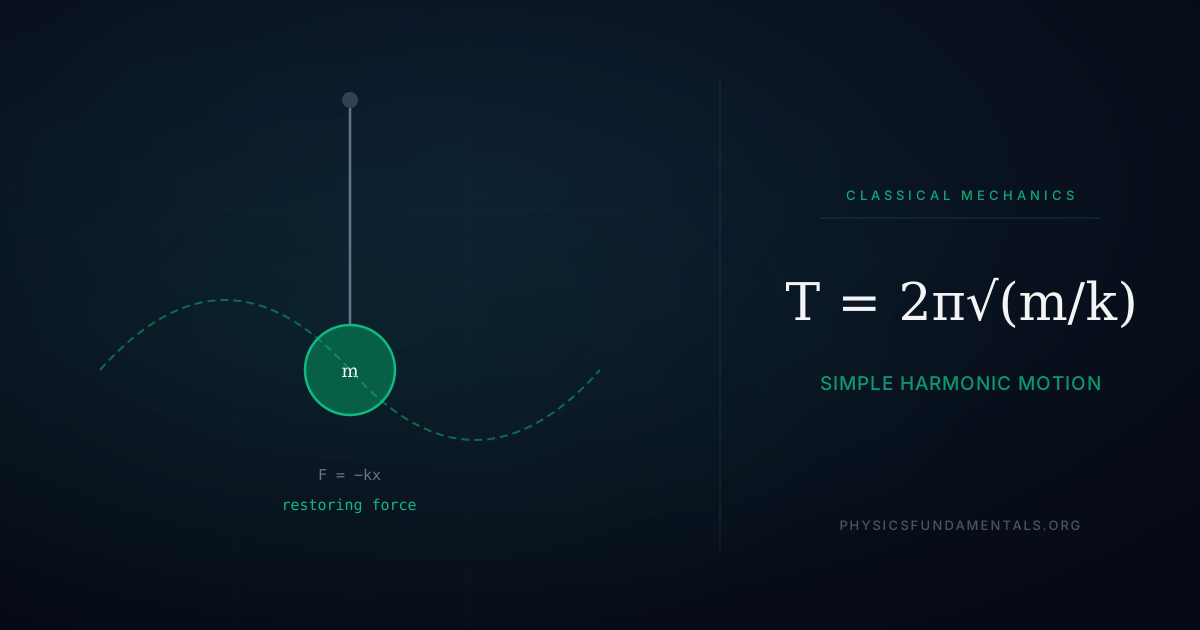
Hooke's Law (F = −kx) is the condition that produces SHM. Newton's second law: ma = −kx → a = −(k/m)x. This is the SHM equation with ω = √(k/m) and period T = 2π√(m/k). Any system with a Hooke's Law-type restoring force (pendulum for small angles, molecular bonds, LC circuits) exhibits approximately SHM.
Frequently Asked Questions
The Spring Constant k and What It Means
The spring constant k (measured in N/m) tells you how stiff a spring is. A high k means a stiff spring — it takes a large force to produce a small extension. A low k means a soft spring. Values in practice range from ~10 N/m (a very soft spring, like a Slinky) to ~100,000 N/m (stiff industrial springs).
The spring constant is an intrinsic property of the spring: it depends on the wire material, wire diameter, coil diameter, and number of coils. For two identical springs in series: k_eff = k/2 (softer). In parallel: k_eff = 2k (stiffer). This mirrors resistors, but the rules are swapped.
Elastic Potential Energy: E = ½kx²
When a spring is compressed or stretched by x, it stores elastic potential energy:
This is derived by integrating the force over displacement: E = ∫₀ˣ kx dx = ½kx². The energy is quadratic in displacement — doubling the extension stores four times the energy. This stored energy converts to kinetic energy when the spring is released.
For a spring-mass system released from extension x₀, conservation of energy gives: ½kx₀² = ½mv_max² → v_max = x₀√(k/m).
Worked Example 1: Finding Extension
A spring with k = 200 N/m has a 2.0 kg mass hung from it. Find the extension.
Worked Example 2: Elastic PE in a Compressed Spring
A spring (k = 500 N/m) is compressed by 0.04 m and releases a 0.1 kg ball. Find the ball's speed when it leaves the spring.
Worked Example 3: Finding the Spring Constant
A spring stretches 12 cm under a 6.0 N force. Find k.
The Elastic Limit and Beyond
Hooke's Law only holds up to the elastic limit. Below it: the spring returns to its original length when the force is removed (elastic deformation). Above it: the spring is permanently deformed (plastic deformation) and Hooke's Law no longer applies. The stress-strain curve for a metal wire shows a linear (Hookean) region, a yield point, plastic deformation, and ultimately fracture.
The elastic limit matters in engineering: springs in suspension systems, bridges, and buildings must never be stressed beyond their elastic limit. Safety factors (typically 2–4×) ensure operating loads stay well within the elastic region.
Real-World Applications
Suspension systems: car springs and shock absorbers use Hooke's Law to absorb road impacts. Spring k is chosen to match the car's mass for optimal ride frequency. Spring scales: the extension of a calibrated spring directly measures force/weight. Seismometers: use mass-spring systems to detect ground motion — the spring force resists acceleration, allowing tiny movements to be amplified and recorded. Atomic force microscopes (AFM): a cantilever tip deflects by Hooke's Law amounts (nanometres) as it scans atom-by-atom across a surface, creating atomic-resolution images.
Frequently Asked Questions
What is Hooke's Law?
Hooke's Law states that the force exerted by a spring is proportional to its extension or compression: F = kx, where F is the restoring force (N), k is the spring constant (N/m), and x is the displacement from the natural length (m). It applies within the elastic limit — if the spring is overstretched, it deforms permanently and Hooke's Law no longer holds. The law applies to any elastic material, not just springs: rubber bands, metal wires, and biological tissues all follow it within their elastic range.
What is the spring constant k?
The spring constant k (also called stiffness) measures how much force is needed per unit extension: k = F/x in N/m. A high k means a stiff spring requiring large forces for small deflections. A low k means a soft spring that deflects easily. k is determined by the spring material, wire thickness, coil diameter, and number of coils. It can be measured experimentally by plotting F vs x — the gradient is k. Springs in series give 1/k_eff = 1/k₁ + 1/k₂ (softer); springs in parallel give k_eff = k₁ + k₂ (stiffer).
What is elastic potential energy?
Elastic potential energy is the energy stored in a deformed elastic object. For a spring displaced by x from its natural length: E = ½kx². The energy is proportional to the square of displacement — double the compression stores four times the energy. This stored energy is released as kinetic energy when the spring returns to its natural length, following conservation of energy. The formula E = ½kx² is derived by integrating the Hooke's Law force F = kx over the displacement.
What is the elastic limit?
The elastic limit is the maximum force (or extension) a material can experience and still return to its original shape when the load is removed. Below the elastic limit, deformation is elastic — temporary and fully reversible. Above it, deformation becomes plastic — permanent. For steel, the elastic limit corresponds to a stress of roughly 250 MPa. Engineering components are always designed to operate well below their elastic limit (typically using safety factors of 2–4) to ensure no permanent deformation occurs under normal loads.
How does Hooke's Law relate to simple harmonic motion?
A mass on a spring undergoes simple harmonic motion (SHM) because Hooke's Law provides a restoring force proportional to displacement: F = −kx (negative because force opposes displacement). By Newton's second law: ma = −kx, giving a = −(k/m)x. This is the defining equation of SHM with angular frequency ω = √(k/m) and period T = 2π√(m/k). Larger k → stiffer spring → faster oscillation. Larger m → more inertia → slower oscillation. The period is independent of amplitude — a key property of SHM.
Simple Harmonic Motion and Hooke's Law
A mass m on a spring with constant k oscillates in simple harmonic motion. Hooke's Law provides the restoring force: F = −kx (negative because it opposes displacement). Newton's second law gives: ma = −kx → a = −(k/m)x. This is the SHM condition: acceleration proportional to and opposing displacement. The resulting motion: x(t) = A cos(ωt + φ), where ω = √(k/m) is the angular frequency and T = 2π/ω = 2π√(m/k) is the period. A heavier mass oscillates more slowly; a stiffer spring oscillates faster. The period is independent of amplitude — whether you pull the spring 1 cm or 10 cm, the oscillation period is the same (within the elastic limit).
This has profound applications: clock pendulums, quartz crystal oscillators in watches, and atomic clocks all use resonant oscillators governed by the same mathematics as Hooke's Law applied to springs.
Hooke's Law in Materials Science
Hooke's Law in one dimension (F = kx for springs) extends to three dimensions as the theory of elasticity. For a uniform material under uniaxial stress: stress σ = E × strain ε, where E is Young's modulus (Pa) — the materials-science equivalent of the spring constant. Young's modulus for steel ≈ 200 GPa, aluminium ≈ 70 GPa, rubber ≈ 0.01–0.1 GPa. The relationship σ = Eε is linear (Hookean) up to the proportional limit; above this, more complex plastic behaviour dominates. Engineers use finite element analysis (FEA) to solve the three-dimensional generalisation of Hooke's Law for complex component geometries and loading conditions.
Common Mistakes and Exam Tips
Always convert to SI units first. Forces in N, distances in m, masses in kg — before plugging into any formula. Spring extensions given in cm must be converted to metres. Masses given in grams need converting to kg.
Remember F = kx gives the spring force, not the net force. When a spring is attached to a hanging mass at equilibrium, the spring force equals the weight. In dynamics (e.g. the mass is accelerating), the spring force and weight don't cancel — write Newton's second law carefully.
The restoring force is always toward equilibrium. If you extend the spring downward, the spring force acts upward (toward the natural length). If you compress it, the force acts downward. The minus sign in F = −kx reflects this: force opposes displacement.
What is Hooke's Law?
Hooke's Law states that the spring force is proportional to displacement from natural length: F = kx (magnitude). The restoring force opposes displacement: F = −kx. k is the spring constant (N/m). The law holds within the elastic limit — beyond that, permanent deformation occurs.
What is the spring constant?
The spring constant k (N/m) measures stiffness — force required per unit extension. A larger k means a stiffer spring. k is determined by the spring's material, wire gauge, coil diameter, and number of coils.
What is elastic potential energy?
EPE = ½kx² — energy stored in a deformed spring. Equal to the work done to deform it (area under F-x graph). When released, EPE converts to kinetic energy. Doubling extension quadruples stored energy.
What happens beyond the elastic limit?
Beyond the elastic limit, plastic deformation occurs — the spring does not return to its original length. The F-x graph curves, Hooke's Law no longer applies, and permanent elongation results. Further stretching leads to fracture.
How is Hooke's Law related to SHM?
F = −kx is the condition for SHM. Applying Newton's second law gives a = −(k/m)x — the SHM equation. Period T = 2π√(m/k). Any system with a proportional restoring force exhibits SHM.
Share this article
Written by
Physics Fundamentals Editorial Team
Written and reviewed by our team of physics educators. Content is aligned with A-Level, GCSE, AP Physics, and undergraduate curricula.
About Physics Fundamentals →