Every object you have ever seen — every car on the highway, every satellite in orbit, every atom vibrating in your coffee cup — follows the same three rules. These are Newton's laws of motion, and they form the bedrock of classical mechanics. If you understand these three laws deeply, you have the key to analyzing nearly every mechanical system you will ever encounter in introductory physics.
Isaac Newton published these laws in 1687 in his Principia Mathematica, and they have withstood over three centuries of experimental scrutiny. They break down only at speeds approaching light (where Einstein's relativity takes over) and at atomic scales (where quantum mechanics governs). For everything in between — which includes essentially all of everyday human experience — Newton's laws are not approximations. They are the rules.
Newton's First Law: The Law of Inertia
Newton's first law states: An object at rest stays at rest, and an object in motion stays in motion with the same speed and in the same direction, unless acted upon by a net external force.
This sounds straightforward, but it contradicts a deep intuition most people carry. Our everyday experience tells us that moving objects slow down and stop — slide a book across a table and it eventually halts. But Newton's first law insists that the book would keep sliding forever if not for friction. The stopping isn't natural behavior; it's the result of a force (friction) acting on the book.
The conceptual core here is inertia — the tendency of an object to resist changes to its state of motion. Mass is the quantitative measure of inertia: a bowling ball has more inertia than a tennis ball, which is why it's harder to start moving and harder to stop. Inertia isn't a force; it's a property. Objects don't need a force to keep moving. They need a force to change their motion.
Many students believe that a moving object must have a force acting on it in the direction of motion. This is Aristotelian thinking, not Newtonian. A hockey puck sliding across frictionless ice needs no forward force to maintain its velocity. It will glide at constant speed forever unless something pushes or pulls it.
Newton's Second Law: F = ma
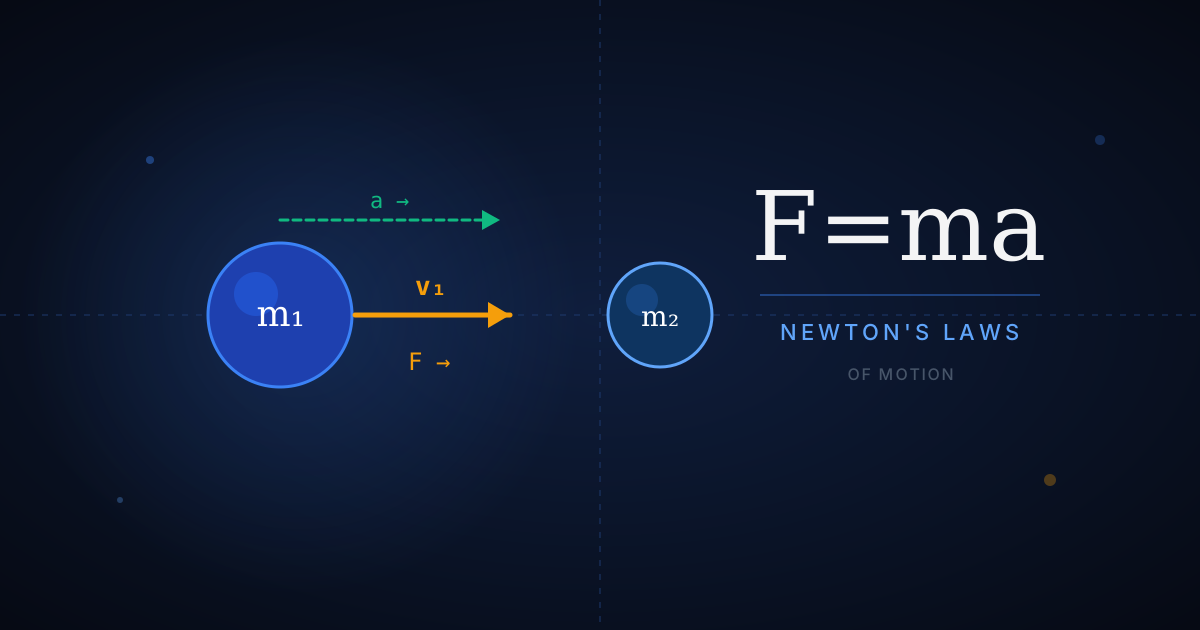
Newton's second law is the workhorse of classical mechanics: The net force on an object equals its mass times its acceleration. We cover this equation in exhaustive depth in our dedicated guide to Newton's Second Law (F = ma) — but here's the essential picture.
This single equation connects three fundamental quantities — force, mass, and acceleration — and it tells you how any object will respond to any combination of forces. If you know the forces acting on a system and the system's mass, you can calculate exactly how it will accelerate. And from the acceleration, you can reconstruct the entire future trajectory of the object.
The key insight is that acceleration, not velocity, is proportional to force. Push a car with a constant force and it doesn't move at constant speed — it continuously speeds up. Double the force and the acceleration doubles. Double the mass and the acceleration halves. This inverse relationship between mass and acceleration is why a loaded truck accelerates more slowly than an empty one under the same engine force.
Newton's second law also reveals something profound about the first law: the first law is simply the special case of the second law when Fnet = 0. If no net force acts, acceleration is zero, and velocity is constant. The first law doesn't add new physics — it establishes the conceptual framework that the natural state of motion is constant velocity, not rest.
Units and Dimensional Analysis
Force is measured in newtons (N), where 1 N = 1 kg·m/s². This means one newton is the force required to accelerate a one-kilogram mass at one meter per second squared. A typical apple weighs roughly 1 N due to gravity — fitting, given Newton's legendary encounter with falling fruit.
Newton's Third Law: Action and Reaction
Newton's third law states: For every action, there is an equal and opposite reaction.
This is the most frequently misunderstood of the three laws. It does not mean that forces cancel out. The two forces in a third-law pair always act on different objects. When you push on a wall, the wall pushes back on you with equal magnitude. But your push acts on the wall, and the wall's push acts on you — these forces belong to two separate free-body diagrams.
Consider a book resting on a table. Gravity pulls the book downward (Earth pulls on book). The table pushes the book upward (normal force). These two forces are equal and opposite, but they are not a Newton's third-law pair — they both act on the same object (the book). The actual third-law partner of gravity on the book is the book pulling Earth upward. And the third-law partner of the normal force from the table is the book pushing down on the table.
Third-law pairs always involve two different objects and always involve the same type of force. The gravitational pull of Earth on a ball is paired with the gravitational pull of the ball on Earth — same force type, different objects, equal magnitude, opposite direction.
Applying Newton's Laws: The Free-Body Diagram
The single most useful skill in mechanics is drawing a correct free-body diagram (FBD). This is a simplified sketch showing a single object and every external force acting on it. No internal forces, no forces the object exerts on other things — just the forces the rest of the universe exerts on your chosen object.
Once you have a correct FBD, applying Newton's second law becomes mechanical: sum the forces in each direction, set them equal to mass times acceleration in that direction, and solve. Nearly every mechanics problem in an introductory physics course reduces to this procedure. This approach powers everything from projectile motion to orbital mechanics.
Conservation Laws: What Newton's Laws Imply
Newton's laws aren't just a set of standalone rules — they imply deeper conservation principles. Newton's third law, applied systematically across a system of particles, leads directly to the conservation of momentum: the total momentum of an isolated system never changes. And when you combine Newton's second law with the concept of work, you arrive at the work-energy theorem and conservation of energy — arguably the most powerful tool in all of physics.
Newton's Laws of Motion — Summary
| Law | Statement | Key Concept |
|---|---|---|
| First Law | An object remains at rest or in uniform motion unless acted on by a net force | Inertia — objects resist changes to their motion |
| Second Law | Fnet = ma — net force equals mass times acceleration | Force causes acceleration, not velocity |
| Third Law | For every action there is an equal and opposite reaction | Forces always come in pairs acting on different objects |
Frequently Asked Questions About Newton's Laws of Motion
Newton's Three Laws
First Law (Law of Inertia): An object at rest stays at rest, and an object in motion continues at constant velocity, unless acted upon by a net external force. Mathematically: if ΣF = 0, then a = 0 (velocity is constant — or zero). Inertia is the tendency to resist changes in motion. Mass is the measure of inertia.
Second Law: ΣF = ma. The net force on an object equals its mass times its acceleration. Force and acceleration are in the same direction. This is the key equation of classical mechanics.
Third Law: For every action there is an equal and opposite reaction. If object A exerts force F on object B, then B exerts force −F on A. Same magnitude, opposite direction, same type of force. The two forces act on different objects — they never cancel each other.
Worked Examples Across All Three Laws
First Law example: A hockey puck sliding on ice continues at constant velocity because friction is near zero — nearly no net force. A seatbelt is needed in a crash because your body "wants" to continue at the car's original velocity when the car stops (inertia).
Second Law example: A 1,200 kg car has 4,800 N driving force and 1,200 N friction. Net force = 3,600 N. a = F/m = 3,600/1,200 = 3.0 m/s². Time to reach 60 mph (26.8 m/s) from rest: t = v/a = 26.8/3.0 = 8.9 s.
Third Law example: A rocket expels gas backward (action). The gas pushes the rocket forward (reaction). Note: these forces act on different bodies (gas and rocket), so they don't cancel. The rocket accelerates forward by F = ma with the net rocket force equal to the thrust minus gravity and drag.
Common Third Law Misconceptions
Third Law force pairs always: act on different objects; are the same type of force; are equal in magnitude; are opposite in direction. They do NOT cancel because cancellation requires forces on the same object. A horse-drawn cart: the cart pulls the horse backward (Third Law reaction). So how do they move forward? Because friction from the ground pushes the horse's hooves forward. The net force on the system (horse + cart) is the friction minus air resistance — Third Law pairs between horse and cart are internal forces that cancel within the system.
Frequently Asked Questions
What are Newton's three laws of motion?
First Law: An object remains at rest or in uniform motion unless a net external force acts on it — objects resist changes in their state of motion (inertia). Second Law: Net force equals mass times acceleration: ΣF = ma. This gives the relationship between force and the resulting motion. Third Law: Every action has an equal and opposite reaction — forces always come in pairs acting on different objects. Together, these three laws form the foundation of classical mechanics and describe all non-relativistic, non-quantum mechanical motion.
What is Newton's First Law in simple terms?
Newton's First Law says objects don't change their motion unless something makes them. A stationary book stays stationary (no force to accelerate it). A ball rolling across a frictionless surface continues rolling at constant speed and direction forever (no force to slow it or turn it). In everyday life, friction and air resistance are always present, so objects seem to naturally stop — but this is because friction is a force, not because objects "run out of motion." Without friction, the ball would roll indefinitely. The First Law also implies: if an object accelerates (changes speed or direction), there must be a net force acting on it.
Why don't Newton's Third Law pairs cancel?
Newton's Third Law pairs act on different objects, not the same one. Cancellation requires two forces acting on the same object in opposite directions. When you push a wall with 20 N, the wall pushes you back with 20 N — but these act on different objects (the wall and you). The net force on you is 20 N (wall's push), which accelerates you backward. The net force on the wall from your push is 20 N, but the wall is fixed and other forces (foundation) hold it. The forces in a Third Law pair are always equal, opposite, the same type, and on different bodies.
How do Newton's laws apply to a rocket in space?
First Law: in space with no forces, the rocket travels at constant velocity — no fuel needed to maintain speed, only to change it. Second Law: thrust F = ṁv_e (mass flow rate × exhaust velocity) gives acceleration a = F/m, which increases as fuel is consumed (m decreases). Third Law: the rocket pushes exhaust backward; the exhaust pushes the rocket forward (equal and opposite). No air to push against is needed — the Third Law reaction works between rocket and exhaust. The Tsiolkovsky rocket equation (Δv = v_e ln(m₀/m_f)) governs the achievable speed change.
What is the difference between mass and weight?
Mass (kg) is the amount of matter — it measures inertia (resistance to acceleration, via F = ma). Mass is the same everywhere. Weight (N) is the gravitational force on a mass: W = mg, where g is the local gravitational field strength. On Earth's surface, g = 9.8 N/kg, so a 70 kg person weighs 70 × 9.8 = 686 N. On the Moon (g = 1.62 N/kg), the same person weighs 113 N — but their mass is still 70 kg. In everyday language, "weight" often means "mass" (when people say they weigh 70 kg, they mean their mass is 70 kg), but in physics these are strictly different quantities with different units.
What are Newton's three laws of motion?
Newton's three laws of motion are: (1) The Law of Inertia — an object at rest stays at rest, and an object in motion stays in motion at constant velocity, unless acted on by a net external force. (2) F = ma — the net force on an object equals its mass times its acceleration. (3) Action-Reaction — for every action force there is an equal and opposite reaction force acting on a different object.
What is Newton's first law of motion?
Newton's first law states that an object will remain at rest or continue moving in a straight line at constant speed unless a net external force acts on it. This is the law of inertia. It means objects don't need a force to keep moving — they need a force to change their motion.
What is Newton's second law of motion?
Newton's second law states that the net force on an object equals its mass times its acceleration: F = ma. This means force causes acceleration — the greater the net force, the greater the acceleration; the greater the mass, the smaller the acceleration for the same force.
What is Newton's third law of motion?
Newton's third law states that for every action force, there is an equal and opposite reaction force acting on a different object. When you push a wall, the wall pushes back on you with equal force. The two forces always act on different objects — they do not cancel each other out.
Who discovered Newton's laws of motion?
Newton's laws of motion were discovered by Sir Isaac Newton and published in his 1687 book Principia Mathematica. Newton built on the work of Galileo Galilei, who had established key insights about inertia and falling objects. Newton unified these ideas into three comprehensive laws that describe all motion in the classical (non-relativistic) world.
What are Newton's laws used for?
Newton's laws are used to analyze any situation involving forces and motion — from calculating the acceleration of a car to plotting satellite orbits, designing bridges, testing crash safety, biomechanics in sport, and spacecraft trajectory planning. They are the foundation of all classical mechanics and engineering dynamics.
Why Newton's Laws Matter
Newton's three laws are not just historical relics or exam topics. They are the foundation on which we build bridges, launch rockets, design cars, predict planetary orbits, and understand the biomechanics of human movement. Every engineering discipline that deals with forces and motion starts here. These laws are physics fundamentals in the truest sense — without them, nothing else in mechanics makes sense.
When you study energy, momentum, rotational dynamics, or even fluid mechanics, you are always building on Newton's laws. Master them deeply — not just the equations, but the physical reasoning — and the rest of classical physics becomes dramatically more accessible.
Share this article
Written by
Physics Fundamentals Editorial Team
Written and reviewed by our team of physics educators. Content is aligned with A-Level, GCSE, AP Physics, and undergraduate curricula.
About Physics Fundamentals →