A cable holds a suspension bridge in place. A rope supports a rock climber. A string connects two masses in an Atwood machine. In each case, the force transmitted through the material is tension — a pulling force that acts along the length of a rope, cable, string, or rod. Tension is one of the most frequently encountered forces in mechanics problems, and getting it right requires understanding exactly what it means and how it behaves.
Tension is a pulling force transmitted through a string, rope, cable, or rod.
For a massless string in equilibrium: tension T is the same throughout.
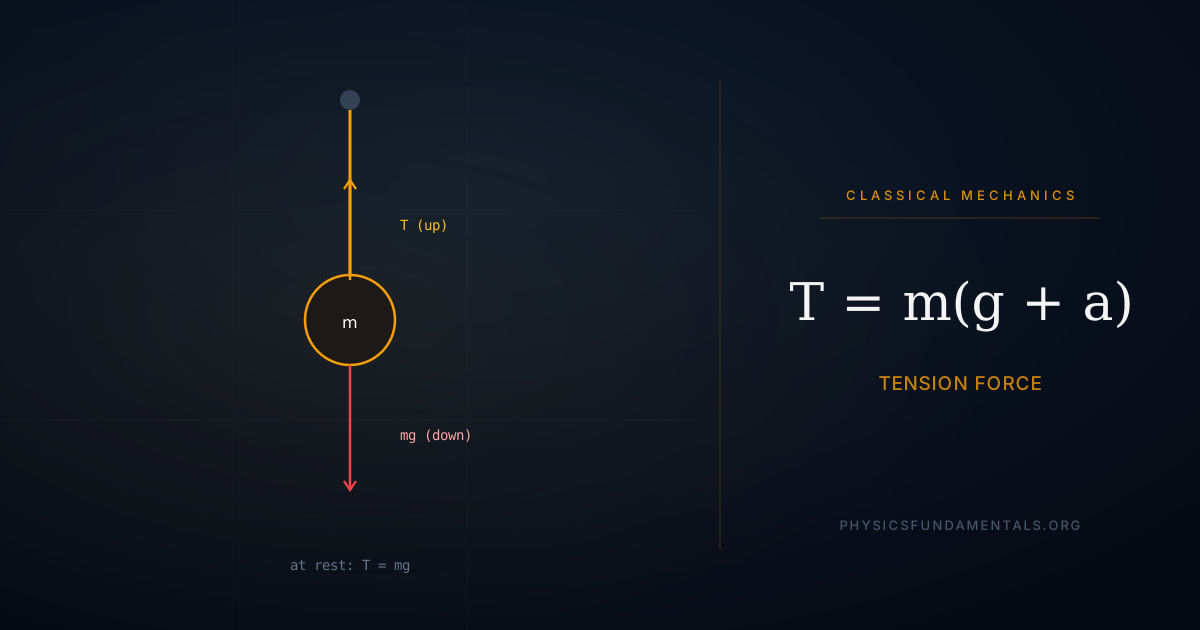
For an object hanging at rest: T = mg (tension = weight)
For an accelerating system: T = m(g ± a) (see examples below)
Units: newtons (N). Direction: always along the string, away from the object.
What Is Tension Force?
Tension is the internal pulling force within a string, rope, cable, or any material being stretched. When you hang a mass from a string, the string pulls the mass upward — that's the tension force on the mass. By Newton's third law, the mass pulls the string downward with an equal and opposite force.
Several key characteristics distinguish tension from other forces:
- Always a pull, never a push. A rope can pull but cannot push — if you try to push with a rope, it goes slack and the force drops to zero. (Rigid rods can both push and pull.)
- Acts along the string. The tension force on an object is always directed away from the object, along the line of the string.
- Same magnitude throughout a massless string. If the string has negligible mass and there's no friction on it, tension is constant along its entire length.
- Varies in a massive string. A heavy rope supporting its own weight has higher tension at the top than the bottom, because the upper sections support more weight.
Tension Formula for a Hanging Object
For a mass m hanging stationary from a string, Newton's second law (net force = 0) gives:
The tension equals the weight. A 2 kg mass hanging in equilibrium: T = 2.0 × 9.8 = 19.6 N.
Tension When Accelerating — Elevator Problems
When a mass accelerates, the net force is not zero. For a mass on a string accelerating upward at a m/s²:
For downward acceleration:
If a = g (free fall), T = 0 — the string is slack, consistent with weightlessness.
This is exactly what happens in a lift (elevator). When a lift accelerates upward, you feel heavier — the floor pushes up on you with a greater force, and the cable tension increases. When the lift accelerates downward (or decelerates while moving up), you feel lighter and the tension decreases.
Worked Example 1: Hanging Mass
A 5.0 kg mass hangs from a string attached to a ceiling. Find the tension in the string (g = 9.8 m/s²).
The mass is stationary (a = 0), so net force = 0:
Worked Example 2: Elevator Acceleration
A 70 kg person stands on scales in a lift. Find the scale reading (normal force, equal to T from the floor) when:
(a) the lift accelerates upward at 2.0 m/s²
(b) the lift accelerates downward at 1.5 m/s²
(c) the lift moves at constant velocity
(a) T = m(g + a) = 70 × (9.8 + 2.0) = 70 × 11.8 = 826 N (mass "feels" 84 kg)
(b) T = m(g − a) = 70 × (9.8 − 1.5) = 70 × 8.3 = 581 N (mass "feels" 59 kg)
(c) T = mg = 70 × 9.8 = 686 N (normal weight)
Worked Example 3: Atwood Machine
An Atwood machine has two masses connected by a string over a frictionless, massless pulley: m₁ = 3.0 kg and m₂ = 5.0 kg. Find the acceleration and tension.
The heavier mass (m₂) accelerates downward; the lighter mass (m₁) accelerates upward. Both accelerate at the same rate a (inextensible string).
For m₁ (net upward): T − m₁g = m₁a
For m₂ (net downward): m₂g − T = m₂a
Adding both equations (eliminates T):
Finding T from m₁'s equation:
Check with m₂: T = m₂(g − a) = 5.0 × (9.8 − 2.45) = 5.0 × 7.35 = 36.75 N ✓
Worked Example 4: Two Masses on a Surface
A 4.0 kg block (A) is connected by a string to a 2.0 kg block (B) on a frictionless surface. A horizontal force F = 18 N pulls block B. Find the acceleration of the system and tension in the connecting string.
System total mass = 6.0 kg:
Tension T accelerates block A only:
Check: Net force on B = F − T = 18 − 12 = 6 N; a = 6/2 = 3 m/s² ✓
Tension in Strings at Angles
When an object is supported by two strings at angles, apply equilibrium conditions (sum of forces = 0 in x and y).
A 10 kg mass hangs from two strings making angles 30° and 45° with the horizontal. Find tensions T₁ and T₂.
Horizontal: T₁ cos 30° = T₂ cos 45° → T₁ × 0.866 = T₂ × 0.707 → T₁ = 0.816 T₂
Vertical: T₁ sin 30° + T₂ sin 45° = mg = 98 N
Substituting: 0.816T₂ × 0.5 + T₂ × 0.707 = 98 → 0.408T₂ + 0.707T₂ = 98 → 1.115T₂ = 98
Tension vs. Normal Force vs. Weight
| Force | Acts on | Direction | Pull or push? |
|---|---|---|---|
| Tension | Object attached to string/rope | Along string, away from object | Pull |
| Normal force | Object on a surface | Perpendicular to surface, away from it | Push |
| Weight | Every object with mass | Vertically downward | Pull (gravity) |
Common Mistakes with Tension
Forgetting that tension pulls in both directions. A string exerts a tension force on both objects it connects — upward on the hanging mass, downward (and backward) on whatever the other end is attached to. Newton's third law: for every tension force the string exerts, there is an equal and opposite force on the string.
Assuming tension always equals weight. T = mg only in static equilibrium with no horizontal component. Add acceleration, add angles, add friction — and T ≠ mg. Always write Newton's second law for each object separately.
Neglecting string mass in precision problems. "Massless string" is an approximation. A 1 kg rope supporting a 10 kg weight has tension that varies from 98 N at the bottom to 107.8 N at the top (supporting the rope's own weight too). In most GCSE and A-Level problems, string mass is given as negligible.
Frequently Asked Questions
Tension in Real Structures
Tension is central to structural engineering. Suspension bridges like the Golden Gate Bridge carry their deck load entirely through tension in the main cables. Each cable is under roughly 1.6 × 10⁸ N (160 MN) of tension — over 16,000 tonnes-force. The cables are made of thousands of high-strength steel wires bundled together, each with tensile strength of ~1,500 MPa (1,500 N/mm²).
In contrast, arch bridges (like the Sydney Harbour Bridge) work in compression — the arch is pushed rather than pulled. Masonry (stone, brick) is strong in compression but weak in tension; steel and rope are strong in tension. This is why Gothic cathedrals needed flying buttresses (to redirect the outward thrust of arched roofs into compression in the buttress) while modern cable-stay bridges let steel cables carry enormous tension loads efficiently.
Tendons and ligaments in the human body are biological tension members — they connect muscle to bone and bone to bone, transmitting pulling forces throughout the musculoskeletal system. The Achilles tendon, for example, transmits the full force of the calf muscles to the heel bone during walking and running — peak forces of 3,000–5,000 N during running, equivalent to 4–7 times body weight.
Common Mistakes with Tension Problems
Using a single equation for a multi-object system. In connected mass problems (Atwood machine, blocks on surfaces with strings), write separate F = ma equations for each object. Then solve the system simultaneously. Trying to use one equation for the whole system loses information about the tension.
Ignoring the direction of tension. Tension always pulls — it acts away from the object, along the string. Draw a free-body diagram: show the string leaving the object and the tension arrow pointing along it. This prevents sign errors when setting up equations.
Forgetting that pulleys redirect force but (for ideal pulleys) don't change magnitude. An ideal (massless, frictionless) pulley simply changes the direction of the tension. The tension magnitude is the same on both sides. A real pulley has bearing friction and rotational inertia, which reduce the tension on the output side — but ideal pulleys are the standard assumption in GCSE and A-Level.
What is tension force?
Tension is a pulling force transmitted through a string, rope, cable, or rod that is being stretched. When a mass hangs from a string, the string pulls the mass upward with a tension force equal to the mass times gravity (T = mg) when stationary. Tension always acts along the string, directed away from the object it acts on. Unlike compression (which can be exerted by rods and surfaces), a rope or string can only pull — it cannot push.
What is the formula for tension?
For a hanging mass in equilibrium: T = mg (tension equals weight). For a mass accelerating upward: T = m(g + a). For a mass accelerating downward: T = m(g − a). For an Atwood machine (two masses over a pulley): T = 2m₁m₂g/(m₁ + m₂). In all cases, derive the formula by applying Newton's second law (F = ma) to the specific system, writing separate equations for each object.
Is tension the same throughout a rope?
Yes, if the rope is massless (or its mass is negligible) and there is no friction along the rope. These are standard assumptions in most GCSE and A-Level problems, and they mean the tension force is the same at every point in the string. If the rope has significant mass, tension varies — it's greatest at the point of support (which must support both the rope and the attached load) and least at the free end.
What happens to tension when a system accelerates?
When a system accelerates, tension changes from the static value T = mg. For upward acceleration a: T = m(g + a) — greater than weight, explaining why you feel heavier in a rising lift. For downward acceleration: T = m(g − a) — less than weight. At a = g (free fall), T = 0 — the string has no tension, which is why astronauts feel weightless in orbit (they and the spacecraft are both in free fall around Earth).
What is an Atwood machine?
An Atwood machine consists of two masses connected by a string over a frictionless, massless pulley. It's a classic physics problem used to study Newton's second law and tension. The acceleration of the system is a = (m₂ − m₁)g/(m₁ + m₂), and the tension in the string is T = 2m₁m₂g/(m₁ + m₂). When m₁ = m₂, a = 0 and T = mg — static equilibrium. The Atwood machine was historically used by George Atwood in 1784 to slow down gravitational acceleration to measurable speeds with the instruments available at the time.
How does tension relate to Newton's third law?
Newton's third law says every force has an equal and opposite reaction. For tension: the string pulls the attached mass with force T (upward, say). The mass pulls the string with force T (downward). The string pulls the ceiling with force T (downward). The ceiling pulls the string with force T (upward). The tension force appears in action-reaction pairs throughout the system. This is why drawing a free-body diagram for each object separately — showing only the forces acting on that object — is essential for solving tension problems correctly.
Share this article
Written by
Physics Fundamentals Editorial Team
Written and reviewed by our team of physics educators. Content is aligned with A-Level, GCSE, AP Physics, and undergraduate curricula.
About Physics Fundamentals →