Push a box across a floor. Lift a weight from the ground. Compress a spring. In each case, a force acts through a distance — and that's the physical definition of work done. Work done in physics is not about effort or time; it's a precise, calculable quantity: force multiplied by displacement in the direction of the force. It's the bridge between force and energy, and it's the foundation of the work-energy theorem.
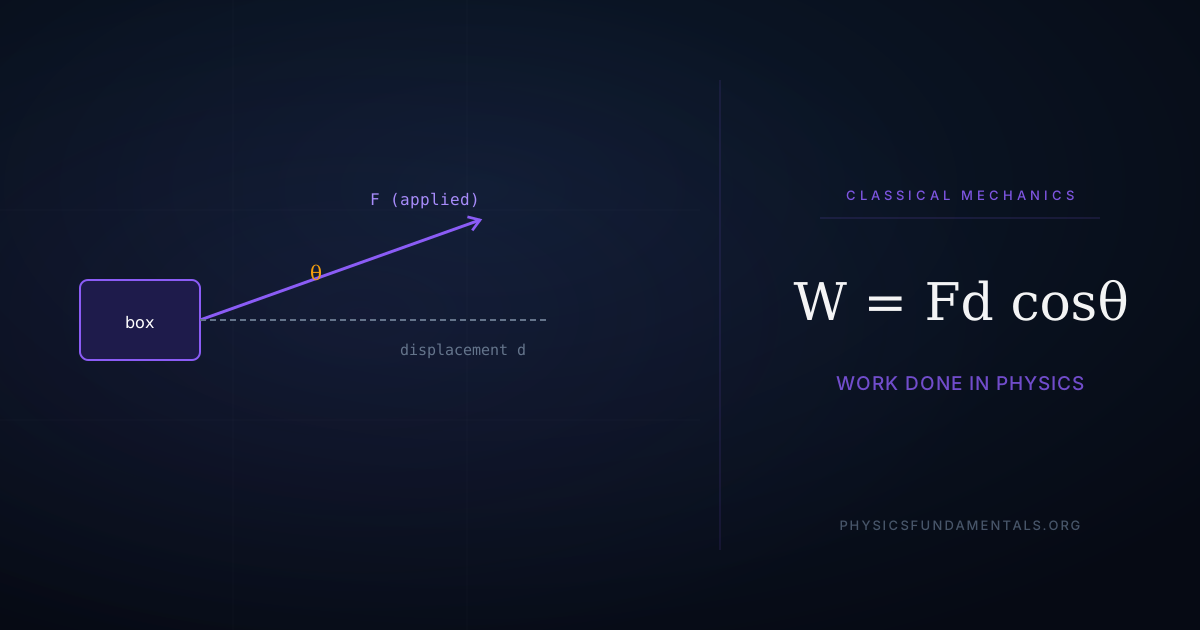
W = Fd cos θ
W = work done (joules, J)
F = applied force (newtons, N)
d = displacement (metres, m)
θ = angle between the force and the displacement
Special case: if force and displacement are parallel (θ = 0°): W = Fd
What Is Work Done in Physics?
Work done is the energy transferred when a force causes an object to move through a displacement. The key requirement: the object must actually move, and the force (or a component of it) must be in the direction of movement.
Formally: W = F · d = Fd cos θ, where θ is the angle between the force vector and the displacement vector. This is the scalar (dot) product of force and displacement.
The unit is the joule (J). 1 J = 1 N·m = 1 kg·m²·s⁻². One joule is the work done when a force of 1 newton moves an object 1 metre in the direction of the force.
The W = Fd cos θ Formula — Three Cases
Case 1: θ = 0° (force parallel to displacement)
cos 0° = 1, so W = Fd. This is the simplest case — pushing a box horizontally, a car engine propelling a car forward. All the force contributes to work.
Case 2: 0° < θ < 90° (force at an angle to displacement)
Only the component of force along the displacement (F cos θ) does work. The component perpendicular to displacement (F sin θ) does no work. Example: dragging a suitcase with a handle at 30° to the floor.
Case 3: θ = 90° (force perpendicular to displacement)
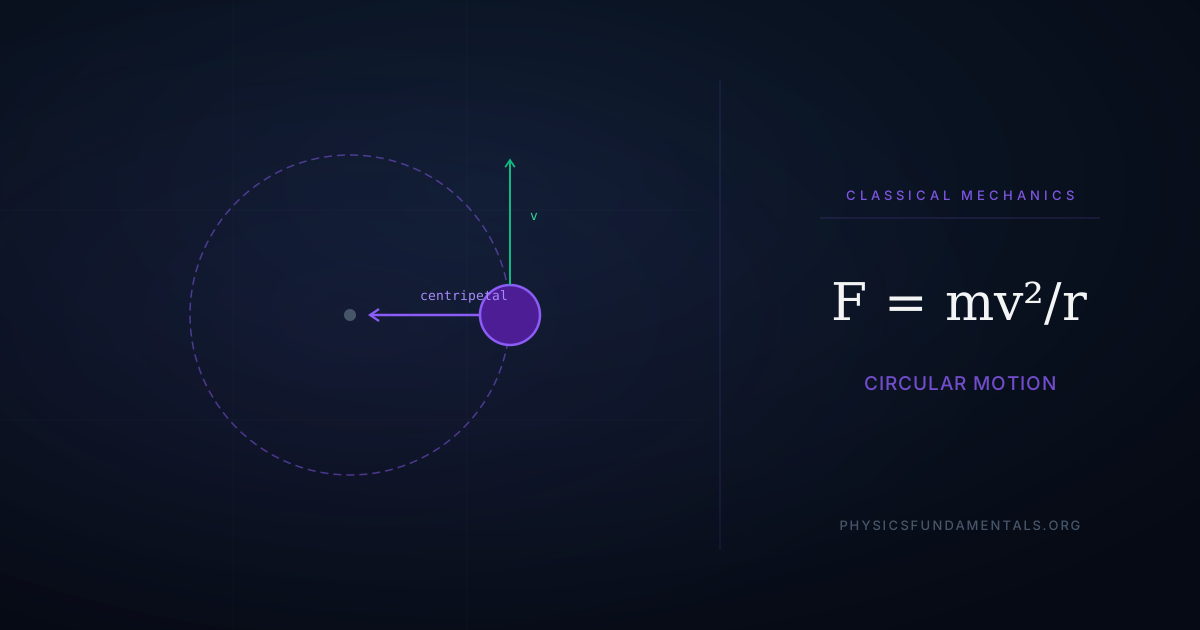
cos 90° = 0, so W = 0. A centripetal force, the normal force on a flat surface, the magnetic force on a moving charge — all do zero work because they're perpendicular to motion. This is why magnetic forces never change a particle's kinetic energy.
Case 4: 90° < θ ≤ 180° (force opposing displacement)
cos θ is negative, so W is negative. The force removes energy from the object. Friction on a sliding box does negative work — it takes kinetic energy and converts it to heat.
Worked Example 1: Simple Horizontal Push
A 15 N force pushes a crate 6.0 m along a flat floor. Force and displacement are parallel (θ = 0°). Find the work done.
Worked Example 2: Force at an Angle
A child pulls a toy wagon 5.0 m with a rope tension of 20 N. The rope makes a 25° angle with the horizontal. Find the work done by the tension.
If the child held the rope horizontally (θ = 0°), work would be 100 J. The 25° angle reduces effective forward force to 20 cos 25° = 18.1 N — 9.4% less useful, the rest going into the ground as a downward component.
Worked Example 3: Lifting Against Gravity
A 5.0 kg box is lifted 1.2 m vertically at constant velocity. Find the work done by the lifting force.
At constant velocity, lifting force = weight = mg = 5.0 × 9.8 = 49 N. Force and displacement are both upward (θ = 0°):
This work is stored as gravitational potential energy: ΔPE = mgh = 5.0 × 9.8 × 1.2 = 58.8 J. ✓ Work done lifting = gravitational PE gained — they must be equal since KE doesn't change at constant velocity.
Worked Example 4: Work Done Against Friction
A 10 kg box slides 3.0 m across a floor. Coefficient of kinetic friction μ_k = 0.3. Find: (a) friction force, (b) work done by friction, (c) work done by the normal force.
(a) N = mg = 10 × 9.8 = 98 N; friction f = μ_k N = 0.3 × 98 = 29.4 N
(b) Friction opposes motion (θ = 180°): W_friction = fd cos 180° = 29.4 × 3.0 × (−1) = −88.2 J
(c) Normal force is perpendicular to motion (θ = 90°): W_normal = Nd cos 90° = 0 J
The −88.2 J means friction removed 88.2 J of kinetic energy from the box — converted to internal energy (heat) in the surfaces.
The Work-Energy Theorem
The work-energy theorem states that the net work done on an object equals the change in its kinetic energy:
This follows from Newton's second law: F = ma, W = Fd = mad, and using v² = u² + 2ad (SUVAT) gives W = ½mv² − ½mu².
It means: if you know all the forces acting and their displacements, you can find the final speed without needing to solve equations of motion at every instant. It's often the fastest method for problems involving forces and motion.
Work Done by Multiple Forces
When multiple forces act on an object, calculate the work done by each force separately, then sum them:
Alternatively, find the net force first, then calculate W = F_net × d (if all forces are constant). The net work then equals ΔKE by the work-energy theorem.
Work Done in a Variable Force
When force varies with position (like a spring: F = kx), W = Fd doesn't apply directly. Work is the area under the force-displacement graph:
For a spring compressed by x₀: W = ∫₀^x₀ kx dx = ½kx₀². This stored energy is elastic potential energy — the energy that fires an arrow when you release a bowstring.
Real-World Applications
Elevators: an elevator motor does work W = mgh to raise passengers. For a 600 kg elevator rising 20 m: W = 600 × 9.8 × 20 = 117,600 J = 117.6 kJ. A modern elevator motor with regenerative braking converts most of the descending work back to electricity.
Braking distance: when a car brakes, friction does negative work, removing kinetic energy. KE = ½mv². Using W_friction = −fd: d = mv²/(2f) = mv²/(2μmg) = v²/(2μg). This shows braking distance is proportional to v² — doubling speed quadruples stopping distance. At 30 mph (13.4 m/s) with μ = 0.7: d = 13.4²/(2 × 0.7 × 9.8) = 13.1 m. At 60 mph: 52.4 m — four times as far.
Mechanical advantage: simple machines (levers, pulleys, ramps) redistribute work. A ramp of length L and height h lets you apply force F = mgh/L over distance L instead of mg over distance h. Work input = work output (ignoring friction): FL = mgh. You trade force for distance — the machine does the same work, you just apply less force over more distance.
For related calculations, use the work-power calculator. For how work connects to kinetic energy, see the kinetic energy article, and for work done against gravity, see gravitational force.
Frequently Asked Questions
Work Done and Energy Conservation
Work done is the mechanism by which energy is transferred between objects. The principle of conservation of energy says total energy is conserved — it can only change form, not appear or disappear. Work done by external forces converts energy between types:
- Work done lifting = gravitational PE gained: W = mgh
- Work done accelerating = kinetic energy gained: W = ½mv² − ½mu²
- Work done against friction = thermal energy (heat) generated: W_friction = fd (dissipated as internal energy)
- Work done compressing a spring = elastic PE stored: W = ½kx²
If all forces are conservative (gravity, springs — no friction), total mechanical energy (KE + PE) is conserved. Friction introduces non-conservative (dissipative) forces that convert mechanical energy to heat, meaning mechanical energy is not conserved — but total energy including heat still is.
Common Mistakes with Work Done
Multiplying the full force by distance when force is at an angle. If you pull a box along the floor with a rope at 30° and use W = Fd without the cos 30° factor, you overestimate work by 15%. Always use W = Fd cos θ.
Assuming stationary objects have no forces doing work. A wall pushes on a stationary box with a normal force, but since displacement = 0, work done = 0. Work requires both force and displacement. Holding a heavy weight motionless above your head requires significant muscular effort but does zero mechanical work (though your muscles do biochemical work internally).
Adding work done by all forces when the question asks for net work. Net work = work done by net force = ΔKE. If you push a box across the floor at constant velocity, your force does positive work and friction does equal negative work — net work = 0, consistent with ΔKE = 0 (no change in speed).
What is the formula for work done in physics?
The formula for work done is W = Fd cos θ, where W is work in joules, F is the force in newtons, d is the displacement in metres, and θ is the angle between the force and the displacement. When force and displacement are in the same direction (θ = 0°), this simplifies to W = Fd. Work done is positive when force has a component in the direction of motion, and negative when force opposes motion (like friction).
What is the unit of work done?
The SI unit of work done is the joule (J). 1 joule = 1 newton-metre = 1 kg·m²·s⁻². One joule is the work done when a force of 1 newton displaces an object by 1 metre in the direction of the force. Since work and energy have the same unit, this confirms that work done is a transfer of energy.
What does W = Fd mean?
W = Fd means work done equals force multiplied by displacement — specifically when force and displacement are parallel (pointing in the same direction). It is the simplified form of W = Fd cos θ when θ = 0°. For example, a 10 N force pushing an object 3 m in the direction of the force does 10 × 3 = 30 J of work. If the force is at an angle to the displacement, you must use the full formula W = Fd cos θ.
Can work done be negative?
Yes. Work done is negative when the force has a component opposing the displacement (θ between 90° and 180°, so cos θ is negative). Friction always does negative work on a sliding object — it opposes motion and removes kinetic energy, converting it to heat. Negative work means energy is transferred away from the object. The work done by gravity on a rising object is also negative — gravity opposes upward motion and reduces the object's kinetic energy.
What is the work-energy theorem?
The work-energy theorem states that the net work done on an object equals the change in its kinetic energy: W_net = ΔKE = ½mv² − ½mu². This is derived from Newton's second law. It's one of the most useful tools in mechanics — if you know all the forces and their displacements, you can directly calculate the final speed without working through accelerations step by step. It works for any combination of constant and variable forces.
Why does a perpendicular force do no work?
A force perpendicular to displacement has θ = 90°, so W = Fd cos 90° = Fd × 0 = 0. There's no component of force along the direction of motion, so no energy is transferred to or from the object's kinetic energy. This is why the normal force on a horizontal surface does no work, the centripetal force on a circular orbit does no work, and the magnetic force on a moving charge does no work — all perpendicular to motion.
Share this article
Written by
Physics Fundamentals Editorial Team
Written and reviewed by our team of physics educators. Content is aligned with A-Level, GCSE, AP Physics, and undergraduate curricula.
About Physics Fundamentals →