A spinning ice skater pulls her arms inward — and immediately spins faster. A planet orbits faster when closer to the Sun. A gyroscope resists being tilted. A spinning top maintains its orientation. All of these phenomena are governed by a single conservation law: the conservation of angular momentum. Angular momentum is to rotation what linear momentum is to translation — a conserved vector quantity that can only change if a torque acts. It is one of the most fundamental conserved quantities in the universe, from subatomic particles to galaxies.
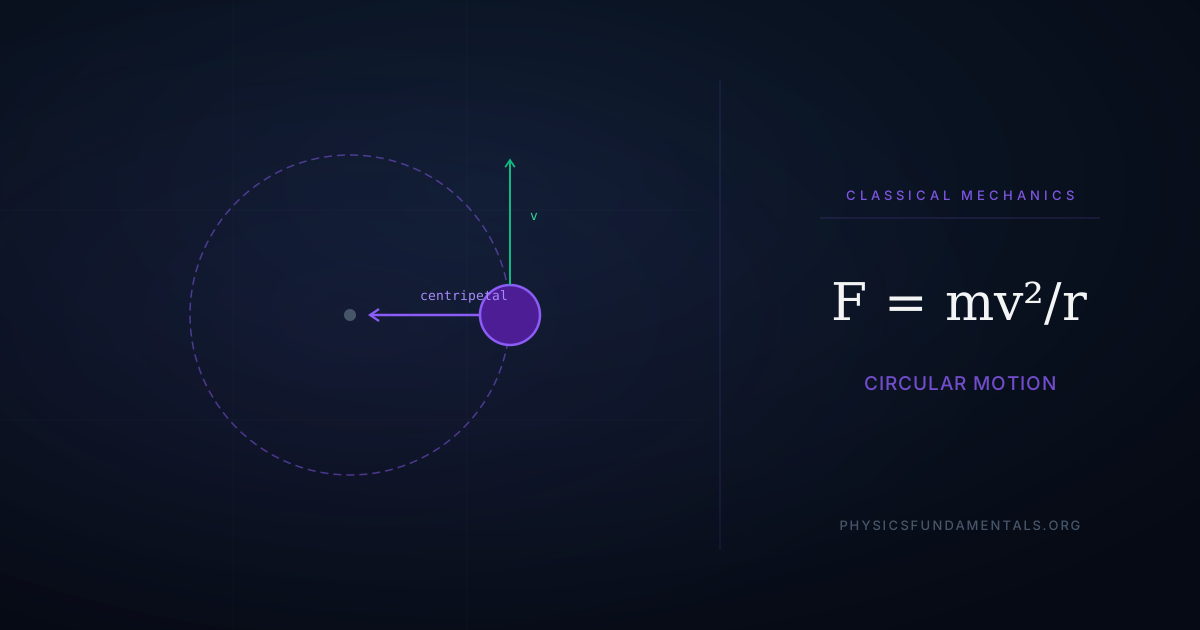
For a point mass moving in a circle of radius r at speed v:
L = mvr = pr
For a rotating rigid body:
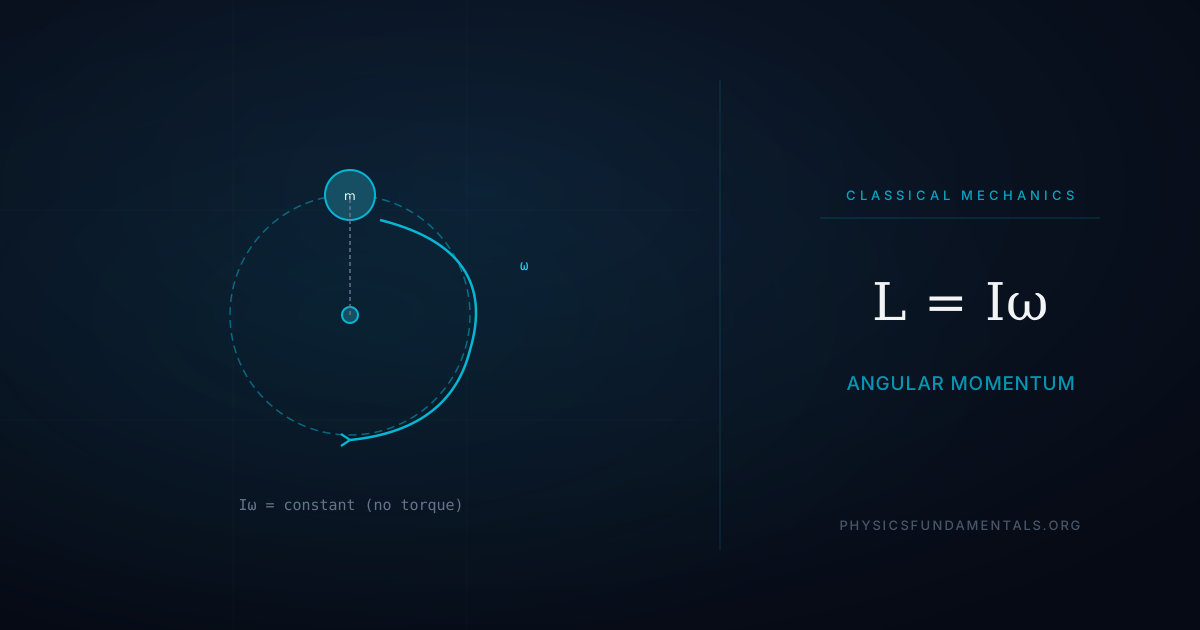
L = Iω
where I is the moment of inertia (kg·m²) and ω is the angular velocity (rad/s). Angular momentum is a vector — its direction is given by the right-hand rule (thumb points along rotation axis when fingers curl in direction of rotation). Unit: kg·m²/s.
Angular Momentum of a Point Mass
For a point mass m moving with velocity v at perpendicular distance r from a reference axis:
More generally, L = m v r sinθ, where θ is the angle between the position vector r and velocity v. The direction of L is perpendicular to both r and v.
This is the relevant form for orbital mechanics. The angular momentum of a planet orbiting the Sun:
where v_orb is the orbital speed and r_orb is the orbital radius. Since L is conserved (gravity acts through the centre — zero torque about the Sun), when r decreases (closer to Sun), v must increase. This is Kepler's second law — a planet sweeps out equal areas in equal times — expressed as angular momentum conservation.
Angular Momentum of a Rotating Body: L = Iω
For an extended rotating body, the angular momentum is:
where I is the moment of inertia (the rotational analogue of mass — a measure of how mass is distributed about the rotation axis) and ω is the angular velocity (rad/s).
The moment of inertia depends on both the mass and its distribution:
| Object | Moment of inertia I | Axis |
|---|---|---|
| Point mass at radius r | mr² | Through pivot |
| Solid cylinder / disc | ½mr² | Central axis |
| Hollow cylinder / ring | mr² | Central axis |
| Solid sphere | ⅖mr² | Through centre |
| Thin rod | 1/12 mL² | Through centre, perpendicular |
Mass concentrated further from the axis gives larger I. A hollow cylinder (I = mr²) has twice the moment of inertia of a solid cylinder (I = ½mr²) of the same mass and radius, because all its mass is at the maximum radius.
Newton's Second Law for Rotation
Just as F_net = dp/dt (net force equals rate of change of linear momentum), the rotational equivalent is:
Net torque equals the rate of change of angular momentum. For constant I: τ = I × dω/dt = Iα (Newton's second law for rotation). This is the equation of motion for all rotating systems.
Conservation of Angular Momentum
If the net external torque on a system is zero, its total angular momentum is conserved:
This is one of the most fundamental conservation laws in physics, holding from quantum spin states of electrons to the rotation of galaxies.
The spinning skater
An ice skater spins with arms extended: I₁ = 4.0 kg·m², ω₁ = 2.0 rad/s. She pulls her arms in: I₂ = 1.0 kg·m². Find ω₂.
She spins four times faster. Her kinetic energy also increases: KE = ½Iω² = ½(4.0)(4) = 8 J → ½(1.0)(64) = 32 J. The extra energy comes from the work she does pulling her arms in against the centrifugal tendency to fly outward.
Angular momentum is quantised in quantum mechanics — electrons in atoms can only have angular momentum values that are integer multiples of ħ = h/(2π) = 1.055 × 10⁻³⁴ J·s. Electrons also possess intrinsic "spin" angular momentum of ±½ħ — a purely quantum property with no classical analogue. The conservation of angular momentum governs atomic transitions, selection rules for photon emission, and nuclear decay modes.
The Gyroscope: Angular Momentum and Precession
A spinning gyroscope resists changes to its orientation — a direct consequence of angular momentum conservation. When a torque τ is applied (e.g. gravity on a tilted gyroscope), instead of toppling, the gyroscope precesses — the rotation axis itself slowly rotates. The precession angular velocity:
where M is the gyroscope mass, g = 9.8 m/s², r is the distance from pivot to centre of mass, and L = Iω is the spin angular momentum. Faster spin → larger L → slower precession. Gyroscopes are used in aircraft attitude indicators, ship stabilisers, and the Hubble Space Telescope pointing system.
Frequently Asked Questions
The Angular Momentum Formula
Angular momentum L combines the rotational equivalent of linear momentum. For a point mass m moving at velocity v at distance r from a pivot: L = mvr sin θ = pr sin θ, where θ is the angle between the position vector and velocity. For a rigid body rotating at angular velocity ω with moment of inertia I:
Units: kg·m²·s⁻¹ (= N·m·s). Angular momentum is a vector, directed along the rotation axis (right-hand rule: curl fingers in direction of rotation, thumb points along L).
Conservation of Angular Momentum
In the absence of external torques, angular momentum is conserved: L = Iω = constant. If I changes, ω changes inversely to keep L constant. This explains:
Ice skater: pulls arms in → I decreases → ω increases (spins faster). Arms out → I increases → ω decreases (slows).
Planets: closer to the Sun (smaller r) → must move faster (Kepler's second law — equal areas in equal times — is conservation of angular momentum).
Neutron stars: a star with radius ~10⁶ km collapses to ~10 km radius. I ∝ R² → I decreases by factor (10⁶/10)² = 10¹⁰ → ω increases by 10¹⁰. Pulsars rotate at up to 716 times per second.
Moment of Inertia
I = Σmr² (sum of mass × distance² for all particles). For common shapes: solid sphere I = (2/5)MR²; hollow sphere I = (2/3)MR²; solid cylinder I = ½MR²; thin rod (about centre) I = (1/12)ML²; thin ring I = MR². The parallel axis theorem: I = I_cm + Md², where d is the distance from the centre of mass axis.
Torque and Angular Momentum
Just as F = dp/dt for linear momentum, the net torque τ = dL/dt. Torque causes angular momentum to change: τ = Iα (α = angular acceleration). No external torque → no change in L → conservation. Gyroscopes precess (rotation axis slowly rotates) under a torque perpendicular to L — this is why a spinning top doesn't fall over and why gyroscopes are used for navigation.
Frequently Asked Questions
What is angular momentum?
Angular momentum is the rotational analogue of linear momentum. For a rotating rigid body: L = Iω, where I is the moment of inertia (kg·m²) and ω is the angular velocity (rad/s). For a point mass: L = mvr sin θ. Like linear momentum, angular momentum is conserved when no external torque acts. It is a vector directed along the rotation axis. Angular momentum explains why spinning objects resist changes to their orientation (gyroscopic stability) and why ice skaters spin faster when they pull their arms in.
Why does a spinning skater speed up when pulling in their arms?
Conservation of angular momentum: L = Iω = constant. When the skater pulls their arms in, their moment of inertia I decreases (mass is closer to the rotation axis). To keep L constant, angular velocity ω must increase proportionally. If pulling arms in halves I, then ω doubles. The same physics explains why a collapsing star becomes a rapidly spinning pulsar, why a gymnast tucks to spin faster in the air, and why Kepler's second law of planetary motion holds.
What is the moment of inertia?
The moment of inertia I = Σmr² is the rotational analogue of mass — it measures resistance to angular acceleration. Unlike mass (a fixed property), moment of inertia depends on how mass is distributed relative to the rotation axis. Mass far from the axis contributes more to I (r² factor). A hollow cylinder has higher I than a solid cylinder of the same mass and radius (more mass at large r). The parallel axis theorem I = I_cm + Md² allows calculation of I about any axis parallel to one through the centre of mass.
What is the relationship between torque and angular momentum?
Torque τ is the rate of change of angular momentum: τ = dL/dt. This is the rotational analogue of Newton's second law (F = dp/dt). A net torque changes the angular momentum — either in magnitude (speeding or slowing rotation) or direction (causing precession, as in a gyroscope). Without external torque, L is constant (conservation of angular momentum). Torque magnitude is τ = rF sin θ = Iα, where α is angular acceleration, r is the moment arm, and θ is the angle between force and position vector.
Is angular momentum always conserved?
Angular momentum is conserved when the net external torque on a system is zero. Internal torques (between parts of the system) cancel in pairs (Newton's third law). External torques from friction, air resistance, or applied forces change the system's angular momentum. The Earth's rotation is slowly decreasing due to tidal torque from the Moon — about 1.4 milliseconds per century — transferring angular momentum to the Moon's orbit, which is gradually expanding. Over billions of years, this tidal braking will eventually lock Earth so one face always points at the Moon, as already happened to the Moon.
Angular Momentum in Quantum Mechanics
In quantum mechanics, angular momentum is quantised. Orbital angular momentum magnitude is L = ℏ√(l(l+1)), where l = 0, 1, 2, … is the orbital quantum number and ℏ = h/(2π) = 1.055 × 10⁻³⁴ J·s. The z-component is L_z = mℏ, where m = −l, …, 0, …, +l. Electron spin is an intrinsic angular momentum with s = ½: S = ℏ√(3/4) = (√3/2)ℏ. This quantum angular momentum has no classical analogue — it exists even for point particles. Spin determines the magnetic properties of atoms and the structure of the periodic table (Pauli exclusion principle).
What is angular momentum?
Angular momentum is the rotational equivalent of linear momentum. For a point mass: L = mvr. For a rotating body: L = Iω (moment of inertia × angular velocity). It is a vector quantity measured in kg·m²/s. Angular momentum is conserved when no external torque acts — one of the fundamental conservation laws of physics.
What is conservation of angular momentum?
If the net external torque on a system is zero, total angular momentum is constant: L = Iω = constant. When a spinning skater pulls her arms in (decreasing I), her angular speed ω increases to keep L constant. The same principle governs planetary orbits (Kepler's second law), neutron star formation, and atomic electron transitions.
What is the moment of inertia?
Moment of inertia I is the rotational equivalent of mass — it measures resistance to angular acceleration. I depends on both total mass and how it is distributed: I = Σmr². Mass concentrated far from the axis gives larger I. A hollow cylinder (I = mr²) has twice the moment of inertia of a solid cylinder (I = ½mr²) of the same mass and radius.
Why does a spinning skater spin faster when she pulls her arms in?
Pulling her arms in decreases her moment of inertia I. Since angular momentum L = Iω is conserved (no external torque on the ice, which is nearly frictionless), angular velocity ω must increase to compensate: ω = L/I. Halving I doubles ω. Kinetic energy increases because she does work pulling her arms against the tendency to fly outward.
How is angular momentum related to Kepler's second law?
Kepler's second law (a planet sweeps equal areas in equal times) is a direct consequence of angular momentum conservation. Gravity acts through the Sun, exerting zero torque about the Sun. So L = mvr = constant. Closer to the Sun (smaller r), orbital speed v increases proportionally. Greater distance (larger r), slower speed. This traces equal areas in equal times.
Share this article
Written by
Physics Fundamentals Editorial Team
Written and reviewed by our team of physics educators. Content is aligned with A-Level, GCSE, AP Physics, and undergraduate curricula.
About Physics Fundamentals →