When you push a door open, you push near the edge — not near the hinge. Instinctively you know that the same force applied further from the pivot produces a greater turning effect. That turning effect is torque. Torque is to rotation what force is to linear motion: it is the quantity that causes angular acceleration, just as force causes linear acceleration. Understanding torque is essential for analysing everything from the balance of see-saws to the design of gears, crankshafts, and robotic arms.
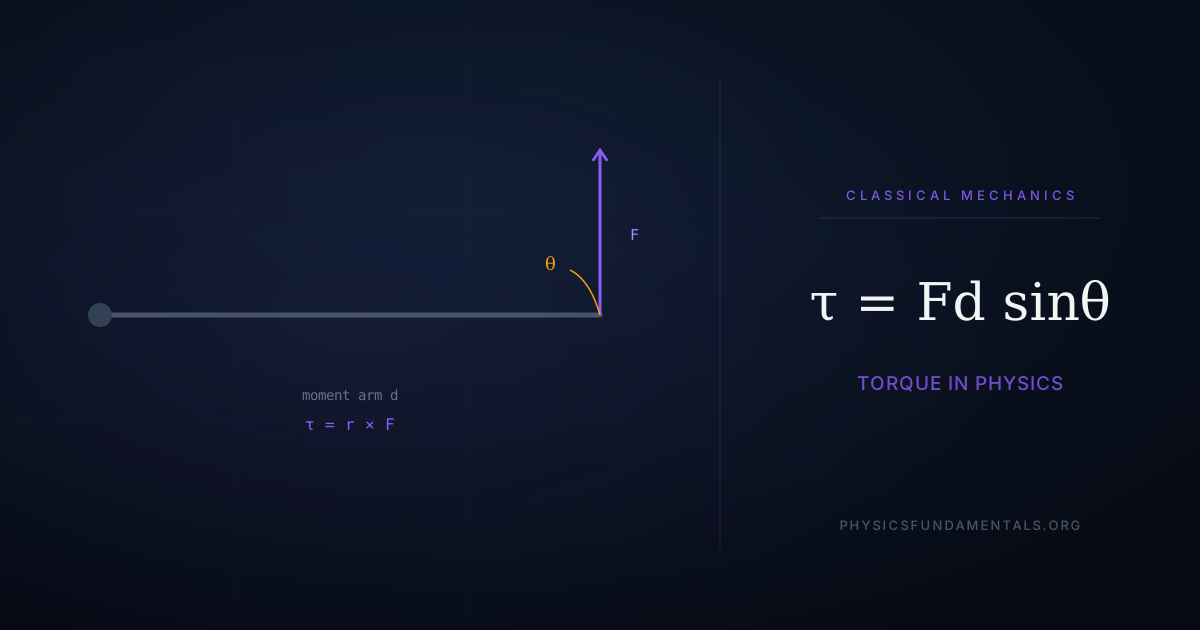
Torque (τ, tau) is the rotational equivalent of force — the measure of a force's tendency to cause rotation about an axis. Formula: τ = Fd sinθ, where F is the applied force (N), d is the distance from the pivot to the point of application (the moment arm, in metres), and θ is the angle between the force and the moment arm. Torque is measured in newton-metres (N·m).
The Torque Formula
where τ (tau) is torque (N·m), F is force (N), d is the distance from the axis of rotation to the point where the force is applied (m), and θ is the angle between the force vector and the line from pivot to point of application.
When the force is perpendicular to the moment arm (θ = 90°, sinθ = 1), torque is maximised:
When the force is parallel to the moment arm (θ = 0° or 180°, sinθ = 0), torque is zero — a force directed straight toward or away from the pivot produces no rotation.
The Moment Arm
The moment arm (also called the lever arm) is the perpendicular distance from the axis of rotation to the line of action of the force. It is not necessarily the distance from pivot to point of application — it is the shortest (perpendicular) distance from the pivot to the extended line along which the force acts.
For a force perpendicular to the lever: moment arm = distance from pivot to point of application.
For a force at angle θ: moment arm = d sinθ, so τ = F × (d sinθ) = Fd sinθ.
Diagram — Torque: force, moment arm, and angle
Direction of Torque: Clockwise and Anticlockwise
Torque is a vector — it has both magnitude and direction. By convention:
• Anticlockwise (counterclockwise) torques are positive.
• Clockwise torques are negative.
The direction is determined by the right-hand rule: curl the fingers of the right hand from the moment arm toward the force direction; the thumb points in the direction of the torque vector (perpendicular to the plane of rotation).
Rotational Equilibrium: The Principle of Moments
An object is in rotational equilibrium when the net torque about any axis is zero:
This is the Principle of Moments: for equilibrium, the sum of clockwise torques about any pivot equals the sum of anticlockwise torques. This is the fundamental principle behind levers, see-saws, balance scales, and structural engineering.
Worked Example: See-saw
A 40 kg child sits 1.5 m from the centre of a see-saw. How far must a 60 kg adult sit on the other side for the see-saw to balance?
The adult must sit 1.0 m from the centre — lighter people sit further from the pivot to balance heavier people sitting closer.
More Worked Examples
Example 2: Tightening a bolt
A mechanic applies 80 N perpendicular to a 0.25 m spanner. What torque acts on the bolt?
Example 3: Force at an angle
A 100 N force acts at 35° to a 0.4 m moment arm.
Newton's Second Law for Rotation
Just as F = ma connects force and linear acceleration, the rotational equivalent connects torque and angular acceleration α:
where I is the moment of inertia (kg·m²) — the rotational analogue of mass — and α is angular acceleration (rad/s²). A larger moment of inertia means the same torque produces less angular acceleration. This is why it is harder to spin a long, heavy flywheel than a small, light disc — even if both have the same mass, the flywheel's mass is concentrated further from the axis, giving it a greater moment of inertia.
Torque and Work in Rotation
Work done by a torque through angle θ (in radians):
Power delivered by a torque at angular velocity ω (rad/s):
This mirrors the linear relationships W = Fd and P = Fv exactly. For a car engine: engine torque × angular velocity = power output. High-revving engines (large ω) can produce high power at moderate torque; diesel engines produce high torque at low revs. Torque and power are related by P = τω — they are not independent quantities.
Real-World Applications of Torque
Door handles: positioned at the edge of the door (maximum moment arm) to minimise the force needed to open it. A handle near the hinge would require enormous force for the same torque.
Wheelie bars on dragsters: prevent the car from rotating (wheelie) by extending the effective wheelbase, increasing the anticlockwise torque of the rear downforce.
Torque wrenches: allow engineers to apply precisely specified torques to bolts, preventing both under-tightening (bolt works loose) and over-tightening (stripping threads or warping flanges).
Seesaws and levers: all governed by the principle of moments — the fundamental application of rotational equilibrium dating back to Archimedes, who reportedly said: "Give me a lever long enough and a fulcrum on which to place it, and I shall move the world."
Frequently Asked Questions
The Torque Formula
Torque τ (tau) is the rotational equivalent of force — it causes angular acceleration. For a force F applied at distance r from a pivot at angle θ:
SI unit: N·m (not joules — torque and energy have the same units but are different quantities). Maximum torque when θ = 90° (force perpendicular to the lever arm). Zero torque when θ = 0° or 180° (force parallel to lever arm, passes through pivot).
Worked Examples
Example 1: Spanner on a bolt. A 25 N force applied perpendicular (θ = 90°) to a 0.30 m spanner. τ = 0.30 × 25 × sin 90° = 7.5 N·m.
Example 2: Force at an angle. Same spanner, force at 60° to lever arm. τ = 0.30 × 25 × sin 60° = 0.30 × 25 × 0.866 = 6.50 N·m.
Example 3: Equilibrium. A 4 m seesaw pivoted at centre. 60 kg person sits 1.5 m left of pivot. Where must a 45 kg person sit (right side) for balance?
Anticlockwise torque = clockwise torque: 60 × 9.8 × 1.5 = 45 × 9.8 × d → d = 60 × 1.5/45 = 2.0 m from pivot.
Torque and Angular Acceleration
Newton's second law for rotation: τ_net = Iα, where I is moment of inertia and α is angular acceleration. A net torque of 10 N·m on a flywheel (I = 5 kg·m²): α = τ/I = 10/5 = 2 rad/s². This is the rotational analogue of F = ma.
Conditions for Equilibrium
For a rigid body in static equilibrium: (1) ΣF = 0 (no net force — no linear acceleration); (2) Στ = 0 about any pivot point (no net torque — no angular acceleration). Both conditions must hold. Choose the pivot point strategically — placing it at an unknown force eliminates that force from the torque equation, simplifying the algebra.
Frequently Asked Questions
What is torque in physics?
Torque is the rotational effect of a force — the tendency of a force to cause angular acceleration about a pivot point. It is calculated as τ = rF sin θ, where r is the distance from the pivot to the point of force application, F is the force magnitude, and θ is the angle between the force and the line from pivot to application point. Unit: N·m. Maximum torque is produced when force is perpendicular to the lever arm (θ = 90°); zero torque when the force acts along the lever arm or passes through the pivot.
What is the difference between torque and force?
Force (F, in newtons) causes linear acceleration: F = ma. Torque (τ, in N·m) causes angular acceleration: τ = Iα. Force acts at a point; torque depends on both force and its distance from the rotation axis (moment arm). The same force produces more torque when applied further from the pivot — why door handles are at the far edge of the door and why longer spanners give more torque. While force and torque have similar dimensions (both involve N·m when you expand), they are distinct quantities — work (also in N·m = joules) is force times displacement, whereas torque is force times perpendicular distance.
What is the moment arm (lever arm)?
The moment arm (or lever arm) is the perpendicular distance from the pivot point to the line of action of the force. Torque = force × moment arm = F × r⊥. This is equivalent to τ = rF sin θ, since r sin θ = r⊥ (the perpendicular component of r). The moment arm is always the shortest distance from the pivot to the line along which the force acts. Maximising the moment arm maximises torque for a given force — why you open a door by pushing at the edge (large r⊥) not near the hinges (small r⊥).
What are the conditions for rotational equilibrium?
For rotational equilibrium, the net torque about any point must be zero: Στ = 0. Combined with translational equilibrium (ΣF = 0), this ensures a body is in complete static equilibrium — no linear or angular acceleration. When choosing a pivot point for torque calculations, placing it at an unknown force eliminates that unknown from the torque equation (since its moment arm is zero). This is the standard approach for solving beam, bridge, and seesaw problems where multiple unknown reaction forces exist.
How does torque relate to power in rotating machines?
Power = torque × angular velocity: P = τω. For an engine producing torque τ at rotational speed ω (rad/s): P = τω. Converting to more familiar units: if torque is 200 N·m and the engine runs at 3,000 rpm = 3000 × 2π/60 = 314 rad/s, then P = 200 × 314 = 62,800 W = 62.8 kW = 84 hp. This relationship explains why electric motors (high torque at low speed) and petrol engines (lower torque but higher speed range) have different power characteristics, and why gearboxes trade torque for speed to match engine output to road conditions.
What is torque in physics?
Torque is the rotational equivalent of force — the measure of a force's tendency to cause rotation about an axis. Formula: τ = Fd sinθ, where F is force, d is the distance from the pivot to the point of application, and θ is the angle between force and moment arm. Unit: newton-metres (N·m).
What is the difference between torque and force?
Force (F, in newtons) causes linear acceleration: F = ma. Torque (τ, in N·m) causes angular (rotational) acceleration: τ = Iα. Torque depends not just on the force's magnitude but on how far from the pivot it is applied and at what angle. The same force can create different torques depending on where and how it acts.
What is the principle of moments?
The principle of moments states that for rotational equilibrium, the sum of clockwise torques about any pivot equals the sum of anticlockwise torques (net torque = 0). It governs levers, see-saws, balance scales, and the structural analysis of beams in civil engineering.
What is the unit of torque?
Newton-metres (N·m). Note: this is the same unit as the joule (J = N·m) but torque and energy are different physical quantities — torque is a vector, energy is a scalar. The units happen to be identical but the contexts are distinct: torque is force × distance (perpendicular), energy is force × displacement (parallel).
Why is torque maximum when the force is perpendicular to the moment arm?
τ = Fd sinθ. sinθ is maximum (= 1) when θ = 90° — when the force is perpendicular to the moment arm. At this angle, 100% of the force contributes to rotation. At other angles, only the perpendicular component (F sinθ) produces rotation; the parallel component acts through the pivot and creates no torque.
Share this article
Written by
Physics Fundamentals Editorial Team
Written and reviewed by our team of physics educators. Content is aligned with A-Level, GCSE, AP Physics, and undergraduate curricula.
About Physics Fundamentals →