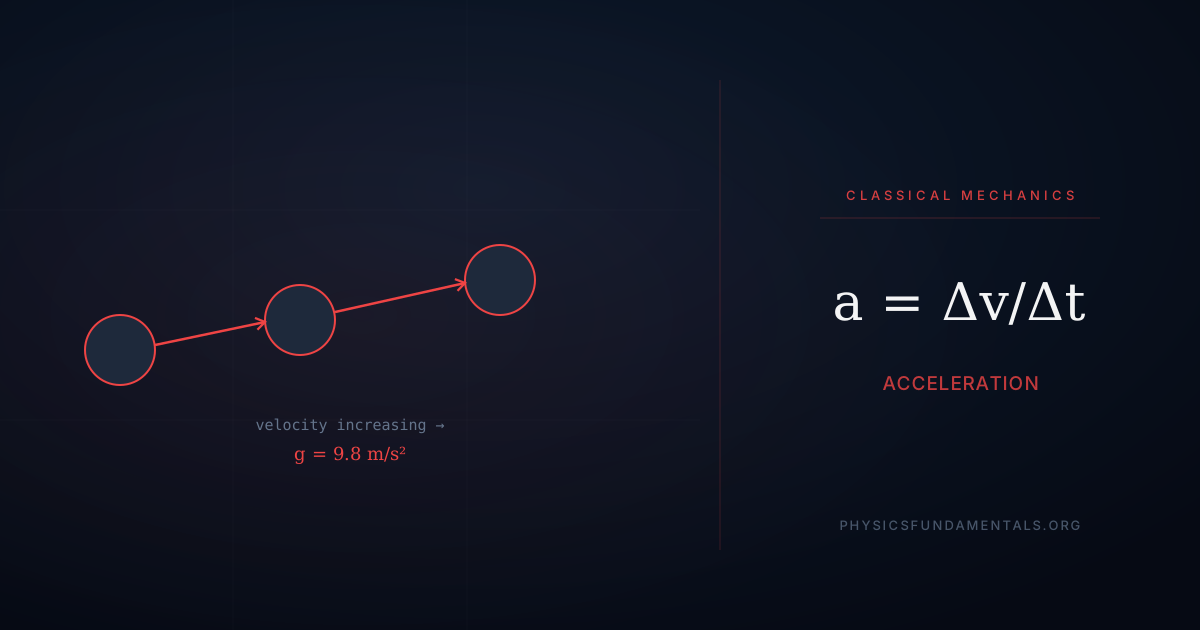

Drop a feather and a hammer on the Moon — they hit the ground at exactly the same time. This famous demonstration (carried out by Apollo 15 astronaut David Scott in 1971) reveals something profound: in the absence of air resistance, every object falls with the same acceleration regardless of mass. That acceleration — g = 9.8 m/s² near Earth's surface — is one of the most important constants in mechanics, and understanding free fall and what happens when air resistance is present (terminal velocity) unlocks a huge range of real-world physics.
Free fall acceleration: g = 9.8 m/s² (downward)
Velocity after time t: v = gt (from rest)
Distance fallen: s = ½gt²
Terminal velocity: when drag force = weight → net force = 0 → constant velocity
Terminal velocity formula: v_t = √(2mg / (ρAC_d))
What Is Free Fall?
Free fall is motion under gravity alone, with no other forces acting — in particular, no air resistance. In free fall, every object accelerates downward at g = 9.8 m/s² regardless of its mass, size, or composition. A 1 kg ball and a 100 kg boulder, released simultaneously in vacuum, hit the ground at exactly the same moment.
This seems counterintuitive — heavier objects feel harder to lift, so shouldn't gravity pull them down faster? The key is that while gravity exerts a larger force on a more massive object (F = mg), that object also has more inertia (a = F/m = mg/m = g). The mass cancels out exactly. This cancellation — the equivalence of gravitational and inertial mass — is one of the deepest results in physics and forms the foundation of Einstein's general theory of relativity.
The Free Fall Equations
Free fall is constant acceleration with a = g = 9.8 m/s², so the SUVAT equations apply directly. Taking downward as positive, starting from rest (u = 0):
For a falling object with non-zero initial velocity u (e.g. thrown downward at u m/s):
For an object thrown upward at speed u (taking upward as positive, a = −g):
Worked Example 1: Stone Dropped from a Building
A stone is dropped from rest from the top of a 45 m building. Find: (a) the time to reach the ground; (b) the impact speed.
(a) s = ½gt² → 45 = ½ × 9.8 × t² → t² = 90/9.8 = 9.18 → t = 3.03 s
(b) v² = 2gs = 2 × 9.8 × 45 = 882 → v = 29.7 m/s ≈ 107 km/h
Worked Example 2: Ball Thrown Upward
A ball is thrown straight up at 15 m/s. Find: (a) maximum height; (b) time to return to the thrower; (c) speed on return.
(a) h = u²/(2g) = 225/(2 × 9.8) = 225/19.6 = 11.5 m
(b) Total time = 2 × time to peak = 2 × (u/g) = 2 × (15/9.8) = 3.06 s
(c) By symmetry, returns at same speed: 15 m/s downward (confirmed by v² = u² + 2as with s = 0)
What Is Terminal Velocity?
Terminal velocity is the constant maximum speed reached by a falling object when the upward drag force exactly equals the downward weight. At this point, the net force is zero, acceleration is zero, and the object falls at a steady speed.
As an object accelerates from rest:
- Initially: weight > drag → net downward force → object accelerates
- As speed increases: drag force increases (drag ∝ v²)
- Eventually: drag = weight → net force = 0 → acceleration = 0 → constant speed
Terminal velocity is reached asymptotically — the object approaches it but never quite reaches it in finite time (the acceleration approaches zero, never exactly equalling zero).
The Terminal Velocity Formula
At terminal velocity, weight equals drag force:
Solving for terminal velocity v_t:
where m = mass (kg), g = 9.8 m/s², ρ = air density (kg/m³, ≈ 1.2 at sea level), C_d = drag coefficient (dimensionless), A = cross-sectional area (m²).
This shows what affects terminal velocity:
- Higher mass → higher terminal velocity (heavier objects reach higher speeds before drag balances weight)
- Larger area → lower terminal velocity (more drag at any given speed)
- Higher drag coefficient → lower terminal velocity (less streamlined shapes)
Worked Example 3: Calculating Terminal Velocity
A skydiver (m = 80 kg) in a spread-eagle position has A = 0.7 m², C_d = 1.0. Air density = 1.2 kg/m³. Find terminal velocity.
In a head-down dive position (much smaller A, lower C_d): terminal velocity can exceed 250 km/h (69 m/s). Felix Baumgartner's 2012 stratospheric jump reached 1,357 km/h — the low air density at 39 km altitude drastically reduced drag.
Real-World Terminal Velocities
| Object | Terminal velocity |
|---|---|
| Raindrop (small) | 2–9 m/s (7–32 km/h) |
| Human (spread-eagle) | ~55 m/s (200 km/h) |
| Human (head-down dive) | ~90 m/s (320 km/h) |
| Peregrine falcon (diving) | ~84 m/s (300 km/h) |
| Golf ball | ~42 m/s (150 km/h) |
The v–t Graph for Free Fall with Air Resistance
The velocity-time graph for an object falling with air resistance has a characteristic shape:
- Early phase: steep gradient (large acceleration ≈ g, drag is small)
- Middle phase: gradient decreases (increasing drag reduces acceleration)
- Terminal phase: gradient → 0, velocity → v_t (constant)
Area under the v-t graph = distance fallen. The shape is an exponential approach: v(t) = v_t(1 − e^(−gt/v_t)), though this formula uses the linear drag approximation; the actual approach with quadratic drag is slightly different.
Historical Context — Galileo's Discovery
Before Galileo (1564–1642), Aristotle's view dominated: heavier objects fall faster, with speed proportional to weight. Galileo challenged this through experiments on inclined planes (not by dropping objects from the Tower of Pisa — that story is almost certainly apocryphal). By timing balls rolling down ramps of various angles and extrapolating to vertical fall, he concluded that all objects fall with the same constant acceleration. This was a radical departure from 2,000 years of accepted physics.
Newton (1687) explained why: gravitational force is proportional to mass (F = mg), but so is inertial resistance to acceleration (F = ma). The mass cancels, giving g as a universal free fall acceleration. Einstein's general relativity (1915) deepened this further: gravity isn't a force at all, but a curvature of spacetime — and all objects follow the same curved paths (geodesics) regardless of mass.
Common Mistakes
Using g = 10 m/s² when precision is needed. g ≈ 10 m/s² is a convenient approximation (2% error) for quick estimates. Many exam mark schemes require g = 9.8 m/s² for full marks — check your syllabus.
Forgetting that g varies with location. g = 9.8 m/s² is the standard value at sea level, mid-latitudes. At the poles (closer to Earth's centre, faster rotation): g ≈ 9.83 m/s². At the equator: g ≈ 9.78 m/s². At the top of Everest: g ≈ 9.76 m/s².
Treating terminal velocity as an instant event. Terminal velocity is approached gradually, not reached at a specific moment. The object's speed asymptotically approaches v_t — theoretically taking infinite time to reach it exactly.
Frequently Asked Questions
Free Fall and the Work-Energy Theorem
Free fall can also be analysed using energy conservation. A mass m falling height h in free fall gains kinetic energy equal to the loss in gravitational potential energy:
This is identical to the SUVAT result v² = 2gs (with s = h). The energy approach is often faster for problems asking for impact speed when height is given — you don't need time at all.
With air resistance present, some energy is dissipated as heat by drag. The energy equation becomes:
where W_drag is the work done against drag (always positive, always reducing final KE). This is why a real falling object hits the ground slower than a free-fall calculation predicts — some GPE went into heat rather than KE.
Free Fall in Space
Astronauts in the International Space Station (ISS) experience weightlessness not because there's no gravity — the ISS orbits at ~400 km altitude where g ≈ 8.7 m/s², still about 89% of surface gravity. They feel weightless because they are in continuous free fall around Earth. The station and everything inside it fall together at the same rate, so no contact forces act between them. This is called microgravity — there's gravity, but everything is falling together so nothing feels it.
This is exactly the equivalence principle at work: in a freely falling reference frame, gravity is locally undetectable. Einstein used this idea as the cornerstone of general relativity — the starting point being that a person in free fall has no local experiment that can distinguish between being in free fall in a gravitational field and floating in empty space far from any mass.
What is free fall in physics?
Free fall is motion under gravity alone, with no other forces (particularly no air resistance). In free fall, every object accelerates downward at g = 9.8 m/s² regardless of mass. The velocity increases by 9.8 m/s every second: after 1 s the object falls at 9.8 m/s, after 2 s at 19.6 m/s, and so on. The distance fallen from rest is s = ½gt². Free fall only occurs in vacuum — in air, drag force acts and the object eventually reaches terminal velocity rather than accelerating indefinitely.
What is terminal velocity?
Terminal velocity is the constant maximum speed reached when the drag force on a falling object exactly equals its weight. At this point the net force is zero, so by Newton's second law the acceleration is zero — the object falls at a steady, unchanging speed. Terminal velocity is reached gradually: the object starts with near-zero drag (acceleration ≈ g), speeds up, experiences increasing drag, and asymptotically approaches the terminal speed. For a human in spread-eagle freefall: ~55 m/s (200 km/h). For a raindrop: ~2–9 m/s depending on size.
Why do all objects fall at the same rate in a vacuum?
Gravitational force on an object is F = mg (proportional to mass). But the acceleration produced by any force is a = F/m. For gravity: a = mg/m = g. The mass cancels out exactly, so every object has the same gravitational acceleration g = 9.8 m/s², regardless of how heavy or light it is. This equivalence between gravitational mass (which determines gravitational force) and inertial mass (which determines resistance to acceleration) is one of the deepest facts in physics — it underpins Einstein's general theory of relativity.
What factors affect terminal velocity?
Terminal velocity v_t = √(2mg/(ρC_dA)) depends on: mass m (heavier objects reach higher terminal speeds), cross-sectional area A (larger area means more drag and lower terminal speed), drag coefficient C_d (more streamlined shapes have lower C_d and higher terminal speeds), and air density ρ (lower density at altitude means less drag and higher terminal speeds — which is why Felix Baumgartner exceeded 1,000 km/h at 39 km altitude). Parachutes increase A and C_d dramatically, reducing terminal velocity to a safe landing speed of ~5–6 m/s.
What is the acceleration due to gravity g?
The acceleration due to gravity at Earth's surface is g = 9.8 m/s² (or 9.81 m/s² for higher precision). It means a freely falling object's downward velocity increases by 9.8 m/s every second. g varies slightly across Earth's surface: higher at the poles (9.83 m/s²) and lower at the equator (9.78 m/s²) due to Earth's rotation and slightly flattened shape. On the Moon, g = 1.62 m/s²; on Mars, g = 3.72 m/s²; on the Sun's surface, g ≈ 274 m/s².
How do you calculate free fall velocity?
For an object dropped from rest (u = 0), velocity after falling for time t is v = gt. After falling a distance s from rest: v = √(2gs). For example, after falling 20 m from rest: v = √(2 × 9.8 × 20) = √392 = 19.8 m/s. If the object had initial velocity u (thrown downward), use v = u + gt or v² = u² + 2gs. These are the standard SUVAT equations with a = g = 9.8 m/s² — they apply only when air resistance is negligible.
Share this article
Written by
Physics Fundamentals Editorial Team
Written and reviewed by our team of physics educators. Content is aligned with A-Level, GCSE, AP Physics, and undergraduate curricula.
About Physics Fundamentals →