
A car brakes from 30 m/s to rest in 50 m — how long does that take? A ball thrown upward at 15 m/s — how high does it reach? A stone dropped from a cliff — how fast is it moving after 3 seconds? These questions all involve motion with constant acceleration, and they're all solved with the same four equations: the SUVAT equations. Named after the five variables they connect — s, u, v, a, t — these are among the most-used equations in all of physics, forming the backbone of kinematics and appearing on every A-Level, GCSE, AP Physics, and university entrance exam.
The good news is that all four SUVAT equations are derived from one simple idea: what does constant acceleration actually mean? Once you understand that, the equations stop being things to memorise and start being things you could re-derive in an exam if needed.
s = displacement (m) — vector distance from start to end, not total path length
u = initial velocity (m/s) — speed and direction at the start
v = final velocity (m/s) — speed and direction at the end
a = acceleration (m/s²) — must be constant for SUVAT to apply
t = time (s) — duration of the motion
Know any three → find the remaining two.
All Four SUVAT Equations
Each equation uses four of the five variables and leaves one out. To pick the right equation: identify which variable is neither given nor needed, then use the equation that omits it.
| Equation | Variables used | Omits | Use when you don't have or need… |
|---|---|---|---|
| v = u + at | v, u, a, t | s | Displacement |
| s = ut + ½at² | s, u, a, t | v | Final velocity |
| v² = u² + 2as | v, u, a, s | t | Time |
| s = ½(u+v)t | s, u, v, t | a | Acceleration |
How to Derive Every SUVAT Equation
Understanding the derivations means you'll never truly forget these equations. They all start from one statement: constant acceleration means velocity increases at a steady rate.
Equation 1: v = u + at
Acceleration is defined as a = (v − u) / t. Rearranging: v = u + at. That's it. If you start at u and gain speed at rate a for time t, your final speed is u + at. There's nothing more to it.
Equation 4: s = ½(u + v)t
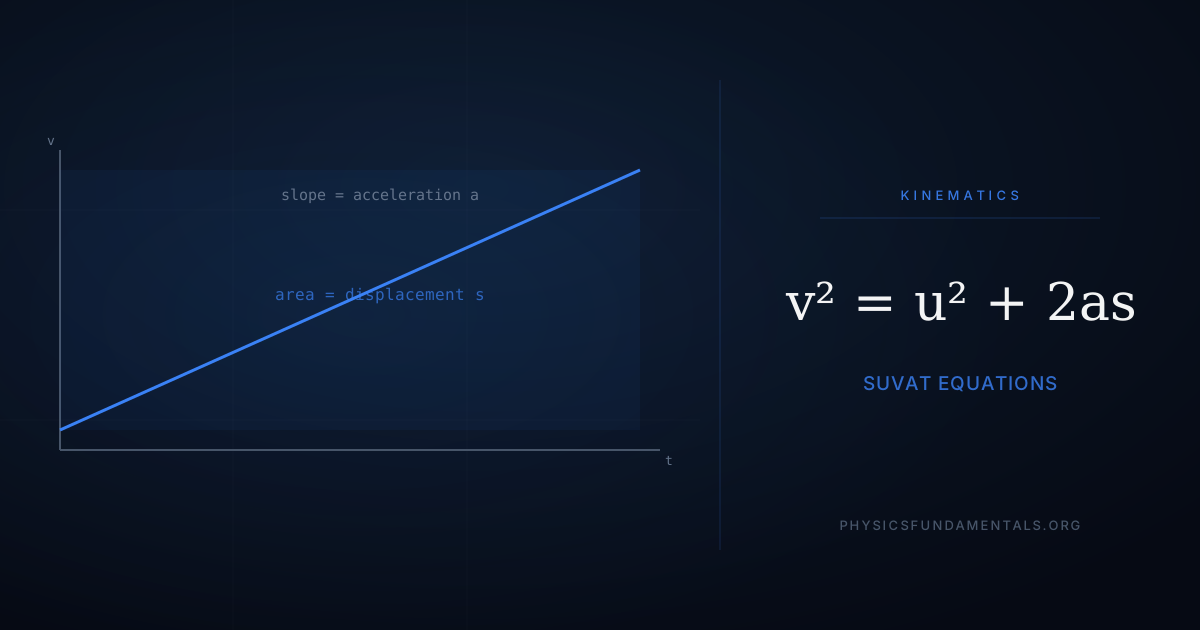
Draw a velocity-time graph. With constant acceleration, the graph is a straight line rising from u to v over time t. The displacement is the area under this line — a trapezium with parallel sides u and v, width t:
This is why s = ½(u+v)t: displacement equals the average velocity multiplied by time, which works only when velocity changes uniformly.
Equation 2: s = ut + ½at²
Substitute v = u + at (Eq. 1) into s = ½(u + v)t (Eq. 4):
Geometrically, ut is the rectangle at the bottom of the v-t graph (the displacement if speed stayed at u), and ½at² is the triangle on top (the extra displacement gained from acceleration).
Equation 3: v² = u² + 2as
Eliminate t from the pair of equations. From Eq. 1: t = (v − u)/a. Substitute into Eq. 4:
This is the energy equation in disguise. Multiplying both sides by ½m gives ½mv² = ½mu² + mas — which is the work-energy theorem (final KE = initial KE + work done by net force).
Step-by-Step Method for Any SUVAT Problem
- Define a positive direction — pick upward or rightward as positive and commit to it for the entire problem.
- List the five variables — write s, u, v, a, t and fill in what's given. Assign signs based on your chosen positive direction.
- Identify the unknown — one variable will be missing from your list; that's what you're solving for.
- Identify the omitted variable — the variable you haven't been given and don't need. This tells you which equation to use.
- Substitute and solve — plug in the known values and rearrange algebraically.
- Check units and signs — a negative answer for s means displacement is in the negative direction; a negative a means deceleration.
Sign Conventions — The Most Common Source of Errors
SUVAT variables are vectors in one dimension — they carry sign. Before writing down a single number:
Choose a positive direction and declare it. Writing "↑ positive" or "→ positive" at the top of your working is not optional — it prevents errors and shows examiners your method.
With upward positive: a thrown ball has u = +20 m/s upward, a = −9.8 m/s² (gravity is downward, so negative). The ball's velocity at the peak is v = 0. On the way down, v becomes negative.
With downward positive: a dropped stone has u = 0, a = +9.8 m/s², and s grows positive as it falls. Either convention gives the same final answer — but mixing conventions mid-problem gives nonsense.
s is displacement, not distance. A ball thrown upward that returns to its launch point has s = 0 m of displacement, even though it has travelled 2 × (maximum height) of total distance. If a problem asks for total distance and the object changes direction, split the motion at the turning point, apply SUVAT to each phase, and add the magnitudes of displacement for each phase.
Worked Example 1: Braking Car
A car travelling at 30 m/s decelerates uniformly to rest over 45 m. Find the deceleration and the time taken to stop.
Given: u = 30 m/s, v = 0 m/s, s = 45 m. Find: a and t.
Step 1: Find a — we have u, v, s; we don't need t, so use v² = u² + 2as:
The negative sign confirms deceleration (opposing the direction of motion).
Step 2: Find t — now we have u, v, a; we don't need s, so use v = u + at:
Worked Example 2: Ball Thrown Upward
A ball is launched vertically at 20 m/s. Taking upward as positive, a = −9.8 m/s². Find: (a) the maximum height reached; (b) the time to return to the launch point; (c) the total distance travelled.
(a) Maximum height: At the peak, v = 0. Given u = 20, v = 0, a = −9.8; omit t; use v² = u² + 2as:
(b) Time to return to start: At the return point, s = 0 again. Use s = ut + ½at²:
(c) Total distance: The ball goes 20.4 m up, then 20.4 m back down. Total distance = 40.8 m, but displacement = 0.
Worked Example 3: Stone Dropped from a Cliff
A stone is released from rest at the top of an 80 m cliff. Taking downward as positive: u = 0, a = 9.8 m/s², s = 80 m. Find the time to hit the ground and impact speed.
Time: Given u, a, s; omit v; use s = ut + ½at²:
Impact speed: Use v² = u² + 2as:
Worked Example 4: Train Overtake Problem
A train passes a station at 10 m/s and accelerates at 0.5 m/s². A second train starts from the same station 20 s later at constant 25 m/s. How far from the station does the second train overtake the first?
Let t = time since the first train passed the station. The second train starts at t = 20 s.
Displacement of train 1: s₁ = 10t + ½(0.5)t² = 10t + 0.25t²
Displacement of train 2 (running for t − 20 seconds): s₂ = 25(t − 20)
Overtake when s₁ = s₂:
Discriminant = −4400, which is negative — the second train never overtakes! (It starts too late: train 1 has enough head start.) This is a useful check: always verify your answer makes physical sense.
If instead train 2 starts 5 s later: t² − 60t + 625 = 0 → t = (60 ± 35)/2 → t = 47.5 s or t = 12.5 s (discard, before train 2 starts). Overtake at s = 25(47.5 − 5) = 1062.5 m from station.
SUVAT in Projectile Motion
Projectile motion is SUVAT applied simultaneously to two perpendicular axes:
Horizontal axis: a = 0 (no horizontal force, ignoring air resistance), so v_x = u_x = constant, and s_x = u_x × t. No SUVAT equations needed beyond this — horizontal motion is uniform.
Vertical axis: a = −g = −9.8 m/s² (upward positive). All four SUVAT equations apply with vertical components only.
The coupling between axes is time t — the horizontal and vertical motions share the same t. Solve the vertical component for t (e.g. when the projectile hits the ground, s_y = 0), then use that t in the horizontal equation to find horizontal range.
This technique is explored in detail in our projectile motion parabola guide and you can verify your answers with the projectile motion calculator.
When SUVAT Does NOT Apply
SUVAT has one strict requirement: constant acceleration. It breaks down in these situations:
Varying thrust: A rocket burning fuel loses mass continuously, so even with constant engine thrust, the acceleration F/m increases as mass decreases. SUVAT won't give the right answer here.
Air resistance: Drag force scales with v² (or v for low speeds). This makes acceleration decrease as the object speeds up. A falling object reaches terminal velocity — something SUVAT cannot model because it predicts indefinitely increasing velocity. See our free fall and terminal velocity guide for how drag is treated properly.
Springs and oscillators: The restoring force in a spring is F = −kx (proportional to displacement), so acceleration is a = −(k/m)x — not constant. Simple harmonic motion requires its own set of equations.
For variable acceleration: a(t) = dv/dt, so v = ∫a dt and s = ∫v dt. Calculus takes over where SUVAT ends.
SUVAT on Inclined Planes
When an object slides along a frictionless ramp inclined at angle θ, the component of gravity along the slope is g sin θ. So a = g sin θ down the slope, and SUVAT applies with this value of a. For a 30° ramp: a = 9.8 × sin 30° = 4.9 m/s² down the slope.
With friction (coefficient μ), the frictional deceleration is μg cos θ, opposing motion. Total acceleration along slope: a = g sin θ − μg cos θ = g(sin θ − μ cos θ). This is still constant, so SUVAT still applies.
Historical Context
The physics behind SUVAT was worked out by Galileo Galilei in the early 17th century. Before Galileo, it was widely believed (following Aristotle) that heavier objects fall faster than lighter ones and that a constant force produces constant velocity. Galileo's inclined plane experiments demolished both ideas.
By rolling balls down ramps at various angles, Galileo showed that distance was proportional to time squared — exactly what s = ½at² predicts. He had effectively derived the SUVAT equations two centuries before they were formalised in their modern algebraic form. Newton's laws (1687) gave the underlying cause — net force produces acceleration — but the kinematic equations were observational discoveries first.
The "SUVAT" naming convention is primarily a British educational convention, not universal physics notation. In American curricula, the same equations appear as the "kinematic equations" and use different variable names (v₀ for initial velocity, Δx for displacement). The physics is identical.
Common SUVAT Mistakes to Avoid
Forgetting sign convention mid-problem. The most common error. Define positive direction at the start and never deviate. If upward is positive, then the acceleration due to gravity is always −9.8 m/s², even when the object is moving downward.
Using SUVAT when acceleration isn't constant. SUVAT gives wrong answers for problems involving drag, springs, or variable thrust. If the problem mentions air resistance that isn't negligible, or a force that changes with position or velocity, check whether constant acceleration is a valid assumption.
Treating displacement as distance. As discussed above, s is a vector quantity. If the object changes direction, you must handle each phase separately.
Using g = 10 m/s² when 9.8 is required. g = 10 m/s² is a useful approximation for quick estimates, but many exam mark schemes require g = 9.8 m/s² or g = 9.81 m/s². Check what your syllabus specifies.
Picking the wrong equation. Don't guess — always list the five variables first, identify what's given and what's needed, then select the equation that matches.
Frequently Asked Questions
What are the SUVAT equations?
The four SUVAT equations are: (1) v = u + at; (2) s = ut + ½at²; (3) v² = u² + 2as; (4) s = ½(u+v)t. They connect five kinematic variables — displacement (s), initial velocity (u), final velocity (v), acceleration (a), and time (t) — for motion with constant acceleration. If you know any three of the five variables, you can find the other two by choosing the right equation.
When can SUVAT equations be used?
SUVAT applies only when acceleration is constant throughout the entire motion. This covers free fall near Earth's surface (a = 9.8 m/s², ignoring air resistance), uniform braking or acceleration, and projectile motion (horizontal: a = 0; vertical: a = −g). SUVAT does not work when acceleration varies — for example, when air resistance is significant, when a spring is involved, or when a rocket is burning fuel and changing mass.
Which SUVAT equation should I use?
Identify the variable that you neither have nor need — this is the "omitted" variable. Then choose the equation that does not include it. No displacement given or needed? Use v = u + at (omits s). No final velocity? Use s = ut + ½at² (omits v). No time? Use v² = u² + 2as (omits t). No acceleration? Use s = ½(u+v)t (omits a). Always list all five variables and their values before selecting an equation.
What does s represent in SUVAT?
s is displacement — the vector change in position from start to finish, measured in metres. It is not the same as total distance travelled. If a ball is thrown upward and falls back to its starting height, the displacement is zero even though it has physically travelled twice the maximum height. Whenever an object changes direction mid-problem, split the motion at the turning point and calculate each segment separately, then combine.
What value of g should I use in SUVAT problems?
Near Earth's surface, use g = 9.8 m/s² (or 9.81 m/s² for higher precision). In SUVAT, g is the magnitude — you assign a sign based on your chosen positive direction. If upward is positive, then a = −9.8 m/s² for a freely falling object. If downward is positive, a = +9.8 m/s². Some courses allow g = 10 m/s² as an approximation — check your syllabus, since some exam mark schemes penalise using 10 when 9.8 is expected.
Are SUVAT equations the same as kinematic equations?
Yes — they are the same equations with different labelling. British A-Level and GCSE syllabuses use the term "SUVAT" and the variables s, u, v, a, t. American AP Physics and university courses call them "kinematic equations" and often use x or Δx for displacement, v₀ for initial velocity, and v or v_f for final velocity. The underlying physics and the mathematical form of the equations are identical in both conventions.
Share this article
Written by
Physics Fundamentals Editorial Team
Written and reviewed by our team of physics educators. Content is aligned with A-Level, GCSE, AP Physics, and undergraduate curricula.
About Physics Fundamentals →