In 1687, Isaac Newton published his Principia Mathematica — arguably the most important scientific work ever written. Among its results was a single equation that unified the fall of an apple with the orbit of the Moon, the tides of the ocean, and the paths of the planets: Newton's law of universal gravitation. Every mass in the universe attracts every other mass. The force between them follows an inverse-square law. This one insight transformed astronomy, enabled space travel, and established the template for all subsequent physics.
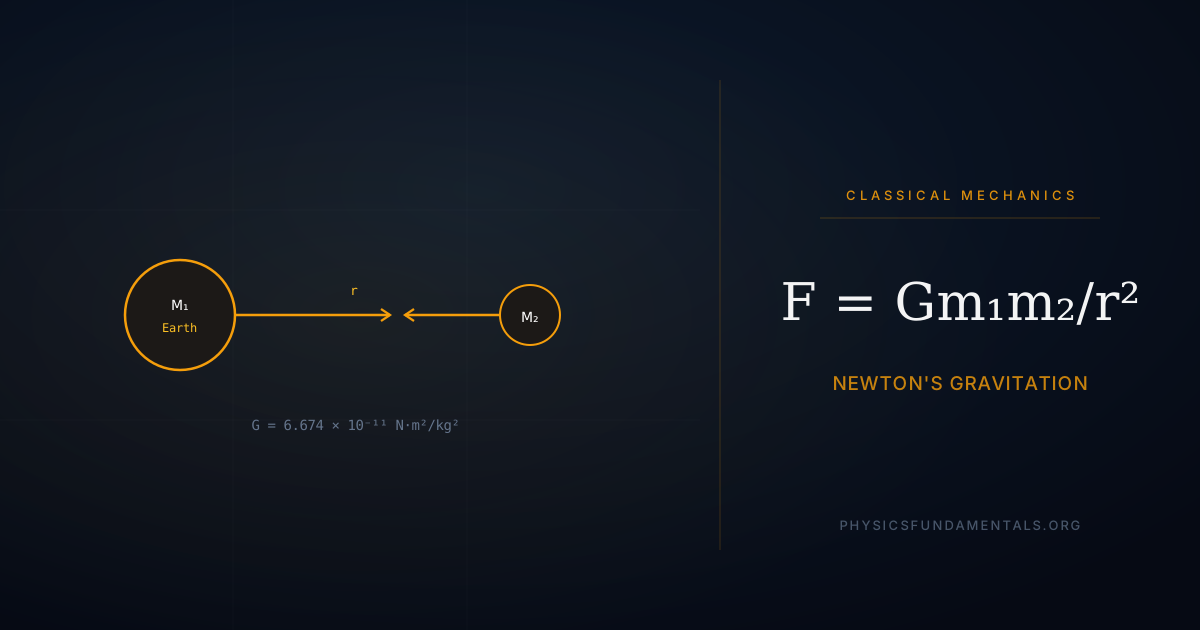
Every pair of masses attracts each other with a force proportional to the product of their masses and inversely proportional to the square of the distance between them:
F = Gm₁m₂/r²
F is gravitational force (N), G = 6.674 × 10⁻¹¹ N·m²/kg² is the gravitational constant, m₁ and m₂ are the masses (kg), and r is the distance between their centres (m). The force is always attractive and acts along the line joining the two masses.
The Gravitational Constant G
G = 6.674 × 10⁻¹¹ N·m²/kg² is one of the fundamental constants of nature. It was first measured by Henry Cavendish in 1798 using a torsion balance — two small lead balls attracted to two larger ones, with the tiny deflection revealing G. Cavendish called his experiment "weighing the Earth": knowing G and measuring g at Earth's surface, he could calculate Earth's mass.
G is extraordinarily small — gravity is the weakest of the four fundamental forces by a factor of ~10³⁶ compared to electromagnetism. Yet it dominates at cosmic scales because it is always attractive (unlike electric forces, which can cancel), and because large masses accumulate in planets, stars, and galaxies.
The Inverse-Square Law
The F ∝ 1/r² dependence of gravity — the inverse-square law — is one of the most important patterns in physics. It also governs the electric force (Coulomb's Law), light intensity, sound intensity, and radiation from a point source. The inverse-square relationship arises geometrically: the surface area of a sphere is 4πr², so any quantity spreading equally in all directions from a point source is diluted in proportion to r².
| Distance from Earth's centre | r (multiples of R_E) | g (m/s²) |
|---|---|---|
| Earth's surface | 1 R_E | 9.8 |
| ISS orbit (~400 km up) | 1.063 R_E | 8.68 |
| 2× Earth's radius | 2 R_E | 2.45 (= 9.8/4) |
| Moon's orbit | 60 R_E | 0.00272 |
| Geostationary orbit | 6.62 R_E | 0.224 |
Deriving g from Newton's Law
Newton's law allows us to calculate the gravitational field strength g at Earth's surface from first principles. Setting the gravitational force equal to mg:
Using M_Earth = 5.97 × 10²⁴ kg, R_Earth = 6.37 × 10⁶ m, G = 6.674 × 10⁻¹¹:
This agrees with the measured value — confirming that the same gravitational law governing the apple falling from a tree also governs the acceleration of objects at Earth's surface. This unification is one of the great triumphs of classical physics.
Orbital Mechanics: Gravity as Centripetal Force
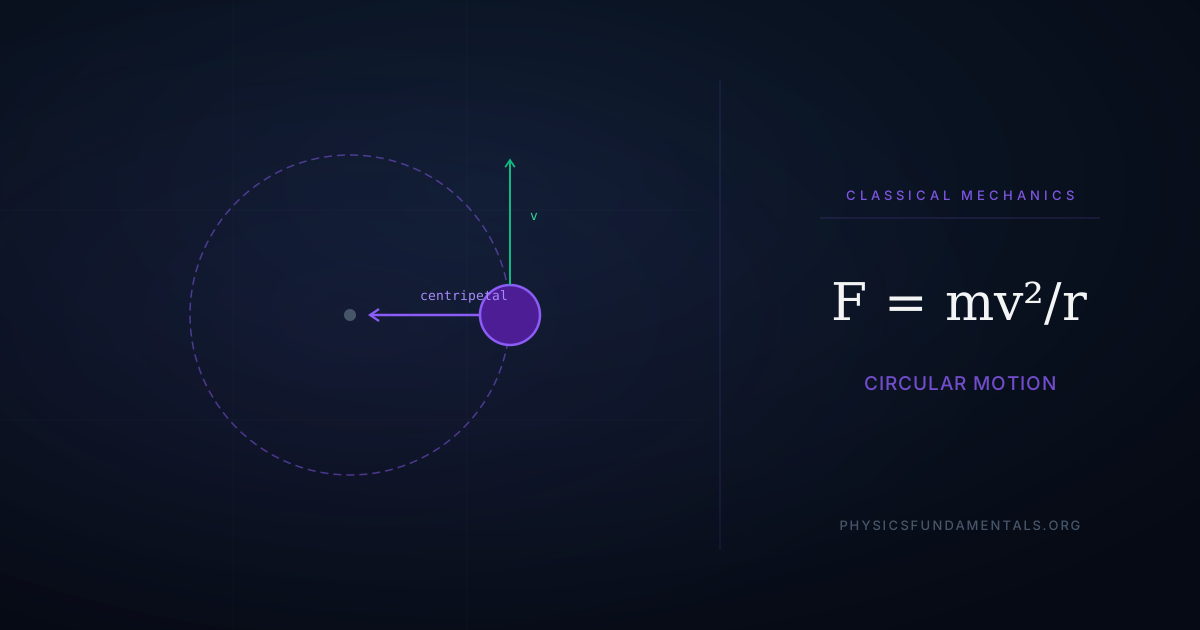
For a satellite of mass m in circular orbit at radius r around Earth (mass M), gravity provides the centripetal force:
The orbital speed depends only on radius — not on the satellite's mass. Lower orbit → faster speed (ISS at 400 km: ~7.66 km/s; geostationary at 35,786 km: ~3.07 km/s).
The orbital period T follows from v = 2πr/T:
This is Kepler's third law — the orbital period squared is proportional to the orbital radius cubed — derived from Newton's laws. Newton's theory explained all three of Kepler's empirical laws of planetary motion, providing the mathematical foundation that Kepler had described observationally.
Escape Velocity
The escape velocity is the minimum speed needed to escape a gravitational field completely — to reach infinity with zero remaining kinetic energy. Setting kinetic energy equal to the magnitude of gravitational potential energy:
For Earth's surface: v_escape = √(2 × 6.674 × 10⁻¹¹ × 5.97 × 10²⁴ / 6.37 × 10⁶) = 11.2 km/s ≈ 40,200 km/h.
Note that escape velocity is √2 × orbital velocity at the same radius. A spacecraft needs 41% more speed to escape Earth's gravity entirely than to orbit at the surface — explaining why low Earth orbit is a significant milestone, but escaping to the Moon requires substantially more energy.
Gravitational Potential Energy
The gravitational potential energy of mass m at distance r from mass M is:
The negative sign is fundamental: gravitational potential energy is always negative (taking zero at infinity). Objects bound in orbit have negative total energy (KE + PE < 0). To escape, total energy must reach zero or above. The work required to move a mass from Earth's surface (r = R) to infinity:
Black Holes: Escape Velocity Exceeds c
If a mass M is compressed into a sufficiently small radius r_s (the Schwarzschild radius), the escape velocity reaches c — the speed of light. Nothing, not even light, can escape. This is a black hole:
For the Sun (M = 2 × 10³⁰ kg): r_s ≈ 3 km. The Sun would need to be compressed from its actual radius of 696,000 km into a sphere 3 km across to form a black hole. Earth's Schwarzschild radius is about 9 mm.
Newton's formula gives the right Schwarzschild radius through a fortunate coincidence — the full calculation requires general relativity — but it illustrates how Newton's law of gravitation naturally leads to the concept of objects from which light cannot escape.
Worked Examples
Example 1: Force between Earth and Moon
M_Earth = 5.97 × 10²⁴ kg, M_Moon = 7.35 × 10²² kg, r = 3.84 × 10⁸ m.
Example 2: Gravitational field at altitude
Find g at 600 km above Earth's surface (r = R_E + 600,000 = 6.97 × 10⁶ m).
Frequently Asked Questions
The Formula and Constants
G = 6.674 × 10⁻¹¹ N·m²·kg⁻² (gravitational constant). The force is always attractive and acts along the line joining the centres of mass. For a uniform sphere, all mass acts as if concentrated at the centre (shell theorem). For objects near Earth: F = mg where g = GM_Earth/R_Earth² = 9.8 m/s².
Worked Examples
Example 1: Force between two 1 kg masses 1 m apart: F = 6.674 × 10⁻¹¹ × 1 × 1 / 1² = 6.67 × 10⁻¹¹ N. This is immeasurably small — confirming that everyday objects don't gravitationally attract each other significantly.
Example 2: Satellite orbital speed. A satellite at r = 7,000 km = 7 × 10⁶ m from Earth's centre (M = 5.97 × 10²⁴ kg): v = √(GM/r) = √(6.674 × 10⁻¹¹ × 5.97 × 10²⁴ / 7 × 10⁶) = √(5.69 × 10⁷) = 7,547 m/s ≈ 7.5 km/s.
Example 3: Variation of g with altitude. At altitude h above Earth's surface: g_h = GM/(R+h)² = g_surface × (R/(R+h))². At h = R: g = g_surface/4. At h = 2R: g = g_surface/9. Gravity falls off as 1/r² — but never reaches zero.
Gravitational Potential Energy
The gravitational PE of mass m at distance r from mass M (taking PE = 0 at infinity):
Negative because work is needed to separate the masses (they attract). Binding energy — energy needed to completely remove m from M's gravity — is |U| = GMm/r. Escape velocity derives from setting KE = binding energy: ½mv² = GMm/R → v = √(2GM/R).
Kepler's Laws from Newton's Gravitation
All three of Kepler's laws follow from F = Gm₁m₂/r². First law (elliptical orbits): circular orbits are a special case; the general solution to the two-body gravitational problem is a conic section (ellipse, parabola, or hyperbola). Second law (equal areas in equal times): conservation of angular momentum (since gravity is a central force with no torque). Third law (T² ∝ r³): for circular orbits, setting GMm/r² = mv²/r and T = 2πr/v gives T² = 4π²r³/(GM) → T² ∝ r³.
Frequently Asked Questions
What is Newton's Law of Universal Gravitation?
Newton's Law of Universal Gravitation states that every two masses attract each other with force F = Gm₁m₂/r², where G = 6.674 × 10⁻¹¹ N·m²·kg⁻² is the universal gravitational constant, m₁ and m₂ are masses in kg, and r is the centre-to-centre distance in metres. The force is always attractive, always acts along the line joining the masses, and follows an inverse-square law (doubling distance reduces force to one-quarter). It applies universally from apples falling to galaxy formation, with equal precision at every scale — until relativistic effects or quantum gravity become relevant.
How did Newton derive the law of universal gravitation?
Newton combined two lines of evidence. From Kepler's Third Law (T² ∝ r³ for planetary orbits) and the formula for circular orbital speed (v = 2πr/T), Newton derived that the centripetal acceleration of planets falls as 1/r². He then identified this with the same gravitational acceleration that causes falling objects on Earth's surface, extended to astronomical distances — the famous "apple and Moon" reasoning. By comparing the Moon's centripetal acceleration (0.0027 m/s²) with g at Earth's surface (9.8 m/s²), he verified the inverse-square law: 9.8 × (R_Earth/R_Moon)² = 9.8/3600 ≈ 0.0027 m/s².
What is the gravitational constant G?
G = 6.674 × 10⁻¹¹ N·m²·kg⁻² is the universal gravitational constant — it sets the overall strength of gravity. It was first measured by Henry Cavendish in 1798 using a torsion balance: two small lead spheres attracted to two large ones, the tiny rotation measured by a light beam and mirror. G is the most poorly known fundamental constant — its relative uncertainty is ~22 ppm, far worse than other constants, because gravity is extremely weak and hard to isolate from other forces. Its small value explains why gravity only becomes significant when at least one object has astronomical mass.
Does gravity ever reach zero?
Technically no — F = Gm₁m₂/r² approaches zero only as r → ∞. In practice, gravity becomes negligible far from massive objects. The sphere of gravitational influence (Hill sphere) of a planet is where its gravity dominates over the Sun's: r_Hill = a × (m_planet/(3M_Sun))^(1/3). Earth's Hill sphere radius is ~1.5 million km. Beyond this, the Sun's gravity dominates. Even in deep space far from any galaxy, the cosmic expansion (dark energy) provides a repulsive effect that dominates over any residual gravitational attraction from distant matter.
What is the relationship between G and g?
g (acceleration due to gravity at Earth's surface) is derived from G and Earth's properties: g = GM_Earth/R_Earth² = (6.674×10⁻¹¹ × 5.97×10²⁴)/(6.371×10⁶)² = 9.82 m/s² (close to the standard 9.80 m/s², with minor variations due to Earth's non-uniform density and rotation). G is universal — the same everywhere in the universe. g is local — it varies with location on Earth (9.78 at equator, 9.83 at poles) and changes with altitude as g_h = GM/(R+h)². G is a fundamental constant of nature; g is a derived quantity specific to Earth's surface.
What is Newton's law of universal gravitation?
Every mass attracts every other mass with a force F = Gm₁m₂/r², where G = 6.674 × 10⁻¹¹ N·m²/kg², m₁ and m₂ are the masses (kg), and r is the distance between their centres (m). The force is always attractive, acts along the line joining the masses, and obeys an inverse-square law.
What is the gravitational constant G?
G = 6.674 × 10⁻¹¹ N·m²/kg² is the universal gravitational constant — the same everywhere in the universe. It was first measured by Cavendish in 1798 using a torsion balance. G is extremely small, reflecting that gravity is the weakest of the four fundamental forces.
What is escape velocity?
Escape velocity is the minimum speed to escape a gravitational field: v_escape = √(2GM/r). For Earth's surface: ~11.2 km/s. It is √2 × orbital velocity at the same radius. A black hole is an object whose escape velocity exceeds the speed of light c.
How does Newton's law explain planetary orbits?
Gravity provides the centripetal force for circular orbits: GMm/r² = mv²/r, giving orbital speed v = √(GM/r). The resulting period T = 2πr/v gives T² ∝ r³ — Kepler's third law. Newton's law thus mathematically explains all three of Kepler's empirically discovered laws.
Why does g = 9.8 m/s² on Earth's surface?
From Newton's law: g = GM_Earth/R_Earth² = (6.674 × 10⁻¹¹ × 5.97 × 10²⁴) / (6.37 × 10⁶)² ≈ 9.8 m/s². The value depends on Earth's mass and radius. On the Moon (smaller M, smaller R): g_Moon ≈ 1.62 m/s²; on Jupiter (much larger M): g_Jupiter ≈ 24.8 m/s².
Share this article
Written by
Physics Fundamentals Editorial Team
Written and reviewed by our team of physics educators. Content is aligned with A-Level, GCSE, AP Physics, and undergraduate curricula.
About Physics Fundamentals →