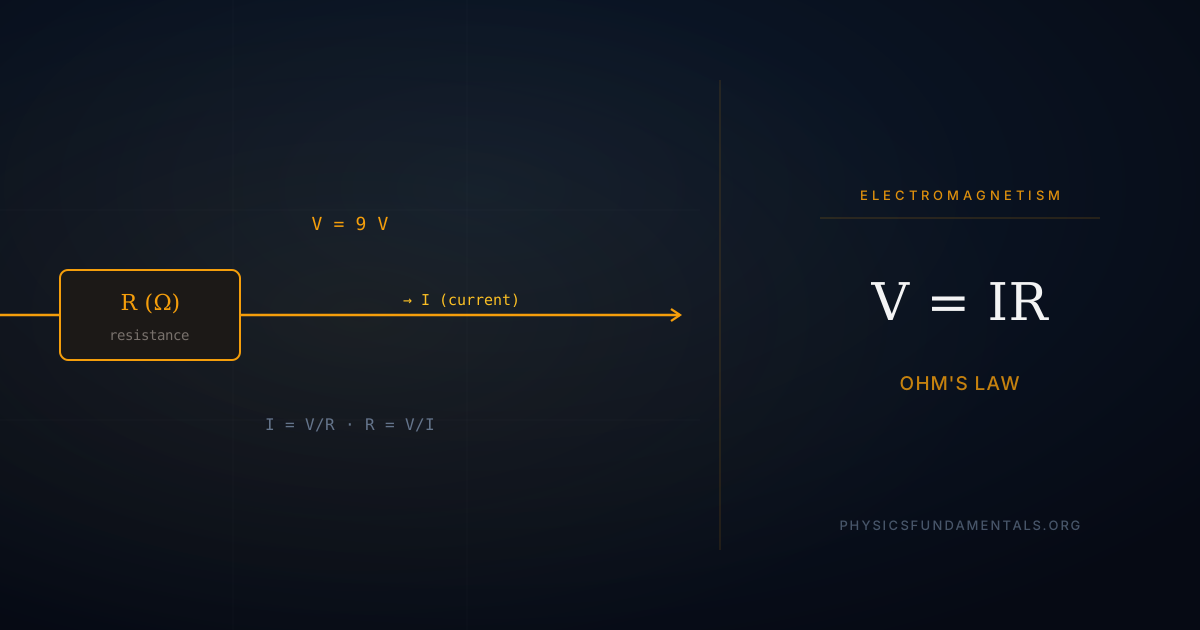
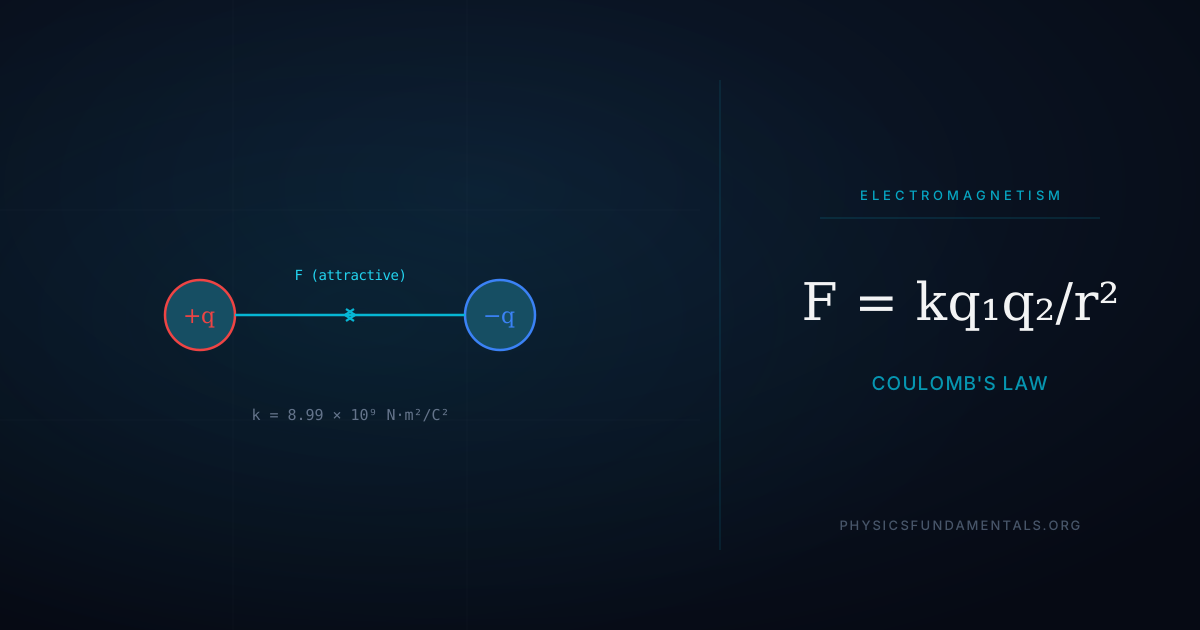
Everything electrical — lightning, batteries, neural signals, transistors — begins with one fundamental property of matter: electric charge. The force between charges, described by Coulomb's Law, is one of the four fundamental forces of nature and shares the same inverse-square structure as Newton's law of gravitation — one of the deepest structural patterns in physics.
Electric charge is a fundamental property of matter measured in coulombs (C). Two types: positive (protons) and negative (electrons). Like charges repel; opposite charges attract. Elementary charge: e = 1.6 × 10⁻¹⁹ C. Charge is always conserved — the total in any isolated system never changes.
Electric Charge: The Basics
Atoms are neutral: equal protons (+e each) and electrons (−e each). Objects become charged by transferring electrons: gain electrons → negative; lose electrons → positive. Protons are fixed in nuclei; electrons are transferable.
Conservation of charge: charge is never created or destroyed, only transferred. When a rubber balloon is rubbed on wool, the balloon gains electrons (becomes negative) while the wool loses them (becomes equally positive). Total charge: unchanged.
Coulomb's Law
where k = 8.99 × 10⁹ N·m²/C² (Coulomb's constant), q₁ and q₂ are charges (C), and r is separation (m). The force is repulsive for like charges, attractive for unlike charges, acts along the line connecting the charges, and is equal and opposite on each charge (Newton's third law).
Coulomb's Law vs Gravity
| Property | Coulomb's Law | Gravity |
|---|---|---|
| Formula | F = kq₁q₂/r² | F = Gm₁m₂/r² |
| Distance law | 1/r² (inverse square) | 1/r² (inverse square) |
| Repulsion possible? | Yes (like charges) | No — always attractive |
| Relative strength | ~10³⁶ × stronger | Weakest fundamental force |
The electrostatic force between two protons is ~10³⁶ times stronger than their gravitational attraction. Gravity dominates at cosmic scales only because large masses accumulate and gravity is always attractive, while positive and negative charges tend to cancel in bulk matter.
Worked Examples
Example 1: Force between two charges
+3 μC and −2 μC separated by 0.10 m:
Example 2: Comparing electric and gravitational forces
Two protons (charge +e = 1.6 × 10⁻¹⁹ C, mass m_p = 1.67 × 10⁻²⁷ kg) separated by 10⁻¹⁰ m:
Ratio: F_e / F_g ≈ 1.24 × 10³⁶ — the electric force is 10³⁶ times stronger.
Conductors and Insulators
Conductors (metals, graphite): free electrons move easily. Charge distributes to the outer surface in electrostatic equilibrium. No net electric field inside a conductor at equilibrium — free charges rearrange until internal fields cancel. This is the principle behind Faraday cages: a conducting enclosure shields its interior from external electric fields.
Insulators (rubber, plastic, glass): electrons are tightly bound — charge stays where placed. Static electricity effects work because insulators retain charge without it spreading. Semiconductors (silicon) are intermediate — their conductivity can be controlled by doping or electric fields, the basis of all modern electronics.
The electric field E at a point is the force per unit positive test charge: E = F/q (N/C or V/m). For a point charge Q: E = kQ/r² directed radially outward (for +Q). The field concept is essential — it describes how charge influences the surrounding space. Force on any charge q in field E: F = qE.
Real-World Applications
Laser printers: electrostatic attraction transfers charged toner particles to paper in patterns corresponding to the printed image.
Electrostatic precipitators: charge particles in industrial exhaust; collect them on oppositely charged plates. Used in power stations to remove particulates before emission.
Lightning: charge separation in thunderclouds builds enormous potential differences. When the electric field exceeds ~3 × 10⁶ V/m (breakdown strength of air), plasma forms and charge discharges rapidly — a lightning bolt.
Van de Graaff generators: accumulate static charge on a conducting sphere for demonstrations and particle acceleration (Tandem generators reach millions of volts).
Frequently Asked Questions
Electric Charge
Electric charge is a fundamental property of matter. The elementary charge is e = 1.6 × 10⁻¹⁹ C (the charge of one proton; an electron has charge −e). All observable charges are integer multiples of e — charge is quantised. The SI unit of charge is the coulomb (C): 1 C = 6.24 × 10¹⁸ elementary charges. Like charges repel; opposite charges attract. Charge is conserved: the total charge in a closed system cannot change.
Coulomb's Law: F = kq₁q₂/r²
The electrostatic force between two point charges q₁ and q₂ separated by distance r:
k = 8.99 × 10⁹ N·m²·C⁻² (Coulomb's constant); ε₀ = 8.854 × 10⁻¹² F/m (permittivity of free space). The force is along the line joining the charges: repulsive if same sign, attractive if opposite. Like the gravitational force, it follows an inverse-square law — but gravity only attracts, while electrostatic force can both attract and repel.
Worked Example 1: Force Between Two Charges
Two charges: q₁ = +3.0 × 10⁻⁶ C and q₂ = −2.0 × 10⁻⁶ C, 0.15 m apart. Find the force.
Worked Example 2: Distance for a Given Force
Two protons experience a repulsive force of 1.0 × 10⁻⁸ N. Find the separation. (q_proton = 1.6 × 10⁻¹⁹ C)
About 0.15 nm — roughly an atomic radius.
Comparison with Gravity
Both Coulomb's Law and Newton's Law of Gravitation follow inverse-square laws. For two protons: F_electric/F_gravity = ke²/(Gm_p²) = (8.99×10⁹ × (1.6×10⁻¹⁹)²) / (6.67×10⁻¹¹ × (1.67×10⁻²⁷)²) ≈ 1.2 × 10³⁶. Electrostatic force between protons is 10³⁶ times stronger than gravity. Gravity dominates at astronomical scales only because astronomical objects are electrically neutral (equal positive and negative charges cancel).
Charging Methods
Friction: rubbing a glass rod with silk transfers electrons, leaving the rod positively charged. Conduction: touching a charged object transfers charge. Induction: bringing a charged object near a neutral conductor redistributes charge without contact — the near side is attracted to the external charge, the far side is repelled. This is how lightning rods work: the charged cloud induces opposite charge on the rod tip, lowering the potential difference that drives a strike.
Frequently Asked Questions
What is Coulomb's Law?
Coulomb's Law gives the electrostatic force between two point charges: F = kq₁q₂/r², where k = 8.99 × 10⁹ N·m²·C⁻², q₁ and q₂ are the charges in coulombs, and r is the separation in metres. The force is along the line joining the charges: attractive for opposite charges (q₁q₂ negative), repulsive for like charges. It follows an inverse-square law — double the separation and the force drops to one quarter. Coulomb's law applies to point charges and to uniformly charged spheres (treating them as point charges at their centres).
What is the unit of electric charge?
The SI unit of electric charge is the coulomb (C). 1 coulomb is the charge transported by a 1 ampere current in 1 second: Q = It. The elementary charge is e = 1.6 × 10⁻¹⁹ C — the magnitude of charge on one proton or electron. All observable charges are integer multiples of e (charge quantisation). Everyday static charges are typically nanocoulombs (nC = 10⁻⁹ C) to microcoulombs (μC = 10⁻⁶ C). A lightning bolt transfers about 5 coulombs of charge.
How does Coulomb's Law differ from Newton's Law of Gravitation?
Both follow inverse-square laws (F ∝ 1/r²) and act along the line joining two objects. Key differences: Coulomb's force can be repulsive (like charges) or attractive (opposite charges), while gravity is always attractive. Coulomb's force is ~10³⁶ times stronger between elementary particles. Coulomb's involves charge (q), gravity involves mass (m). The constants differ vastly: k = 8.99 × 10⁹ N·m²·C⁻² vs G = 6.67 × 10⁻¹¹ N·m²·kg⁻². Electric forces dominate atomic scale; gravity dominates astronomical scale (where matter is charge-neutral overall).
Is charge conserved?
Yes — conservation of charge is one of the most fundamental laws in physics. The total electric charge in a closed system never changes. When you rub a balloon on your hair, electrons transfer from hair to balloon — the balloon gains negative charge, your hair gains equal positive charge. Net charge = 0 before and after. In particle physics, charge is also conserved: in beta-minus decay, a neutron (charge 0) becomes a proton (+1), electron (−1) and antineutrino (0) — total charge remains 0.
What is the elementary charge?
The elementary charge e = 1.6 × 10⁻¹⁹ C is the fundamental unit of charge — the magnitude of charge carried by one proton (positive) or one electron (negative). All observable electric charges are exact integer multiples of e: charge is quantised. Quarks have fractional charges (⅓e or ⅔e) but are never observed in isolation — hadrons (protons, neutrons) always have integer-multiple charges. The value of e was first measured precisely by Robert Millikan's oil-drop experiment in 1909.
Electric Field from Coulomb's Law
The electric field E at a point is the force per unit positive charge: E = F/q = kQ/r². Coulomb's law gives the force on a test charge q₀ placed at distance r from charge Q: F = kQq₀/r², so E = kQ/r². Field lines point away from positive charges and toward negative ones. Superposition: the total field from multiple charges is the vector sum of each individual field. This is how molecular modelling and protein folding calculations work — summing Coulomb interactions between every pair of charged atoms.
Screening and the Dielectric Constant
In a material (not vacuum), Coulomb's law becomes F = kq₁q₂/(εr r²), where ε_r is the relative permittivity (dielectric constant). Water has ε_r ≈ 80 — the Coulomb force between charges in water is 80 times weaker than in vacuum. This is why ionic compounds dissolve in water: the electrostatic attraction holding the lattice together is drastically weakened by water's dielectric screening. For DNA in cell nuclei, the high dielectric constant of water allows charged phosphate groups to coexist without repelling each other violently.
Applications of Coulomb's Law
Atomic structure: Coulomb attraction between the positive nucleus and negative electrons holds atoms together. The hydrogen ground state has r = a₀ = 5.29 × 10⁻¹¹ m (Bohr radius); the Coulomb force there is F = ke²/a₀² = 8.2 × 10⁻⁸ N — enormous at the atomic scale. Chemical bonding: ionic bonds (NaCl) are electrostatic attraction between opposite ions. Covalent bonds involve shared electrons attracted to both nuclei. Van der Waals forces are temporary dipole-induced dipole Coulomb interactions. Electrostatic precipitators: industrial air cleaners that charge dust particles and attract them to oppositely charged plates, removing >99% of particulate pollutants from power station flue gases.
What is electric charge?
A fundamental property of matter determining electromagnetic interactions. Two types: positive (protons) and negative (electrons). Measured in coulombs (C). The elementary charge e = 1.6 × 10⁻¹⁹ C. Always conserved — never created or destroyed, only transferred.
What is Coulomb's Law?
F = kq₁q₂/r², where k = 8.99 × 10⁹ N·m²/C². Gives the electrostatic force between two point charges. Repulsive for like charges, attractive for unlike. Inverse-square law — same mathematical structure as Newton's law of gravitation.
Why is the electric force so much stronger than gravity?
The electric force between two protons is ~10³⁶ times their gravitational attraction. Gravity dominates at cosmic scales because it is always attractive and cumulative in large masses. Electric forces often cancel in bulk matter because positive and negative charges neutralise each other.
What is the elementary charge?
e = 1.602 × 10⁻¹⁹ C — the charge magnitude on one electron (−e) or one proton (+e). All observable charges are integer multiples of e. Quarks carry ±e/3 and ±2e/3 but are always confined in hadrons with integer multiples of e.
What is the difference between a conductor and an insulator?
Conductors (metals) have free electrons — charge distributes to the surface in equilibrium, with no field inside. Insulators (rubber, glass) have tightly bound electrons — charge stays where placed. Semiconductors (silicon) are intermediate, with controllable conductivity — the basis of all electronics.
Share this article
Written by
Physics Fundamentals Editorial Team
Written and reviewed by our team of physics educators. Content is aligned with A-Level, GCSE, AP Physics, and undergraduate curricula.
About Physics Fundamentals →