Every time you sit in a chair, stand on a floor, or press a book against a table, a force pushes back on you — perpendicular to the surface. This is the normal force. It is the contact force that prevents solid objects from passing through each other, and it is one of the most fundamental and frequently misunderstood forces in classical mechanics. Despite appearing in almost every mechanics problem, the normal force is often taken for granted without a deep understanding of what determines its magnitude — and crucially, it is not always equal to weight.
The normal force (N or F_N) is the contact force exerted by a surface on an object, directed perpendicular (normal) to the surface. It is a reaction force that prevents objects from interpenetrating solid surfaces. Its magnitude is not fixed — it adjusts to maintain the constraint that the object stays on (rather than through) the surface. It is never negative: surfaces can push but cannot pull.
The Normal Force on a Flat Horizontal Surface
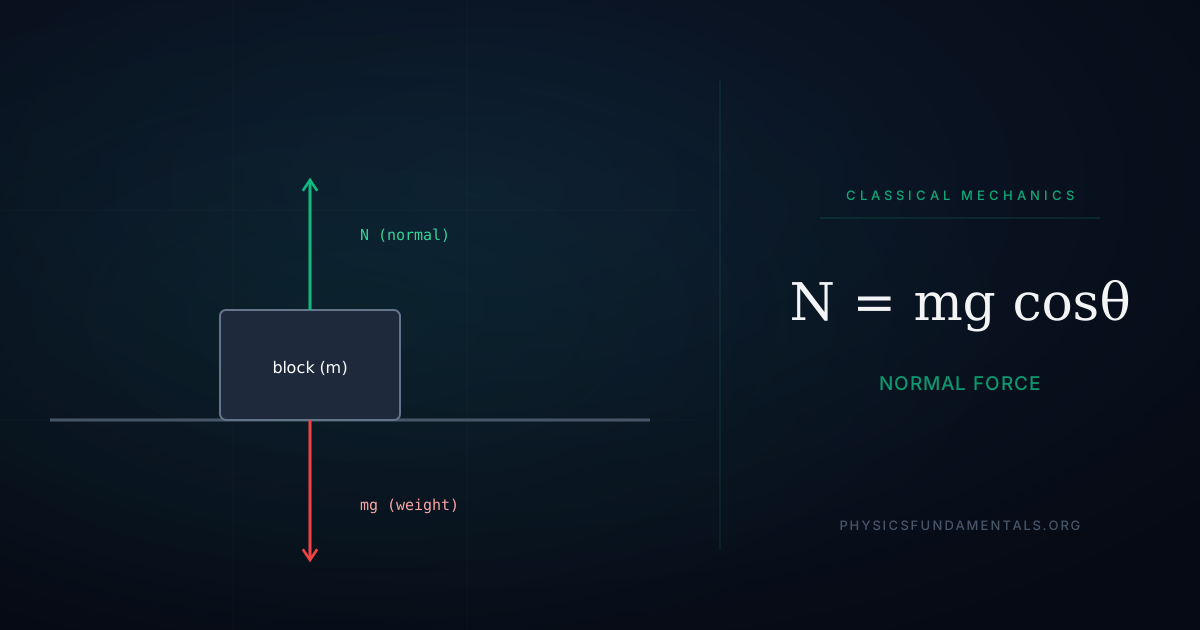
For an object of mass m resting on a flat horizontal surface with no vertical acceleration, Newton's second law (vertical direction) gives:
The normal force equals the weight. This is the most familiar case — but it is a special result, not a universal rule. The normal force equals mg only when:
• The surface is horizontal
• There are no other vertical forces
• The object has no vertical acceleration
Change any of these conditions and N ≠ mg.
Normal Force on an Inclined Plane
On a slope at angle θ to the horizontal, the weight component perpendicular to the surface is mg cosθ:
As θ increases (steeper slope), N decreases. At θ = 90° (vertical wall), N = 0 — a vertical wall exerts no upward normal force on an object resting against it (only a horizontal one). This is why friction force f = μN also decreases on steeper slopes.
Worked example: Block on a slope
A 5 kg block sits on a 40° incline. Find the normal force.
Compare to weight on flat ground: mg = 49 N. The slope reduces the normal force by cos40° = 23.4%.
Normal Force in a Lift (Elevator)
In a lift accelerating upward at a (a > 0), Newton's second law vertically:
You feel heavier — the floor pushes harder on you. In a lift accelerating downward at a:
You feel lighter. In free fall (a = g downward): N = m(g − g) = 0 — apparent weightlessness. Astronauts in orbit are in continuous free fall around Earth — the normal force from their spacecraft floor is zero, giving the sensation of weightlessness despite gravity being nearly as strong as at Earth's surface.
| Situation | Normal force | Apparent weight |
|---|---|---|
| At rest / constant velocity | N = mg | Normal |
| Accelerating upward | N = m(g + a) | Heavier |
| Accelerating downward | N = m(g − a) | Lighter |
| Free fall (a = g down) | N = 0 | Weightless |
| On inclined plane (angle θ) | N = mg cosθ | Reduced |
Normal Force in Circular Motion
At the bottom of a valley or loop: the object follows a circular path — centripetal acceleration is upward. Newton's second law (upward positive):
N > mg — you feel pressed into the seat at the bottom of a roller coaster.
At the top of a loop or hill: centripetal acceleration is downward.
N < mg — you feel lighter at the top of a hill. If v² = gr, then N = 0 — the track exerts no force and you are momentarily weightless (the minimum speed to maintain contact). Below this speed, N would need to be negative — impossible for a surface that can only push — so contact is lost and the object flies off the track.
Normal force equals weight (N = mg) only on a flat, horizontal surface with no vertical acceleration and no additional vertical forces. Add an angle, vertical acceleration, circular motion, or an applied force with a vertical component, and N ≠ mg. Always apply Newton's second law perpendicular to the surface to find the actual normal force in each situation.
Why Is It Called "Normal"?
In mathematics and physics, "normal" means perpendicular. The normal force acts perpendicular (normal) to the contact surface, not along it. The component of contact force along the surface is friction. Together, the normal force and friction are the two components of the total contact force between surfaces: one perpendicular (normal), one parallel (friction).
Frequently Asked Questions
What Is the Normal Force?
The normal force N (also written F_N) is the contact force exerted by a surface on an object resting on it, perpendicular to the surface. "Normal" means perpendicular — not ordinary. It is a reaction force: the surface pushes back against whatever is pressing into it. On a flat horizontal surface, the normal force on a stationary object equals its weight: N = mg. But on inclines, or with additional vertical forces, the normal force changes.
Worked Examples
Flat surface: 5 kg block on a horizontal floor. N = mg = 5 × 9.8 = 49 N upward.
Inclined plane: 3 kg block on a 30° ramp. N = mg cos 30° = 3 × 9.8 × 0.866 = 25.5 N perpendicular to the ramp surface.
Elevator accelerating upward: 70 kg person in an elevator accelerating upward at 2 m/s². N − mg = ma → N = m(g + a) = 70 × 11.8 = 826 N.
Elevator in free fall: a = −g → N = m(g − g) = 0 N. Apparent weightlessness — the person floats.
Normal Force on an Incline
On a slope at angle θ, resolve the weight mg into components: perpendicular to surface (mg cos θ) and parallel to surface (mg sin θ). For a stationary object, the normal force balances the perpendicular component: N = mg cos θ. As θ increases, cos θ decreases — so N decreases. At θ = 90° (vertical wall), N = mg cos 90° = 0 — no normal force (the wall provides no support for weight). The normal force always acts perpendicular to the surface, never parallel to it.
Normal Force and Friction
Friction force depends directly on the normal force: f = μN. This is why heavier objects are harder to slide — larger weight → larger N → larger friction. On an incline, N = mg cos θ (less than on flat ground), so friction is reduced. This is why wet inclined roads are particularly dangerous: both N and μ are reduced, drastically lowering the available friction force.
Frequently Asked Questions
What is the normal force?
The normal force is a contact force exerted by a surface on an object, directed perpendicular (normal) to the surface. It is a reaction force — the surface pushes back against the object pressing into it. On a horizontal surface with no other vertical forces, N = mg (weight). On inclined surfaces: N = mg cos θ. With additional applied forces: N changes accordingly. The normal force never acts parallel to the surface — that's the role of friction. It prevents objects from falling through surfaces.
Is the normal force always equal to weight?
No — N = mg only for a stationary object on a horizontal surface with no other vertical forces. Situations where N ≠ mg: on an incline (N = mg cos θ, less than weight); in an accelerating elevator (N = m(g ± a)); when additional vertical forces are applied (a hand pushing down increases N; a rope pulling up decreases N); in circular motion over a hill or in a dip (N differs from mg by the centripetal force). Always find N by applying Newton's second law in the direction perpendicular to the surface.
Why do you feel heavier in an upward-accelerating lift?
In an upward-accelerating lift, the normal force from the floor must provide both your weight support and the upward net force for acceleration: N − mg = ma → N = m(g + a). The normal force exceeds your weight, making you feel pressed into the floor — apparent weight increases. Your scales would read N/g = m(g+a)/g = m(1+a/g), which is greater than your actual mass m. At acceleration a = g (e.g. rocket launch at 2g): apparent weight = 2mg, double your normal weight. This is the same effect that causes g-force in aircraft and on roller coasters.
What is the normal force at the top of a loop?
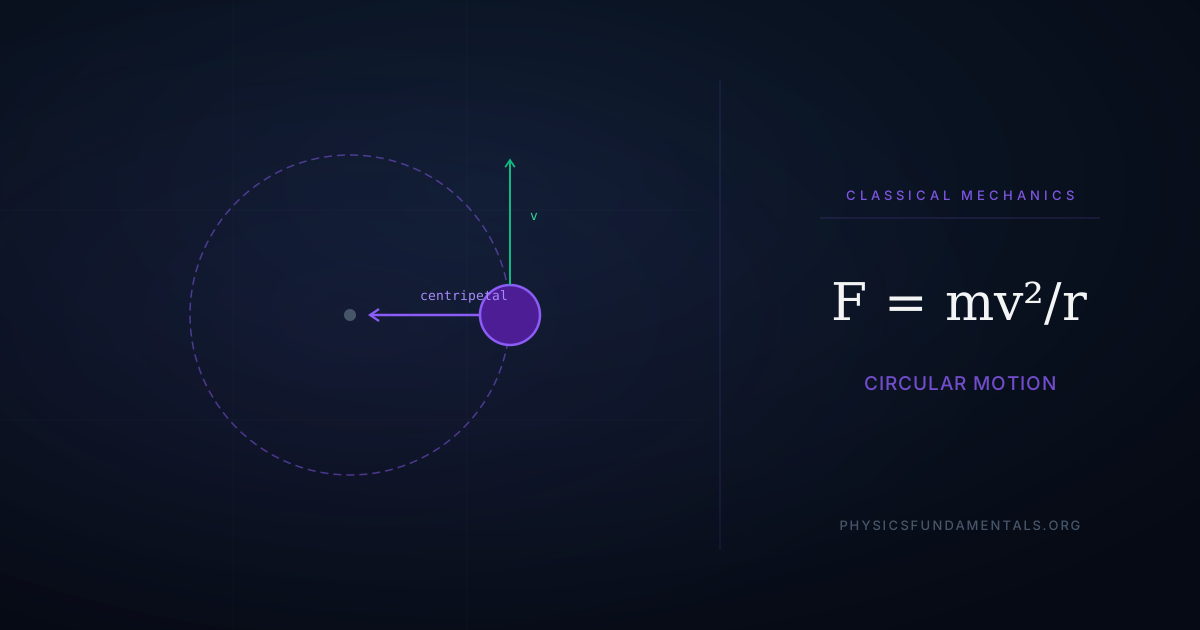
At the top of a circular loop, both the normal force N and weight mg point toward the centre (downward). Centripetal force requirement: N + mg = mv²/r. So N = mv²/r − mg. The minimum speed to maintain contact (N = 0): v_min = √(gr). Below this speed, the object falls away from the track before completing the loop. At v_min, N = 0 — the track provides no force; gravity alone supplies the centripetal acceleration. This is why roller coasters have minimum speed requirements at loop tops.
Can the normal force be zero or negative?
The normal force can be zero (when the object just loses contact with the surface), but it cannot be negative for ordinary surfaces. Surfaces can push but not pull — they can only push perpendicular to themselves. When N = 0, the object is about to leave the surface (e.g. a roller coaster cresting a hill too fast, or an object in free fall). If calculations give N < 0, the object has left the surface and the surface is no longer in contact — the normal force constraint no longer applies and the object is in free flight.
Normal Force in Engineering
Structural engineers calculate normal forces in columns, beams, and foundations constantly. A column supporting a floor load must provide a normal (compressive) force equal to the weight above. Reinforced concrete columns can support compressive normal forces of tens of megaNewtons. Bridges transfer loads through a network of normal and shear forces — the pylons of a cable-stayed bridge carry enormous compressive normal forces while the cables carry tensile forces. Understanding normal forces is fundamental to calculating whether a structure will collapse under its design loads plus safety factors.
What is the normal force?
The normal force is the contact force exerted by a surface on an object, acting perpendicular to the surface. It prevents objects from passing through solid surfaces. Its magnitude adjusts to satisfy Newton's second law — it is not always equal to the weight of the object.
Is the normal force always equal to weight?
No. N = mg only on a horizontal surface with no vertical acceleration and no extra vertical forces. On an inclined plane: N = mg cosθ. In an accelerating lift: N = m(g ± a). In circular motion at the top of a loop: N = m(g − v²/r). Always apply Newton's second law perpendicular to the surface.
Can the normal force be zero?
Yes — in free fall, the normal force from the floor is zero (N = m(g−g) = 0), producing apparent weightlessness. At the top of a circular loop, N = 0 when v² = gr — the minimum speed to maintain contact. Below this speed the object loses contact with the surface because surfaces cannot pull, only push.
What is the relationship between normal force and friction?
Friction force = μN. Normal force and friction are the two perpendicular components of the total contact force: normal force acts perpendicular to the surface; friction acts parallel to it. Because friction depends on N, anything that changes the normal force (slope angle, acceleration, applied forces) also changes the friction force.
Why do you feel heavier in a lift accelerating upward?
The floor must provide both the upward force to support your weight (mg) and the upward net force to accelerate you (ma). Total normal force = m(g + a) > mg. The greater force the floor exerts on you is what you perceive as increased weight — your bathroom scales would show a higher reading. Your actual mass and gravitational weight are unchanged.
Share this article
Written by
Physics Fundamentals Editorial Team
Written and reviewed by our team of physics educators. Content is aligned with A-Level, GCSE, AP Physics, and undergraduate curricula.
About Physics Fundamentals →