Lift a 10 kg box one metre in one second versus one minute — the work done is the same, but the second case feels much easier. What's different is the rate at which you do that work. That rate is power. Power is one of the most practically important concepts in physics, appearing everywhere from the kilowatt-hours on your electricity bill to the horsepower rating of a car engine, from the wattage of a light bulb to the megawatts of a wind turbine.
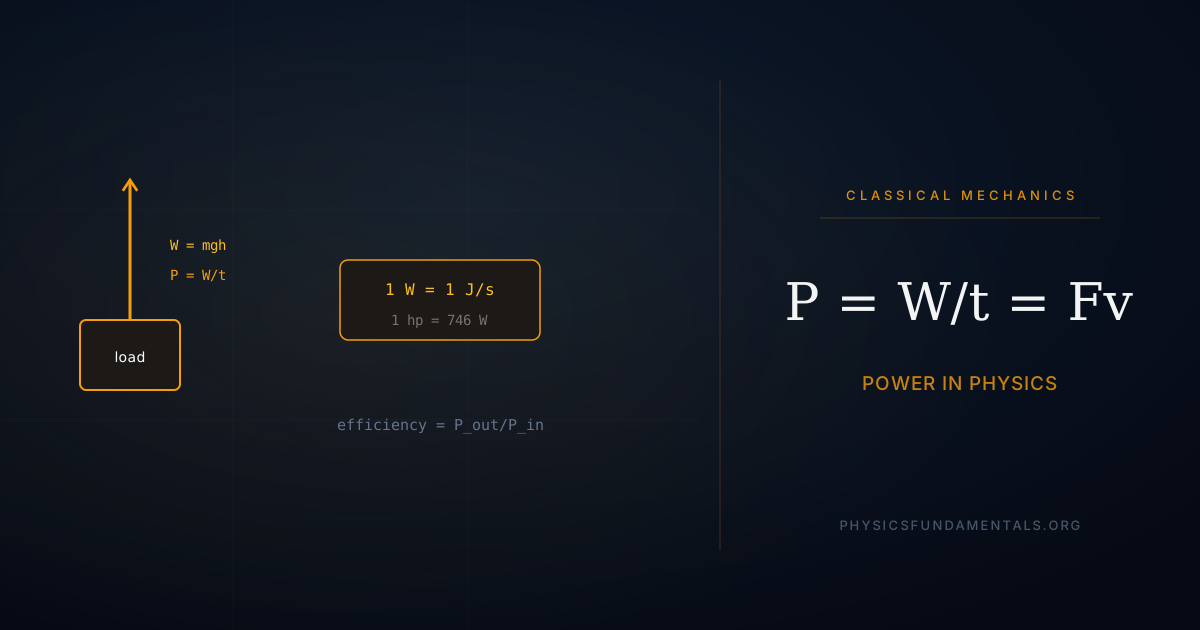
P = W / t
P = power (watts, W)
W = work done (joules, J)
t = time taken (seconds, s)
Power is the rate of doing work or transferring energy. 1 watt = 1 joule per second.
Alternative form: P = Fv (force × velocity)
What Is Power in Physics?
Power is the rate at which work is done or energy is transferred. Two machines that do the same work but take different amounts of time have different power outputs — the faster one is more powerful.
Formally: if work W is done in time t, then average power P = W/t. The SI unit of power is the watt (W), named after James Watt. 1 watt = 1 joule per second.
Power can also be expressed as P = F × v when a constant force F produces motion at velocity v. This is derived directly from P = W/t: since W = Fd and v = d/t, we get P = Fd/t = Fv.
The Power Formula P = W/t
Where work done W = F × d × cos θ (force times displacement times cosine of the angle between them). Substituting:
When force and velocity are in the same direction (θ = 0, cos θ = 1):
This form is especially useful for vehicles: knowing the driving force and speed gives power output directly, without needing to know the time interval.
Units of Power
The SI unit is the watt (W): 1 W = 1 J/s. For larger powers:
| Unit | Value | Typical use |
|---|---|---|
| Milliwatt (mW) | 10⁻³ W | Laser pointer, LED indicator |
| Watt (W) | 1 W | Light bulb, phone charger |
| Kilowatt (kW) | 10³ W | Electric kettle, car engine |
| Megawatt (MW) | 10⁶ W | Power station output, wind farm |
| Gigawatt (GW) | 10⁹ W | National grid demand, nuclear plant |
The non-SI unit horsepower (hp) is still common for engines: 1 hp = 745.7 W. James Watt defined it (somewhat arbitrarily) based on the estimated power of a draft horse, and used it to market his steam engines — "my engine is equivalent to X horses."
Worked Example 1: Lifting a Load
A crane lifts a 500 kg steel beam 12 m vertically in 8 seconds. Calculate the crane's output power.
Step 1: Work done against gravity = mgh = 500 × 9.8 × 12 = 58,800 J
Step 2: Power = W/t = 58,800 / 8 = 7,350 W = 7.35 kW
In practice, the crane motor would need more power than this to account for mechanical inefficiencies — friction in the gears, motor losses, etc. The 7.35 kW is the useful output power.
Worked Example 2: Car Engine Power
A car travels at a constant 30 m/s on a level road. The driving force from the engine is 800 N (balancing air resistance and friction). Find the engine's output power.
At constant speed, all the engine power goes into overcoming resistive forces. This is actually quite modest — a typical family car engine can produce 100–150 kW at maximum output; 24 kW represents gentle cruising.
Worked Example 3: Human Power Output
A 70 kg cyclist climbs a hill gaining 50 m of height in 2 minutes (120 s). What is their average power output (ignoring air resistance)?
Work done = mgh = 70 × 9.8 × 50 = 34,300 J
A trained cyclist can sustain ~250–400 W for extended periods. Elite cyclists sustain ~400–500 W during a climb, with peak sprint powers exceeding 1,500 W. In comparison, the average person can sustain only 70–100 W continuously.
Worked Example 4: Efficiency and Power
An electric motor has input power 2.5 kW and lifts a load at output power 1.8 kW. Find the efficiency.
The remaining 28% (700 W) is dissipated as heat due to friction in bearings, electrical resistance in windings, and other losses. Real motors typically achieve 85–95% efficiency; this example is on the lower end.
Power in Electrical Circuits
In electrical circuits, power has its own form. Since work done moving charge Q through potential difference V is W = QV, and current I = Q/t:
Combined with Ohm's Law (V = IR), this gives three equivalent forms for electrical power:
A 100 W light bulb connected to 230 V mains draws I = P/V = 100/230 = 0.435 A of current. Its resistance is R = V/I = 230/0.435 = 529 Ω (when at operating temperature — cold resistance is much lower).
Electrical energy consumed is measured in kilowatt-hours: 1 kWh = 1 kW × 1 hour = 3,600,000 J = 3.6 MJ. Your electricity meter counts kWh.
Real-World Power Comparisons
Understanding power requires a sense of scale. A human at rest dissipates about 80 W as metabolic heat — roughly the same as an old incandescent light bulb. A person climbing stairs works at ~200 W. A car engine produces 100–200 kW. A commercial aircraft at cruise burns about 30–50 MW of fuel energy. A large nuclear power station outputs ~1 GW. The total power consumption of the UK electricity grid is about 30–50 GW. The Sun radiates 3.846 × 10²⁶ W — a number that makes human-scale power look microscopic.
Power and the Work-Power Calculator
Solving P = W/t or P = Fv numerically is quick once you have the variables — use the work-power calculator to handle unit conversions and verify your answers. For the underlying concept of work done, see the work done in physics article.
Historical Context
The concept of power was formalised by James Watt in the late 18th century as he tried to convince mine owners to buy his steam engines. He defined "horsepower" by measuring how much work a mill horse could sustain in an hour — multiplying force by distance per minute. His engines outperformed horses reliably on this measure, and the metric sold the machines. The SI unit watt was named in his honour in 1960.
The formal physics definition — power as the time derivative of work, P = dW/dt — was established in the 19th century as mechanics was being mathematised. For variable power, P = dW/dt and total work W = ∫P dt.
Common Mistakes
Confusing power and energy. Power is J/s (rate); energy is J (total). "100 W for 1 hour" is not 100 J — it's 100 × 3600 = 360,000 J = 0.1 kWh.
Using the wrong W. In P = W/t, W is work done in joules — not watts. The symbol clash between watt (the unit W) and work (the quantity W) is a genuine source of confusion. Many textbooks use E for energy/work to avoid this.
Forgetting to check the angle in P = Fv. If force and velocity aren't parallel, P = Fv cos θ. A force perpendicular to velocity (like the normal force on a banked turn) does zero work and contributes zero power.
Frequently Asked Questions
Common Mistakes with Power Calculations
Confusing instantaneous and average power. P = W/t gives average power over time t. A car engine doesn't run at constant power — it varies with speed and throttle. Peak power (what manufacturers advertise) is the maximum achievable; typical cruising power is much lower. For variable power, instantaneous power P = dW/dt requires calculus.
Forgetting efficiency. Input power ≠ output power. A motor rated at 5 kW input that is 80% efficient delivers only 4 kW of useful mechanical output. Always be clear which power you're calculating: input, output, or wasted.
Unit errors between horsepower and watts. 1 horsepower ≠ 1 watt. 1 hp = 745.7 W. A "100 hp" car engine produces ~74.6 kW, not 100 kW. Metric horsepower (PS, used in European car specs) is slightly different: 1 PS = 735.5 W.
Power in Nature
A striking way to understand power scales: the average human metabolic power is about 80 W at rest (this is why a room full of people gets warm — 30 people = 2,400 W of body heat). During vigorous exercise, this rises to 400–800 W. An elite Tour de France cyclist on a mountain climb sustains ~450 W for 30–40 minutes — and the total mechanical output of 200 such cyclists would still be less than one kilowatt of electrical household heating.
Lightning discharges about 10⁹ J of energy in roughly 0.2 seconds — a peak power of ~5 × 10⁹ W (5 GW). However, this is spread over a tiny fraction of a second and a small volume, making it spectacular but actually carrying less total energy than running a kettle for 15 minutes.
The Sun outputs 3.846 × 10²⁶ W. Earth intercepts about 1.74 × 10¹⁷ W of this — roughly 10,000 times current global human energy consumption. The solar constant at Earth's distance is about 1,361 W/m² — the power falling on each square metre of Earth's upper atmosphere facing the Sun.
What is power in physics?
Power is the rate at which work is done or energy is transferred. It is calculated as P = W/t, where W is work done in joules and t is time in seconds. The SI unit is the watt (W), where 1 watt = 1 joule per second. Two machines can do the same total work but have very different power outputs if they take different amounts of time — the faster one has higher power.
What is the formula for power in physics?
The main formula is P = W/t (power = work done ÷ time). For a constant force producing motion, this becomes P = Fv (force × velocity). In electrical circuits, power is P = IV = I²R = V²/R. All these are equivalent expressions of the same concept — energy transfer rate — applied to different physical contexts.
What is the SI unit of power?
The SI unit of power is the watt (W), named after James Watt. 1 watt = 1 joule per second. Common multiples include the kilowatt (kW = 10³ W), megawatt (MW = 10⁶ W), and gigawatt (GW = 10⁹ W). The non-SI unit horsepower (hp) is still used for engines: 1 hp = 745.7 W.
What is the difference between power and energy?
Energy (measured in joules) is the total amount of work done or heat transferred. Power (measured in watts) is the rate of energy transfer — joules per second. Doubling the power but keeping the time the same doubles the energy transferred. Running a 100 W bulb for 1 hour transfers 100 × 3600 = 360,000 J = 0.1 kWh of energy. Power tells you how fast; energy tells you how much total.
What does P = W/t mean?
P = W/t means: power equals work done divided by time taken. If you do 1,000 joules of work in 10 seconds, your average power is 1000/10 = 100 W. If you do the same 1,000 J in 5 seconds, your power is 200 W. The faster you do work, the greater the power. W here is work in joules, not the unit watt — a common notation confusion to watch out for.
What is P = Fv and when is it used?
P = Fv is an alternative form of the power formula for situations involving a constant force F producing motion at velocity v. It follows from P = W/t because W = Fd and v = d/t, giving P = Fd/t = Fv. It's especially useful for vehicles: if you know the driving force and speed, you can calculate engine power without needing to know the time interval. If force and velocity aren't parallel, it becomes P = Fv cos θ.
Share this article
Written by
Physics Fundamentals Editorial Team
Written and reviewed by our team of physics educators. Content is aligned with A-Level, GCSE, AP Physics, and undergraduate curricula.
About Physics Fundamentals →