Every object launched into the air — a basketball, a cannonball, a water droplet from a fountain — traces the same distinctive curved path under gravity alone. That curve is a parabola, one of the most elegant shapes in mathematics. But why a parabola specifically? Not a circle, not a hyperbola, not some irregular squiggle — always and precisely a parabola. The answer reveals something deep about how Newton's laws and mathematics are connected.
What Is a Parabola?
A parabola is the curve defined by the equation y = ax² + bx + c, where a ≠ 0. It's a symmetric U-shape (or inverted U) with a single vertex (the highest or lowest point) and two arms that spread outward indefinitely. Parabolas appear throughout physics and engineering: the reflective dish of a satellite antenna, the cables of a suspension bridge under uniform load, the mirror of a reflecting telescope — all parabolic.
In projectile motion, the parabola is inverted (opening downward, because gravity pulls down). The vertex is the highest point of the trajectory. Understanding why this shape emerges requires breaking the motion into two independent components.
The Key Insight: Two Independent Motions
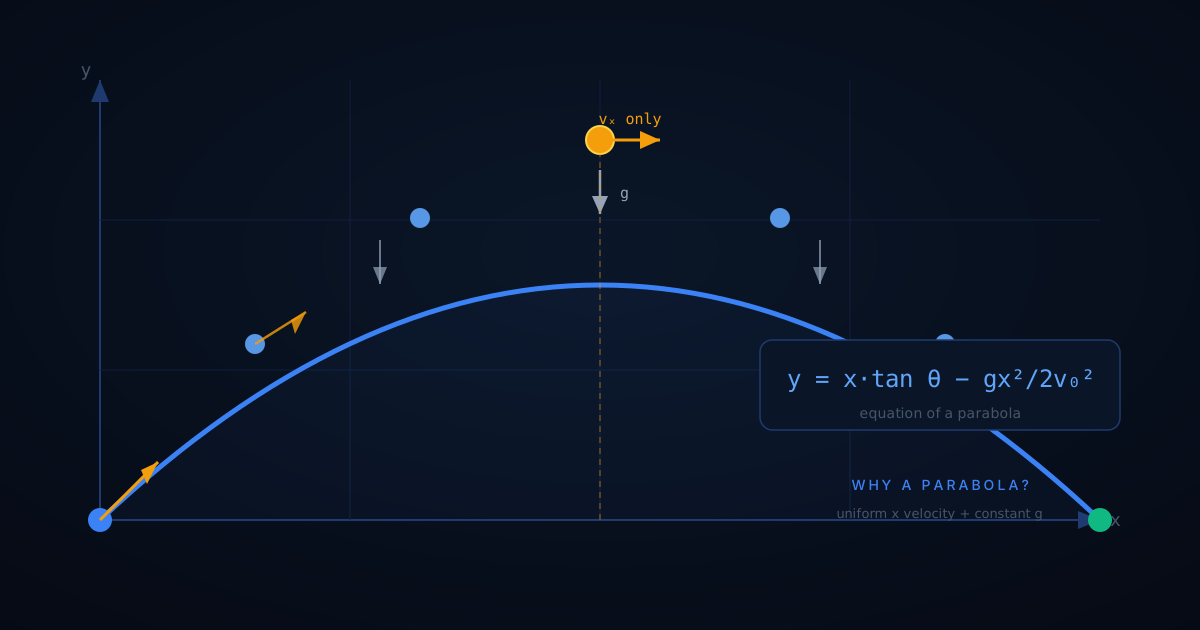
The most important idea in projectile motion — the one that makes the whole analysis clean and tractable — is that horizontal and vertical motion are completely independent. This is a direct consequence of Newton's second law: F = ma applied separately to each direction.
Horizontally, there is no force (ignoring air resistance). So by Newton's first law, horizontal velocity is constant throughout the flight. The object moves the same horizontal distance in every equal time interval.
Vertically, gravity acts downward with constant acceleration g ≈ 9.8 m/s². The vertical velocity changes continuously — slowing on the way up, stopping at the peak, speeding up on the way down.
Diagram — Horizontal & Vertical Components of Projectile Motion
The Mathematical Derivation
Let's derive the parabolic shape rigorously. Start with a projectile launched from the origin with speed v₀ at angle θ above the horizontal.
The initial velocity components are:
Since horizontal acceleration is zero and vertical acceleration is −g (downward):
Now eliminate time. From the x equation:
Substitute into the y equation:
Simplify:
This is exactly of the form y = bx + ax² — a quadratic in x. A quadratic equation in two variables is precisely the definition of a parabola. The shape falls directly out of the mathematics of constant acceleration. There is no other possibility.
The Shape of the Trajectory Under Gravity Alone
The phrase "under gravity alone" in your question is crucial. It's the condition that makes the trajectory a perfect parabola. If any other force acts — air resistance, wind, thrust — the path deviates from a parabola. In real life, a football or a bullet doesn't trace a perfect parabola because air resistance matters. But for a dense, slow-moving object over short distances, the parabola is an excellent approximation.
Diagram — Same Speed, Different Launch Angles
Key Results from the Parabolic Equations
Once you have the parabolic equation, several important results follow directly:
Maximum height — reached when vertical velocity = 0:
Time of flight — total time in the air (set y = 0, solve for t):
Range — horizontal distance covered:
The range formula reveals a beautiful symmetry: since sin(2θ) = sin(180° − 2θ), launch angles of θ and (90° − θ) give the same range. A projectile launched at 30° travels the same horizontal distance as one launched at 60° — just with a very different flight path. And the maximum range occurs at θ = 45°, where sin(2θ) = sin(90°) = 1.
Why This Matters Beyond Textbook Problems
The parabolic trajectory isn't just a mathematical curiosity. It's the foundation for understanding:
Ballistics — the trajectory of shells, bullets, and rockets in the absence of air resistance. Real ballistics is more complex, but the parabola is the zeroth-order approximation that all refinements build on.
Sports physics — the optimal angle for throwing a javelin or putting a shot put (close to 45°, modified by the height advantage of release). The arc of a basketball free throw. The angle a ski jumper wants at takeoff.
Satellite orbits — here's the surprising connection. Newton himself recognized that if you throw a ball fast enough horizontally, it never lands because Earth's surface curves away as fast as the ball falls. An orbit is a projectile motion in which the "ground" continuously curves away. The transition from a parabolic arc to a circular orbit to an elliptical orbit is a matter of launch speed — and it leads directly to Newton's law of universal gravitation.
Conservation of energy — projectile motion is one of the cleanest examples of kinetic and potential energy exchanging continuously. At launch and landing (same height), KE is maximum. At the peak, KE is at a minimum (horizontal component only) and PE is at maximum. The total mechanical energy is constant throughout — provided air resistance is negligible.
The Connection to Conic Sections
A parabola is one of four conic sections — the curves you get by slicing a cone at different angles. A circle, an ellipse, a parabola, and a hyperbola are all conic sections. This connection runs surprisingly deep in physics:
Under an inverse-square gravitational force (like the one between Earth and any projectile), all possible trajectories are conic sections. The specific shape depends on the object's energy. Negative total energy (bound orbit): ellipse (or circle as a special case). Zero total energy: parabola. Positive total energy: hyperbola. Near the surface of Earth, where gravity is approximately constant rather than inverse-square, the ellipse degenerates to a parabola — which is exactly what we derived. The parabola is the dividing line between bound and unbound motion in gravitational fields, making it one of the most physically significant curves in all of mechanics.
Understanding why projectile motion is parabolic thus opens a window into orbital mechanics and gravitational physics — one of the most beautiful areas of classical physics, and the foundation on which our entire understanding of celestial motion is built
The Mathematical Proof
Starting from the parametric equations of projectile motion with launch speed u at angle θ:
From the first equation: t = x/(u cos θ). Substitute into the second:
This has the form y = Ax − Bx², where A = tan θ and B = g/(2u² cos²θ) are constants. This is the equation of a parabola — a conic section with vertex at the highest point of the trajectory.
Why a Parabola and Not an Ellipse or Circle?
The parabolic trajectory assumes uniform gravitational acceleration (constant g). In reality, gravity follows an inverse-square law — g decreases with altitude. For very long-range projectiles (intercontinental ballistic missiles), the path is actually an ellipse, not a parabola — specifically, a partial ellipse around the Earth's centre of mass (Kepler orbit). A parabola is the limiting case of a very elongated ellipse when the launch speed is much less than orbital velocity. At typical human scales (heights ≪ Earth's radius), g is effectively constant and the parabolic approximation is accurate to many decimal places.
Effect of Air Resistance on the Shape
Air resistance makes real trajectories non-parabolic and asymmetric. The optimal angle for maximum range drops below 45° (typically 30–38° for sports balls, bullets, and shells). The descending path is steeper than the ascending path. The maximum height is lower. For artillery shells, aerodynamic lift can actually extend range beyond the no-air-resistance calculation — rifled projectiles gain aerodynamic stability from spin. Naval long-range guns must also account for the Coriolis effect (Earth's rotation) for targets over 10 km away.
The Parabola in History
Galileo was the first to prove projectile trajectories are parabolic (around 1608). He did this by rolling balls off inclined planes and measuring their trajectories, showing horizontal displacement ∝ t while vertical displacement ∝ t². Before Galileo, it was believed (following Aristotle) that cannonballs travelled in a straight line until their "force" was exhausted, then fell straight down. Galileo's parabolic trajectory was one of the most important results in the development of mechanics — it showed that gravity and horizontal motion are independent, which Newton later formalised as the principle of superposition of forces.
Frequently Asked Questions
Why is projectile motion a parabola?
Projectile motion produces a parabolic trajectory because horizontal displacement is proportional to time (x ∝ t) while vertical displacement is proportional to time squared (y ∝ t² due to constant gravitational acceleration). Eliminating t from these equations gives y = Ax − Bx², the equation of a parabola. The key assumptions are: constant gravitational acceleration g (uniform gravitational field) and no air resistance. In reality, the path is a very elongated ellipse (Keplerian orbit), but the parabolic approximation is excellent for objects travelling much smaller distances than Earth's radius.
Is projectile motion really a parabola in real life?
Only approximately. Three factors make real trajectories non-parabolic: (1) Earth's gravity is not perfectly uniform — it decreases with altitude (inverse-square law), making the true path a section of an ellipse. For anything less than intercontinental range, this correction is negligible. (2) Air resistance changes the shape, making the descending path steeper than the ascending path, reducing range, and shifting the optimal angle below 45°. (3) Earth's rotation (Coriolis effect) deflects long-range projectiles. For everyday scales and speeds, the parabola is an excellent approximation — error is less than 0.01% for a 100 m throw.
What is the vertex of the projectile parabola?
The vertex (turning point) of the parabolic trajectory is the maximum height point, where vertical velocity is zero. In the equation y = x tan θ − gx²/(2u² cos²θ), the vertex occurs at x = u² sin θ cos θ / g = (u² sin 2θ)/(2g) and y = (u sin θ)²/(2g). The vertex is the highest point of the trajectory — directly above the midpoint of the horizontal range (since the parabola is symmetric about the vertical through the vertex). After the vertex, the projectile descends on a mirror-image path.
Did Galileo really discover projectile motion is parabolic?
Yes — Galileo proved projectile trajectories are parabolic in his "Discourses and Mathematical Demonstrations Relating to Two New Sciences" (1638), though the experiments were conducted around 1608. He showed by experiment that a ball rolling off a table travels horizontal distances proportional to time while falling vertical distances proportional to time squared — which, when combined, give a parabola. Before Galileo, the prevailing view (following Aristotle) was that cannonballs flew straight before falling vertically — the concept of the two motions being simultaneously independent was revolutionary.
Why does the optimal launch angle for maximum range change with air resistance?
Without air resistance, maximum range occurs at 45° because the range formula R = u² sin 2θ / g is maximised when sin 2θ = 1, i.e. θ = 45°. With air resistance, the drag force (proportional to v²) acts throughout the flight. A lower launch angle means a lower, faster trajectory with less flight time — drag acts for less time. A higher angle means more flight time and more drag. The optimal compromise shifts below 45°, typically to 30–38° depending on the drag coefficient and launch speed. For a golf ball at 70 m/s with drag, the optimal angle is about 38°.
Share this article
Written by
Physics Fundamentals Editorial Team
Written and reviewed by our team of physics educators. Content is aligned with A-Level, GCSE, AP Physics, and undergraduate curricula.
About Physics Fundamentals →