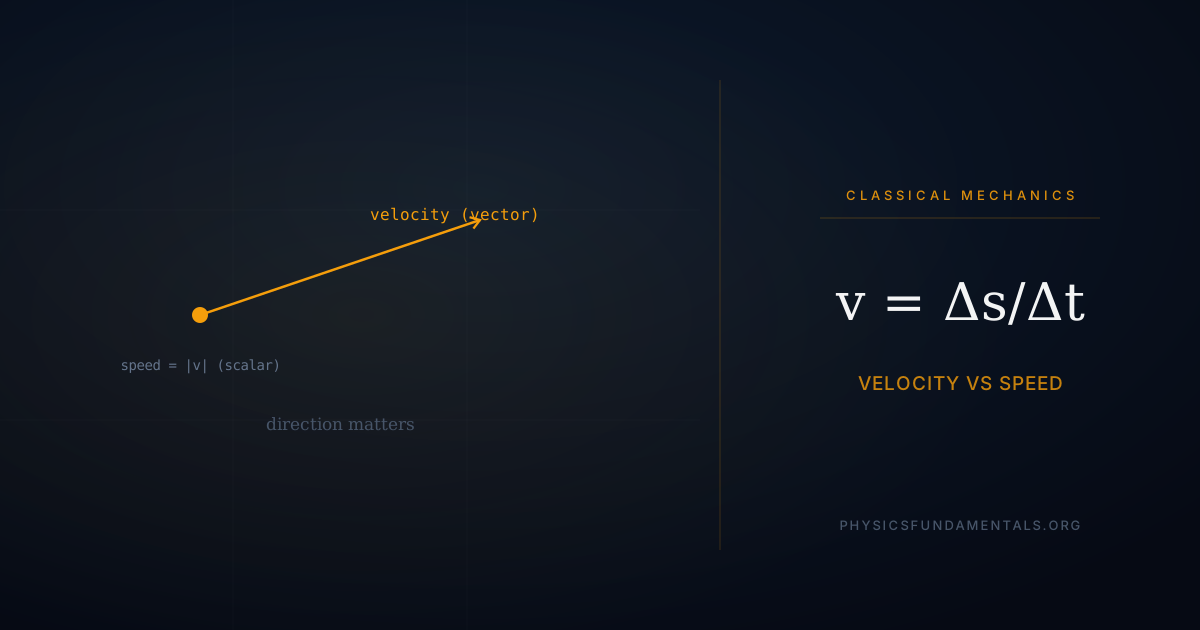
In everyday conversation, "speed" and "velocity" are used interchangeably. In physics, they are fundamentally different quantities — and mixing them up leads to wrong answers. Speed is a scalar: it tells you how fast something is moving, nothing more. Velocity is a vector: it tells you both how fast and in which direction. This distinction isn't pedantic — it's the foundation of all motion analysis in mechanics.
Speed = distance / time (scalar — magnitude only)
Velocity = displacement / time (vector — magnitude AND direction)
Average speed = total distance / total time
Average velocity = total displacement / total time
Units: both measured in m/s (or km/h, mph, etc.)
What Is Speed?
Speed is the rate of change of distance — how much distance is covered per unit time. It is always positive (or zero). A car travelling at 60 km/h has a speed of 60 km/h regardless of whether it's going north, south, left, or right. Speed doesn't care about direction.
The SI unit of speed is metres per second (m/s). Other common units: km/h (÷ 3.6 to convert to m/s), mph (× 0.447 to convert to m/s), knots (1 knot = 0.514 m/s).
What Is Velocity?
Velocity is the rate of change of displacement — a vector quantity that includes both speed and direction. Two cars both moving at 60 km/h but in opposite directions have the same speed but opposite velocities.
Velocity can be positive, negative, or zero. The sign indicates direction: by convention, rightward (or upward) is often positive, leftward (or downward) negative. A ball thrown upward at 10 m/s has velocity +10 m/s at launch. On the way down at the same point, its velocity is −10 m/s — same speed (10 m/s) but opposite velocity (−10 m/s).
Distance vs Displacement
The speed/velocity distinction mirrors the distance/displacement distinction:
| Property | Distance | Displacement |
|---|---|---|
| Type | Scalar | Vector |
| Definition | Total path length | Straight-line change in position |
| Sign | Always ≥ 0 | Can be positive, negative, or zero |
| Round trip | 2 × one-way distance | Zero (start = end) |
Example: You walk 3 km north, then 3 km south back to the start. Distance = 6 km. Displacement = 0 km. Average speed = 6 km / time taken. Average velocity = 0 km/h (no net displacement).
Instantaneous vs Average
Average velocity = total displacement / total time. This can be zero even when the object was moving the whole time (e.g. a lap of a circular track).
Instantaneous velocity is the velocity at a specific moment — the limit of Δx/Δt as Δt → 0, which is the derivative dx/dt. On a displacement-time graph, instantaneous velocity is the gradient of the tangent at that point. Average velocity is the gradient of the chord.
Average speed = total distance / total time. This is always ≥ |average velocity|, because the path length is always ≥ the straight-line displacement. They are equal only when the object moves in one direction without turning back.
Worked Example 1: Speed vs Velocity
A car drives 40 km east in 30 min, then 40 km west in 30 min. Find: (a) average speed; (b) average velocity.
(a) Total distance = 80 km; total time = 1 h → average speed = 80 km/h
(b) Total displacement = 0 km (returned to start) → average velocity = 0 km/h
Worked Example 2: Average Velocity from Displacement
A runner runs 100 m north in 12.5 s, then 60 m east in 9 s. Find average velocity (magnitude and direction).
Total displacement: using Pythagoras: d = √(100² + 60²) = √(10000 + 3600) = √13600 = 116.6 m
Total time = 12.5 + 9 = 21.5 s
Direction: θ = arctan(60/100) = 31.0° east of north
Average speed = (100 + 60)/21.5 = 7.44 m/s (larger than average velocity, as expected)
Worked Example 3: Reading Displacement-Time Graphs
A displacement-time graph shows a line from (0, 0) to (4s, 20m), then a horizontal line to (7s, 20m), then a line to (10s, 5m).
Phase 1 (0–4s): gradient = 20/4 = +5 m/s (moving in positive direction)
Phase 2 (4–7s): gradient = 0 → velocity = 0 (stationary)
Phase 3 (7–10s): gradient = (5−20)/(10−7) = −15/3 = −5 m/s (moving in negative direction)
Average speed over 10s = total distance / 10 = (20 + 0 + 15)/10 = 3.5 m/s
Average velocity = displacement/time = 5/10 = 0.5 m/s (positive direction)
Velocity in Newton's Laws and Kinematics
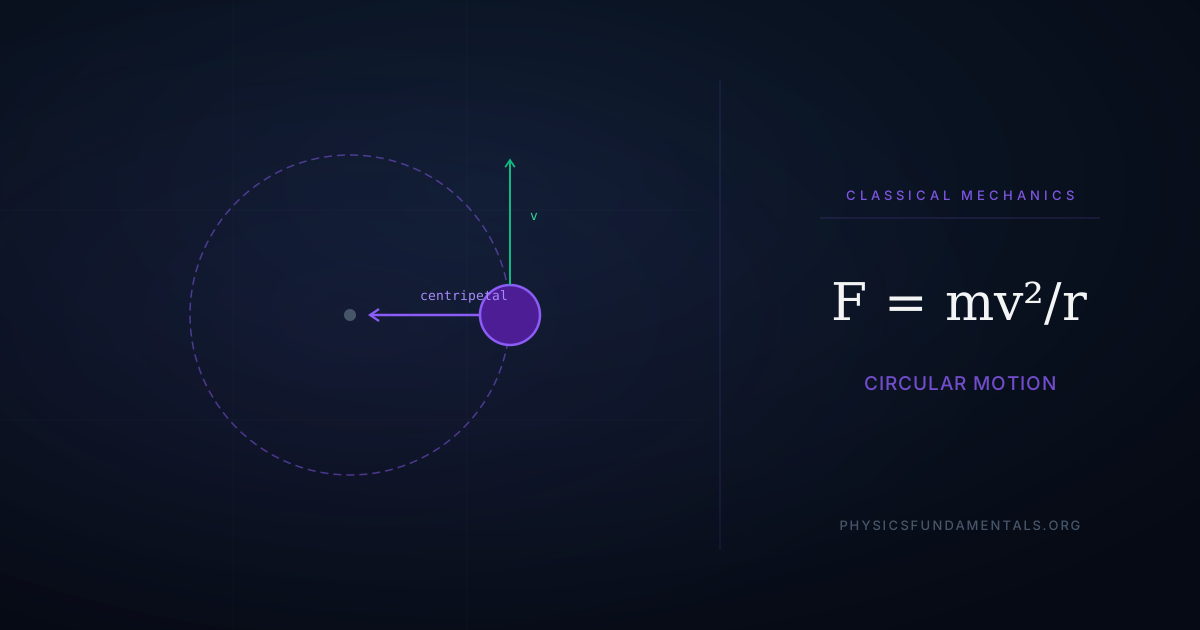
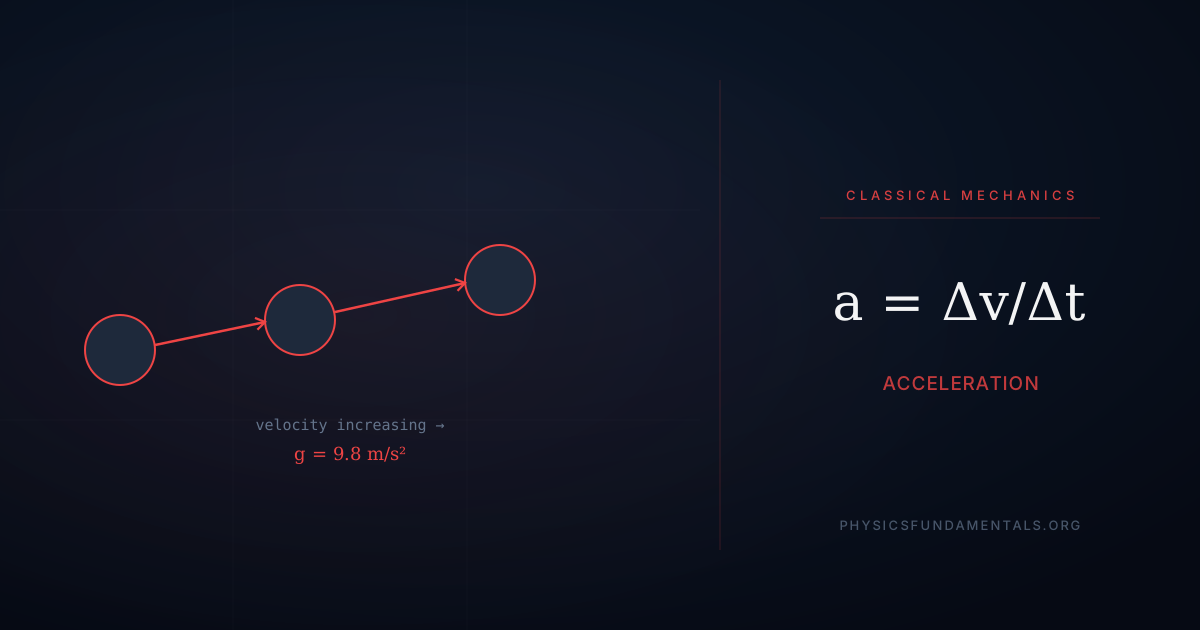
Velocity's vector nature makes it essential in mechanics. Newton's Second Law F = ma relates to changes in velocity, not speed. Acceleration is the rate of change of velocity — a car going around a bend at constant speed is still accelerating (changing direction = changing velocity vector). The centripetal force causing circular motion changes velocity direction without changing speed.
In the SUVAT equations, u and v are velocities (signed quantities), not speeds. Choosing a positive direction and assigning signs correctly to u, v, a, and s is what makes SUVAT work. Using speeds instead of velocities (losing the signs) is one of the most common sources of errors in mechanics problems.
Relative Velocity
Velocity is always measured relative to some reference frame. A passenger walking at 2 m/s toward the front of a train moving at 30 m/s (relative to the ground) has velocity 32 m/s relative to the ground but 2 m/s relative to another passenger.
For two objects A and B, the velocity of A relative to B is: v_AB = v_A − v_B. For two cars approaching head-on at 20 m/s each (taking rightward positive): v_A = +20 m/s, v_B = −20 m/s → v_AB = 20 − (−20) = 40 m/s. The relative approach speed is 40 m/s — which is why head-on collisions are so dangerous compared to rear-end collisions.
Frequently Asked Questions
Velocity in Special Relativity
At everyday speeds, classical velocity addition works: if you walk at 2 m/s on a train moving at 30 m/s, your speed relative to the ground is 32 m/s. At speeds approaching the speed of light c, this breaks down. Special relativity requires relativistic velocity addition:
At everyday speeds (v₁, v₂ ≪ c), the denominator ≈ 1 and we recover classical addition. At v₁ = v₂ = 0.9c: v_total = 1.8c/1.81 = 0.994c — not 1.8c. No matter how you combine sub-light velocities, the result never reaches or exceeds c. This is why the speed of light is a universal speed limit — it's built into the geometry of spacetime, not just a practical engineering constraint.
Terminal Velocity as a Limiting Case
When an object falls through a fluid with drag force opposing motion, it reaches a terminal velocity — the speed at which drag exactly equals gravity, giving zero net force and zero acceleration. Terminal velocity is where speed becomes constant: the object still moves (non-zero speed) but no longer accelerates (constant velocity). This illustrates that constant velocity means zero acceleration — not zero speed. See the free fall and terminal velocity article for the full treatment.
Velocity-Time Graphs
On a velocity-time (v-t) graph, the gradient equals acceleration and the area under the graph equals displacement. A horizontal line means constant velocity (zero acceleration). A sloping line means uniform acceleration. The area between the line and the time axis gives displacement — positive area (above axis) = positive displacement, negative area (below axis) = negative displacement.
For a uniformly accelerating object: the v-t graph is a straight line. Area = ½(u+v)t = displacement — the same as the SUVAT equation s = ½(u+v)t. For non-uniform acceleration: the area must be calculated by integration or approximation (counting grid squares, trapezia rule). This is why v-t graphs are so powerful: they encode velocity, acceleration, and displacement all in one diagram.
Common Mistakes
Treating velocity and speed as interchangeable in calculations. In SUVAT equations, u and v are velocities — they carry signs. Plugging in speeds (always positive) instead of velocities (can be negative) breaks sign conventions and gives wrong answers for problems involving direction changes.
Confusing displacement and distance on graphs. The area under a v-t graph gives displacement (signed), not distance (always positive). If the line crosses the t-axis (velocity changes sign), you must calculate positive and negative areas separately and add the magnitudes to get total distance, or add them directly to get total displacement.
Worked Example 4: Converting Between Speed Units
A car travels at 90 km/h. Convert to m/s and find the distance covered in 25 seconds.
The 3.6 factor comes from: 1 km/h = 1000 m / 3600 s = 1/3.6 m/s. To go the other way (m/s to km/h), multiply by 3.6. A sprinter doing 100 m in 10 s has average speed 10 m/s = 36 km/h.
What is the difference between speed and velocity?
Speed is a scalar quantity — it has magnitude only and tells you how fast an object is moving. Velocity is a vector quantity — it has both magnitude (the speed) and direction. A car travelling at 60 km/h has a speed of 60 km/h. If it's heading north, its velocity is 60 km/h north. Two cars travelling at the same speed in opposite directions have the same speed but opposite velocities. In physics, velocity is more useful than speed because Newton's laws deal with vector quantities — forces cause changes in velocity, not just speed.
Can average speed equal average velocity?
Yes — but only when the object moves in a single direction without changing course. In that case, distance equals the magnitude of displacement, so average speed = |average velocity|. Whenever an object changes direction or returns toward its starting point, total distance is greater than displacement magnitude, so average speed > |average velocity|. If an object completes a full loop and returns to start, average velocity = 0 but average speed > 0.
Can an object have zero velocity but non-zero speed?
No — if velocity is zero, speed is zero, because speed is the magnitude of velocity. They are zero together. However, an object can have zero average velocity but non-zero average speed: a ball thrown up and caught at the same height has zero displacement (zero average velocity) but has travelled up and back (non-zero distance, non-zero average speed). At the instant it reaches maximum height, both instantaneous speed and instantaneous velocity are zero.
How is velocity shown on a displacement-time graph?
On a displacement-time (s-t) graph, velocity at any point equals the gradient (slope) of the graph at that point. A steep positive gradient means high positive velocity (moving fast in the positive direction). A horizontal line means zero velocity (stationary). A negative gradient means negative velocity (moving in the negative direction). The instantaneous velocity at a specific time is the gradient of the tangent to the curve at that point. Average velocity between two times is the gradient of the chord connecting those two points.
What are the units of velocity?
The SI unit of velocity is metres per second (m/s). Other common units: kilometres per hour (km/h; divide by 3.6 to convert to m/s), miles per hour (mph; multiply by 0.447 to convert to m/s), knots (1 knot = 1 nautical mile per hour = 0.514 m/s). Velocity has the same units as speed — the difference is that velocity also carries directional information (expressed as a sign in 1D problems, or as angle and magnitude in 2D problems).
What is instantaneous velocity?
Instantaneous velocity is the velocity of an object at a specific moment in time — the limit of displacement divided by time interval as the time interval approaches zero: v = lim(Δt→0) Δx/Δt = dx/dt. It is the derivative of displacement with respect to time. On a displacement-time graph, it equals the gradient of the tangent at that instant. A car's speedometer shows instantaneous speed (the magnitude of instantaneous velocity). Average velocity gives an overall picture; instantaneous velocity gives the precise state at each moment.
Share this article
Written by
Physics Fundamentals Editorial Team
Written and reviewed by our team of physics educators. Content is aligned with A-Level, GCSE, AP Physics, and undergraduate curricula.
About Physics Fundamentals →