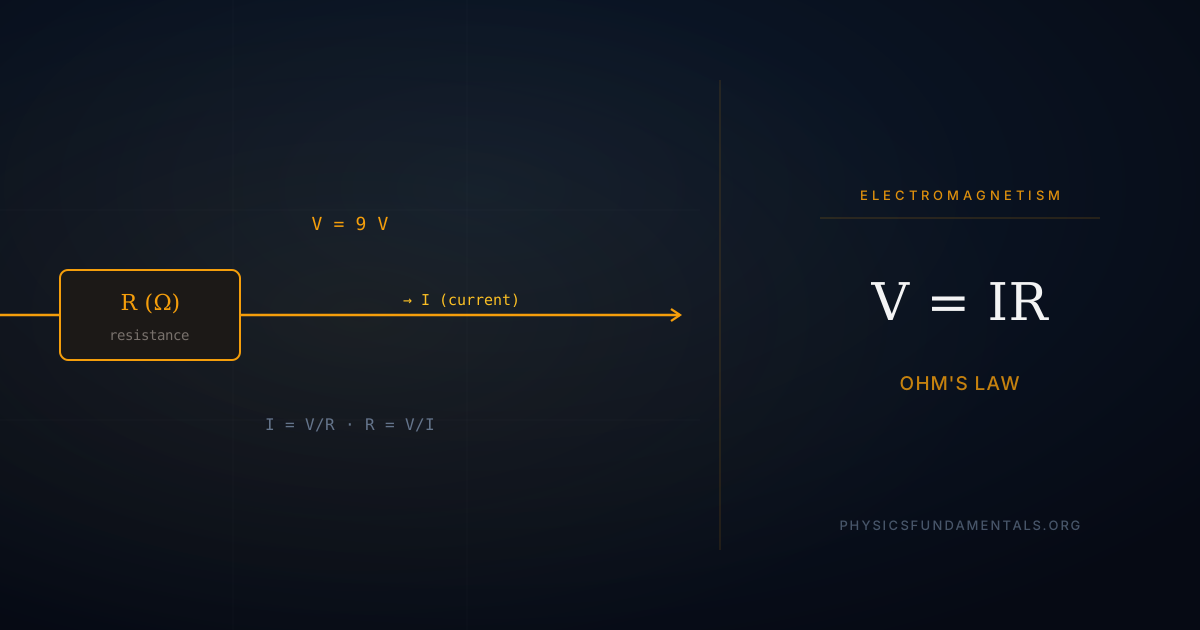

Switch on a light, charge a phone, fire a neuron — every one of these events is driven by electric fields and potentials. The electric field E tells you the force per unit charge at any point in space; the electric potential V tells you the potential energy per unit charge. Together they describe everything from the attraction between a proton and electron to the voltage across a capacitor, and they're linked by one of the most useful equations in electromagnetism: E = F/q and V = kQ/r.
E = F/q — electric field strength (N/C or V/m)
E = kQ/r² — field from a point charge (Coulomb's Law form)
V = kQ/r — electric potential from a point charge
E = V/d — uniform field between parallel plates
W = qV — work done moving charge through potential difference
k = 8.99 × 10⁹ N·m²·C⁻² (Coulomb's constant) = 1/(4πε₀)
What Is Electric Field Strength? E = F/q
The electric field strength E at a point in space is defined as the force per unit positive charge placed at that point:
where F is the force in newtons on a test charge q in coulombs. The unit of E is N/C (newtons per coulomb), which is equivalent to V/m (volts per metre). Electric field is a vector — it has both magnitude and direction. By convention, field lines point in the direction a positive test charge would feel force: away from positive charges, toward negative charges.
Rearranging gives the force on any charge placed in a known field:
A positive charge experiences force in the direction of E; a negative charge experiences force opposite to E.
Electric Field from a Point Charge: E = kQ/r²
A point charge Q creates an electric field that falls off with the square of distance r:
where k = 8.99 × 10⁹ N·m²·C⁻² is Coulomb's constant and ε₀ = 8.854 × 10⁻¹² F/m is the permittivity of free space. This is an inverse-square law — double the distance and the field drops to one-quarter.
For positive Q: field points outward from Q (away from the source charge).
For negative Q: field points inward toward Q (toward the source charge).
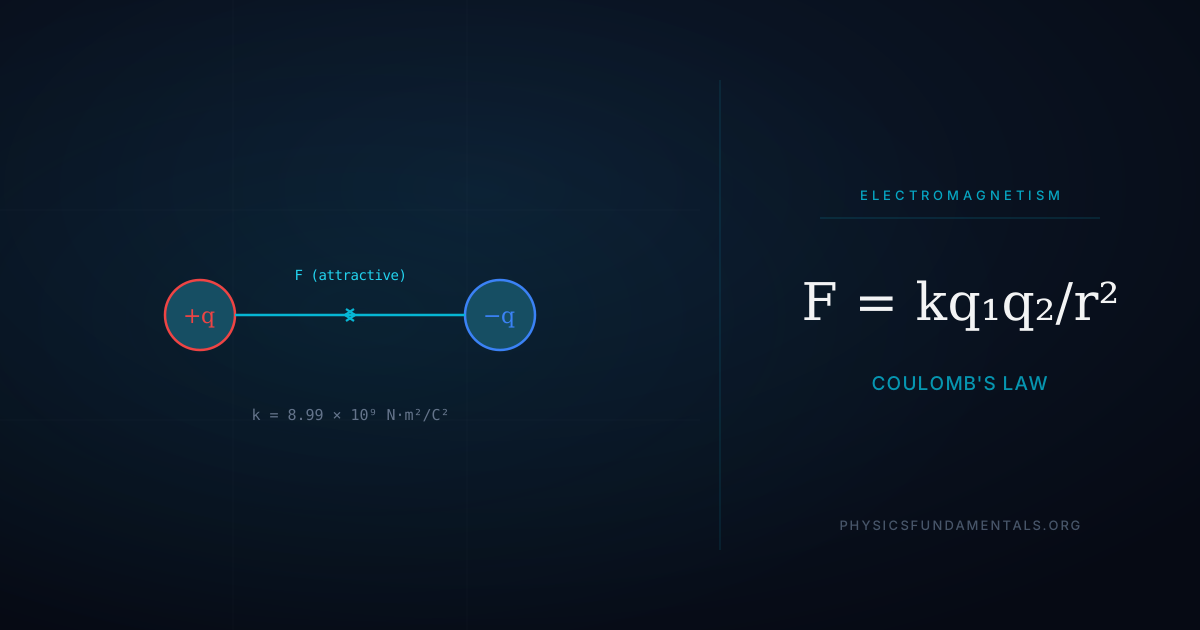
The force between two charges q₁ and q₂ separated by r follows from E = kQ/r²: the field of q₁ at the location of q₂ is E = kq₁/r², so the force on q₂ is F = q₂E = kq₁q₂/r² — Coulomb's Law.
Electric Potential: V = kQ/r
The electric potential V at a point is the electric potential energy per unit charge at that point. For a point charge Q at distance r:
Units: volts (V) = joules per coulomb (J/C). Note the key differences from the field equation:
| Property | Electric Field E | Electric Potential V |
|---|---|---|
| Formula (point charge) | E = kQ/r² | V = kQ/r |
| Type | Vector (has direction) | Scalar (no direction) |
| Unit | N/C = V/m | V = J/C |
| Falls off as | 1/r² | 1/r |
| Superposition | Vector addition (careful with direction) | Scalar addition (just add numbers) |
Because V is a scalar, finding the total potential from multiple charges is easier than finding the total field — just add the individual potentials algebraically (with signs for positive/negative charges).
V = kQ/r — The Electric Potential from a Point Charge
This equation is one of the most important in electrostatics. At distance r from a point charge Q:
This is derived by integrating the work done against the electric field to bring a unit positive charge from infinity to distance r:
Potential is defined as zero at infinity. For a positive charge Q: V is positive everywhere and increases as r decreases (you must do work to bring a positive test charge closer). For a negative charge Q: V is negative everywhere (a positive test charge is attracted and gains energy approaching).
Relationship Between E and V
Electric field and potential are related — E is the negative gradient of V:
For the uniform field between parallel plates separated by distance d with potential difference V:
This is why V/m and N/C are equivalent units for electric field. If you know how potential varies with position, you can find the field by differentiation; if you know the field, integrate to find the potential.
Worked Example 1: Electric Field from E = F/q
A charge of 2.0 × 10⁻⁶ C placed at a point in an electric field experiences a force of 0.10 N. Find the electric field strength.
Worked Example 2: Field and Potential from a Point Charge
A point charge Q = +3.0 × 10⁻⁹ C (3 nanocoulombs). Find E and V at r = 0.20 m from the charge.
Note: E falls as 1/r², so at r = 0.40 m: E = 674/4 = 168.5 N/C. V falls as 1/r: V = 134.9/2 = 67.4 V.
Worked Example 3: Work Done Moving a Charge
Find the work done moving a charge q = +2.0 × 10⁻⁶ C from point A (V_A = 200 V) to point B (V_B = 50 V).
Positive work done by the field (charge moves from high to low potential, like rolling downhill). The charge gains kinetic energy of 3.0 × 10⁻⁴ J — confirmed by the work-energy theorem.
Worked Example 4: V = kQ/r — Two-Charge System
Two charges: Q₁ = +5.0 nC at origin, Q₂ = −3.0 nC at x = 0.30 m. Find the potential at x = 0.10 m (between them).
Distance from Q₁: r₁ = 0.10 m. Distance from Q₂: r₂ = 0.20 m.
Because potential is scalar, we simply add the contributions with their signs — no vector components needed. This is a major practical advantage of using V rather than E for multi-charge problems.
Equipotential Surfaces
An equipotential surface is a surface on which V is constant everywhere. No work is done moving a charge along an equipotential (W = qΔV = 0). Electric field lines are always perpendicular to equipotential surfaces — if they weren't, there would be a component of E along the surface, doing work to move a charge along it, which would contradict V being constant.
For an isolated point charge: equipotentials are concentric spheres. For a uniform field between parallel plates: equipotentials are flat surfaces parallel to the plates. In conductors at electrostatic equilibrium: the entire conductor surface is an equipotential (E = 0 inside).
Real-World Applications
Capacitors: store energy in an electric field between two parallel plates. E = V/d tells you the field from the plate separation and voltage. Energy stored: U = ½CV² = ½QV = Q²/(2C). Capacitors in phones, CPUs, and power supplies all rely on E = V/d.
Lightning: a thundercloud builds up charge, creating an electric field between cloud and ground. When E exceeds the dielectric breakdown strength of air (~3 × 10⁶ V/m), the air ionises and a lightning bolt carries charge to ground. Tall buildings and trees lower the distance d in E = V/d, increasing the local field and making them more likely strike points.
Particle accelerators: charged particles are accelerated through potential differences. A proton accelerated through V = 1,000 V gains kinetic energy KE = qV = 1.6 × 10⁻¹⁹ × 1000 = 1.6 × 10⁻¹⁶ J = 1 keV. The LHC accelerates protons to 6.5 TeV — equivalent to 6.5 × 10¹² eV, achieved by repeated passage through accelerating fields.
Biology — nerve impulses: neurons maintain a potential difference of about −70 mV across their membrane at rest (inside negative relative to outside). An action potential involves the membrane potential briefly swinging to +40 mV — a 110 mV change driven by ion channels. The electric field across the 7 nm membrane: E = V/d = 0.11 / (7 × 10⁻⁹) = 1.57 × 10⁷ V/m. That's five times the breakdown field of air — one of the strongest sustained electric fields in nature.
Frequently Asked Questions
What is electric field strength E = F/q?
Electric field strength E is defined as the force per unit positive charge at a point: E = F/q. If a positive test charge q placed at a point experiences force F, the electric field there is E = F/q in the direction of that force. The unit is N/C (newtons per coulomb), equivalent to V/m (volts per metre). Rearranging gives the force on any charge in a known field: F = qE. Positive charges feel force in the direction of E; negative charges feel force opposite to E.
What is V = kQ/r and what does each symbol mean?
V = kQ/r is the electric potential at distance r from a point charge Q. V is potential in volts (J/C); k = 8.99 × 10⁹ N·m²·C⁻² is Coulomb's constant; Q is the source charge in coulombs; r is the distance from the charge in metres. Unlike the electric field (E = kQ/r²), potential falls as 1/r and is a scalar — it has no direction. This makes it easier to combine contributions from multiple charges: just add V values algebraically, including the sign of each Q.
What is the difference between electric field and electric potential?
Electric field E (N/C or V/m) is a vector describing the force per unit charge at a point. Electric potential V (volts) is a scalar describing the potential energy per unit charge at a point. E falls as 1/r² from a point charge; V falls as 1/r. They are related: E = −dV/dr (the field is the negative rate of change of potential with position). For uniform fields between plates: E = V/d. Potential is often more convenient for energy calculations (W = qΔV), while field is needed for force calculations (F = qE).
What is Coulomb's constant k?
Coulomb's constant k = 8.99 × 10⁹ N·m²·C⁻² (often approximated as 9.0 × 10⁹). It appears in Coulomb's law (F = kq₁q₂/r²), the point-charge field (E = kQ/r²), and the point-charge potential (V = kQ/r). It is related to the permittivity of free space ε₀ by k = 1/(4πε₀), where ε₀ = 8.854 × 10⁻¹² F/m. In SI units, k is a defined constant derived from the speed of light and the definition of the ampere.
How do you calculate work done by an electric field?
Work done moving charge q through potential difference ΔV is W = qΔV = q(V_A − V_B). Positive work means the field accelerates the charge (it moves from high to low potential if positive, or low to high if negative). The work done equals the change in kinetic energy (work-energy theorem) if no other forces act. In electron volts: 1 eV is the work done moving one electron charge through 1 V, equal to 1.6 × 10⁻¹⁹ J — a convenient unit for atomic and subatomic particle energetics.
What are equipotential surfaces?
Equipotential surfaces are surfaces on which electric potential V is constant. No work is done moving a charge along an equipotential (W = qΔV = 0 when ΔV = 0). Electric field lines are always perpendicular to equipotential surfaces. For a point charge, equipotentials are concentric spheres. For a uniform field between parallel plates, they are flat planes parallel to the plates. The surface of any conductor in electrostatic equilibrium is an equipotential, and the electric field inside a conductor is zero.
Share this article
Written by
Physics Fundamentals Editorial Team
Written and reviewed by our team of physics educators. Content is aligned with A-Level, GCSE, AP Physics, and undergraduate curricula.
About Physics Fundamentals →