
Every electric motor, every MRI machine, every loudspeaker, every hard drive relies on the same fundamental interaction: magnetic fields exerting forces on moving charges. Understanding how magnetic fields are described and how they create forces is the gateway to electromagnetism — one of the four fundamental forces of nature and the basis of most modern technology.
F = qvB sin θ — force on a moving charge
F = BIL sin θ — force on a current-carrying conductor
B = μ₀I / (2πr) — magnetic field around a long wire
F = force (N) | q = charge (C) | v = velocity (m/s)
B = magnetic field strength (tesla, T) | θ = angle between v (or I) and B
I = current (A) | L = length of conductor (m)
What Is a Magnetic Field?
A magnetic field is a vector field — at every point in space, it has both a magnitude and a direction. The magnitude is measured in tesla (T), named after Nikola Tesla. The direction is defined as the direction a free north pole would point (the direction field lines run from north to south poles outside a magnet).
The symbol for magnetic field strength (more precisely, magnetic flux density) is B. Common field strengths for reference:
- Earth's magnetic field: ~5 × 10⁻⁵ T (50 μT) at the surface
- Bar magnet near surface: ~0.01–0.1 T
- MRI machine: 1.5–3 T (clinical); 7–10 T (research)
- Strongest continuous laboratory fields: ~45 T
- Magnetar (neutron star): up to 10¹¹ T
Magnetic field lines are closed loops — they always form complete circuits, never starting or ending. This reflects the fact that magnetic monopoles (isolated N or S poles) have never been observed. Every magnet has both a north and south pole; cut it in half and you get two smaller magnets, each with both poles.
The Magnetic Force Formula: F = qvB sin θ
A charged particle moving through a magnetic field experiences a force. The Lorentz force on a charge q moving at velocity v through magnetic field B is:
where θ is the angle between the velocity vector v and the magnetic field vector B.
Key properties of this force:
- It is always perpendicular to both v and B — the force never has a component along the direction of motion.
- Because F ⊥ v, the magnetic force does no work on the charge — it cannot change the particle's kinetic energy, only its direction.
- If v is parallel to B (θ = 0), sin θ = 0 and F = 0 — no force at all.
- Maximum force when θ = 90° (v perpendicular to B): F = qvB.
Direction: given by the right-hand rule (for positive charge). Point fingers in direction of v, curl toward B — the thumb points in the direction of F. For negative charges, the force is opposite.
The Full Lorentz Force: Electric and Magnetic Together
When both electric field E and magnetic field B are present, the total force on charge q is the Lorentz force:
Written in component form for a charge moving in the x-direction through a magnetic field in the z-direction:
The electric part (qE) acts along E and can do work, changing kinetic energy. The magnetic part (qv × B) acts perpendicular to v and does no work. This distinction is fundamental: electric fields accelerate charges; magnetic fields redirect them.
Force on a Current-Carrying Conductor: F = BIL sin θ
A current is a flow of charges. If each charge q moves at drift velocity v_d, and the wire has n charges per unit volume with cross-section A, then in length L there are nAL charges, each experiencing F = qv_dB. The total force is:
where I = nAqv_d is the current and θ is the angle between the current direction and B.
This is the principle behind every electric motor and every loudspeaker. In a motor, a current-carrying coil sits in a magnetic field; the force on the conductors creates a torque that rotates the coil.
Worked Example 1: Force on a Moving Charge
An electron (q = −1.6 × 10⁻¹⁹ C) moves at 2.0 × 10⁶ m/s perpendicular to a magnetic field of 0.50 T. Find the force on the electron.
θ = 90° (perpendicular), so sin θ = 1:
The direction: using the right-hand rule for positive charge then reversing for the electron. The electron curves in a circle — this is how cyclotrons and mass spectrometers work.
Worked Example 2: Circular Motion in a Magnetic Field
The magnetic force on a charged particle moving perpendicular to B is centripetal — it makes the particle move in a circle. Setting F_magnetic = F_centripetal:
An proton (m = 1.67 × 10⁻²⁷ kg, q = 1.6 × 10⁻¹⁹ C) moves at 3.0 × 10⁶ m/s in a 0.20 T field:
This radius formula r = mv/(qB) is the basis of mass spectrometry: different masses m give different radii, separating ions by mass-to-charge ratio.
Worked Example 3: Force on a Current-Carrying Wire
A 0.30 m length of wire carries 4.0 A of current at 60° to a 0.25 T magnetic field. Find the force on the wire.
Magnetic Field Around a Wire: B = μ₀I/(2πr)
A long straight wire carrying current I creates a circular magnetic field around it. At distance r from the wire:
where μ₀ = 4π × 10⁻⁷ T·m/A is the permeability of free space. The field forms concentric circles around the wire (right-hand rule: thumb in direction of current, fingers curl in direction of B).
For a wire carrying 10 A, the field at r = 1 cm = 0.01 m:
That's about 4× the strength of Earth's magnetic field — significant for nearby compasses and electronic components, which is why current-carrying cables are often twisted (the fields from two opposing currents cancel).
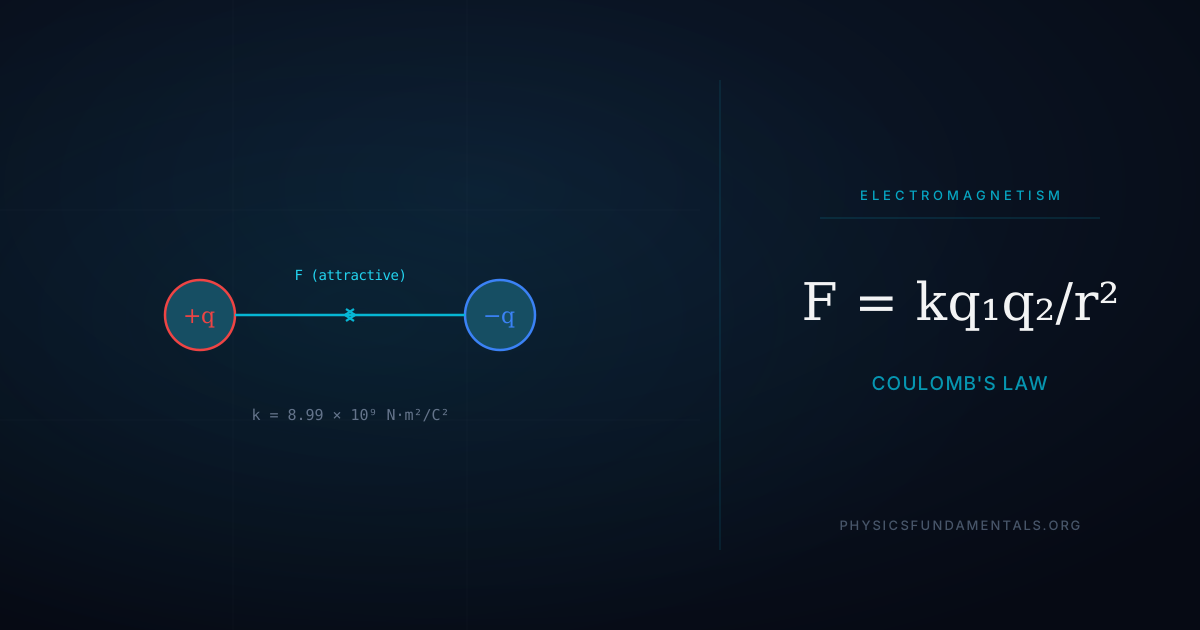
E = F/q — Electric Field Strength
The electric field strength E at a point is defined as the force per unit positive charge placed at that point:
Units: N/C = V/m. This is separate from the magnetic field B, though both appear in the Lorentz force law. For a point charge Q, the electric field at distance r is E = kQ/r² = Q/(4πε₀r²). See the electric field and potential article for full coverage.
Applications of Magnetic Forces
Electric motors: current-carrying coils in magnetic fields experience torque (F = BIL on each side of the coil acts in opposite directions, creating rotation). All electric vehicles, washing machines, and industrial drives use this principle.
MRI machines: strong magnetic fields (1.5–3 T) align hydrogen nuclear spins. Radio-frequency pulses knock them out of alignment; their return to equilibrium emits signals used to construct images. The precision required is extraordinary — field uniformity must be better than 1 part per million across the imaging volume.
Mass spectrometry: ions accelerated through a potential difference then deflected by a magnetic field. Since r = mv/(qB) and kinetic energy fixes v, different masses trace different radii. This identifies compounds and measures atomic masses to one part in 10⁸.
Particle accelerators: the Large Hadron Collider uses 1,232 superconducting dipole magnets (each producing ~8 T) to bend proton beams around its 27 km ring. Without those magnetic fields, the protons would fly off in straight lines.
Earth's magnetosphere: Earth's magnetic field (generated by convection currents in the liquid iron outer core) deflects the solar wind, protecting the atmosphere from erosion. The Van Allen radiation belts are regions where charged particles spiral along field lines. Without Earth's magnetosphere, solar wind would strip the atmosphere over geological timescales — as happened to Mars.
Frequently Asked Questions
Common Mistakes with Magnetic Force Problems
Getting the direction wrong. The right-hand rule takes practice. F = qv × B means: point fingers in direction of v, curl them toward B — thumb points in direction of F (for positive q). For negative charge (electrons), reverse. Many students slip up here, especially when fields are into/out of the page and velocities are in the plane of the page. Draw a 3D diagram, not just x-y components.
Forgetting sin θ. F = qvB is only valid when v ⊥ B (θ = 90°). If the velocity makes another angle with the field, you must include sin θ. A particle moving parallel to a magnetic field (θ = 0) experiences zero force regardless of its speed — it passes straight through undeflected.
Assuming magnetic forces do work. A common conceptual error: thinking a magnetic field can accelerate a particle or change its kinetic energy. It cannot — F ⊥ v always, so power P = F · v = 0. The speed of the particle is unchanged by the magnetic field; only the direction changes. A magnetic field can redirect a beam of charged particles but cannot speed them up. That requires an electric field.
Magnetic Fields and Electromagnetic Induction
Magnetic fields and electromagnetic induction are inseparable. Faraday's law states that a changing magnetic flux through a circuit induces an EMF: ε = −dΦ/dt (where Φ = BA cos θ is magnetic flux in webers). This is the operating principle of generators, transformers, and inductive sensors. Every time you charge a phone wirelessly or drive past a traffic loop detector, electromagnetic induction — which requires a changing B field — is at work.
The relationship between electric and magnetic fields also forms the basis of Maxwell's equations, which predicted the existence of electromagnetic waves (including light) travelling at c = 1/√(ε₀μ₀) — one of the great unifications in all of physics. See the electromagnetic induction article and electromagnetic spectrum for the full picture.
What is the formula for magnetic force?
The magnetic force on a moving charge is F = qvB sin θ, where q is the charge in coulombs, v is the speed in m/s, B is the magnetic flux density in tesla, and θ is the angle between the velocity and the field. For a current-carrying conductor, the force is F = BIL sin θ, where I is current in amps and L is the length of conductor in metres. Maximum force occurs when velocity (or current) is perpendicular to B — when θ = 90° and sin θ = 1.
What is the Lorentz force?
The Lorentz force is the total electromagnetic force on a charged particle: F = q(E + v × B), combining the electric force (qE, along the field) and magnetic force (qv × B, perpendicular to both velocity and field). The magnetic component can never do work on the particle — it only changes direction, not speed. The electric component can do work, changing kinetic energy. Together they govern the behaviour of charged particles in electromagnetic fields.
What is the unit of magnetic field strength?
The SI unit is the tesla (T), named after Nikola Tesla. 1 T = 1 kg/(A·s²) = 1 N/(A·m). An older unit still sometimes encountered is the gauss (G): 1 T = 10,000 G. Earth's surface magnetic field is about 50 μT (microtesla) or 0.5 G. Medical MRI machines operate at 1.5–3 T. The strongest continuous magnetic fields produced in laboratories reach about 45 T.
Why does the magnetic force do no work?
Work is done by a force only when the force has a component along the direction of motion. The magnetic force F = qv × B is always perpendicular to the velocity v (by the definition of the cross product). A perpendicular force cannot change the speed, only the direction. This is why a charged particle in a uniform magnetic field moves in a circle at constant speed — the magnetic force continually redirects it without adding or removing kinetic energy.
What is F = qvB and when is it used?
F = qvB is the simplified form of the magnetic force F = qvB sin θ when the charge moves perpendicular to the field (θ = 90°, sin θ = 1). It gives the maximum possible magnetic force on the charge. It's the form used in most GCSE and A-Level problems involving charged particles in magnetic fields, cyclotrons, and mass spectrometers — where particles are usually set up to move perpendicular to the field for simplicity.
How does a magnetic field create circular motion?
When a charged particle moves perpendicular to a uniform magnetic field, the magnetic force F = qvB is always perpendicular to the velocity — exactly the condition for circular motion. Setting this equal to the centripetal force mv²/r gives r = mv/(qB). The particle orbits in a circle of radius r at constant speed. This principle is used in cyclotrons (particle accelerators) and mass spectrometers, where the radius of curvature reveals the particle's mass-to-charge ratio.
Share this article
Written by
Physics Fundamentals Editorial Team
Written and reviewed by our team of physics educators. Content is aligned with A-Level, GCSE, AP Physics, and undergraduate curricula.
About Physics Fundamentals →