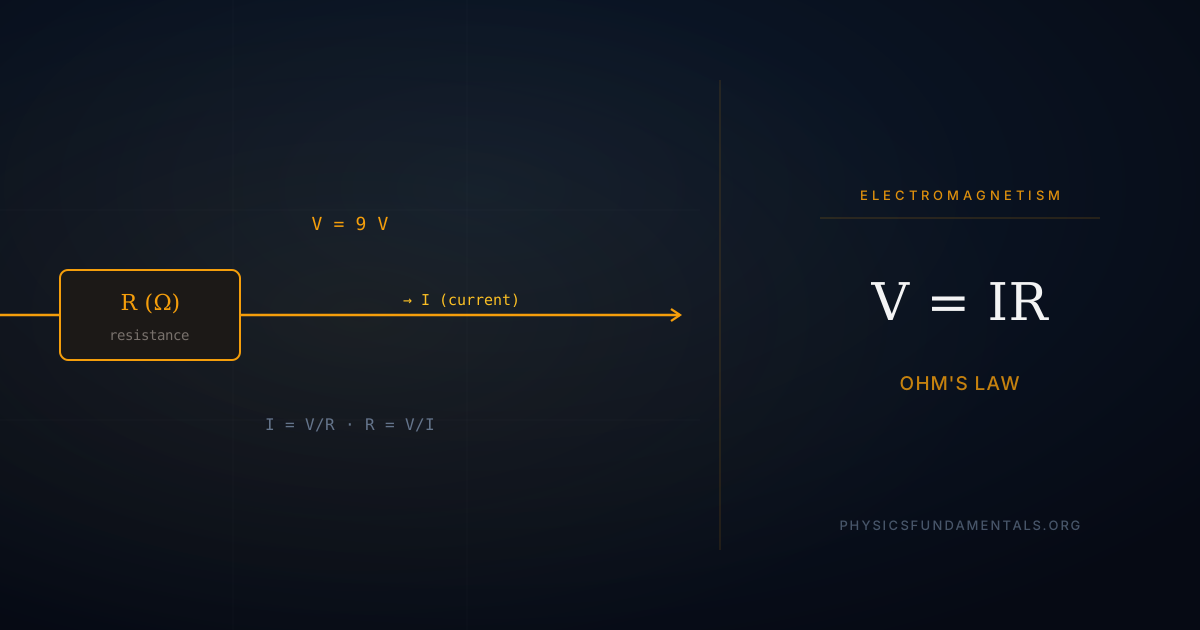
Connect a battery to a resistor. Double the voltage and the current doubles. Halve the resistance and the current doubles again. This simple proportionality — V = IR, Ohm's Law — governs the behaviour of resistors, wires, and most electrical components at a fixed temperature. It's the starting point for every circuit calculation, from the LED in your keyboard to the transmission lines carrying power across continents.
V = IR
V = voltage (volts, V) — potential difference across the component
I = current (amperes, A) — charge flow per second
R = resistance (ohms, Ω) — opposition to current flow
Rearrangements: I = V/R | R = V/I
Power: P = IV = I²R = V²/R
What Is Ohm's Law?
Ohm's Law states that the current through a conductor is directly proportional to the voltage across it, provided temperature and other physical conditions remain constant. The constant of proportionality is resistance R:
A component that obeys Ohm's Law — where R is constant regardless of V and I — is called ohmic. A metal resistor at constant temperature is ohmic. A diode, a bulb filament (as it heats up), and a thermistor are non-ohmic — their resistance changes with conditions.
The Three Variables
Voltage V (potential difference) is the electrical "pressure" driving current around a circuit. Measured in volts (V), it represents the energy transferred per coulomb of charge: 1 V = 1 J/C. A 9 V battery transfers 9 joules of energy for every coulomb of charge it drives around a circuit.
Current I is the rate of charge flow past a point: I = Q/t, where Q is charge in coulombs and t is time in seconds. Measured in amperes (A); 1 A = 1 C/s. In a metal, current is carried by free electrons drifting (very slowly — typically millimetres per second) under the influence of the electric field. The signal propagates at near light speed; the electrons themselves move slowly.
Resistance R is the opposition to current flow, measured in ohms (Ω). It arises from collisions between conduction electrons and the vibrating lattice of metal ions. At higher temperatures, ions vibrate more vigorously — more collisions, higher resistance. This is why filament bulbs have higher resistance when hot than when cold.
Ohm's Law Triangle — Rearrangements
Cover the quantity you want to find — what remains is the formula. This "VIR triangle" is a memory aid: V at the top, I and R at the bottom (side by side, meaning divide). Cover V → I × R. Cover I → V/R. Cover R → V/I.
Worked Example 1: Finding Current
A 12 V battery is connected to a 4 Ω resistor. Find the current.
Worked Example 2: Finding Resistance
A current of 0.5 A flows through a component when 6 V is applied. Find the resistance.
Worked Example 3: Series and Parallel Circuits
Three resistors: R₁ = 2 Ω, R₂ = 3 Ω, R₃ = 6 Ω connected to a 12 V supply. Find the total current when: (a) all in series; (b) all in parallel.
(a) Series: R_total = R₁ + R₂ + R₃ = 2 + 3 + 6 = 11 Ω
(b) Parallel: 1/R_total = 1/2 + 1/3 + 1/6 = 3/6 + 2/6 + 1/6 = 6/6 = 1 → R_total = 1 Ω
Parallel circuits draw far more current because each branch provides an independent path — equivalent resistance is always lower than the smallest individual resistor.
Worked Example 4: Power in a Circuit
A 230 V kettle draws 10 A. Find: (a) resistance; (b) power; (c) energy used in 3 minutes.
(a) R = V/I = 230/10 = 23 Ω
(b) P = IV = 10 × 230 = 2,300 W = 2.3 kW
(c) E = Pt = 2300 × 180 = 414,000 J = 0.115 kWh
Power Formulas: P = IV = I²R = V²/R
Combining P = IV with V = IR gives three equivalent power expressions:
Which to use depends on what's given. Know V and I → use P = IV. Know I and R → use P = I²R (power dissipated as heat in a resistor scales with the square of current — doubling current quadruples heat). Know V and R → use P = V²/R.
Use the Ohm's Law calculator to solve any combination instantly, including power calculations with full unit conversion.
Resistivity and Resistance
The resistance of a conductor depends on its material, length, and cross-section:
where ρ is resistivity (Ω·m, a material property), L is length (m), and A is cross-sectional area (m²). Resistivity values: copper ρ = 1.7 × 10⁻⁸ Ω·m; nichrome (heating element wire) ρ = 1.1 × 10⁻⁶ Ω·m; silicon ρ ≈ 640 Ω·m; glass ρ ≈ 10¹² Ω·m. A 1 m length of 1 mm² copper wire has R = (1.7 × 10⁻⁸ × 1) / (10⁻⁶) = 0.017 Ω — very low resistance.
Non-Ohmic Components
Many components are non-ohmic — their resistance isn't constant:
Filament bulb: resistance increases sharply as temperature rises. Cold resistance ~15 Ω; hot (operating) resistance ~1,200 Ω for a 60 W, 230 V bulb (R = V²/P = 230²/60 = 882 Ω at operating temperature).
Diode: allows current in one direction only. In forward bias above ~0.7 V (silicon), resistance drops dramatically. In reverse bias, resistance is extremely high (behaves as open circuit). Current-voltage graph is exponential, not linear.
Thermistor (NTC): resistance decreases as temperature increases. Used in thermostats, temperature sensors, and self-resetting fuses. At 25°C: typically 10 kΩ. At 100°C: might drop to 300 Ω.
LDR (light-dependent resistor): resistance decreases in brighter light. In the dark: ~1 MΩ. In bright sunlight: ~100 Ω. Used in automatic lighting circuits.
Kirchhoff's Laws
Ohm's Law (V = IR) applies to individual components. To analyse complete circuits with multiple components, Kirchhoff's Laws are needed:
Kirchhoff's Current Law (KCL): the total current entering a junction equals the total current leaving it. ΣI_in = ΣI_out. This is conservation of charge.
Kirchhoff's Voltage Law (KVL): the sum of all voltage drops around any closed loop is zero. ΣV = 0. This is conservation of energy — the energy gained from sources equals the energy dissipated in resistors.
Together with Ohm's Law, these two laws allow analysis of any circuit, however complex, by setting up simultaneous equations.
Historical Context
Georg Simon Ohm (1789–1854) published his experimental discovery of V ∝ I in 1827 in "Die galvanische Kette, mathematisch bearbeitet" (The Galvanic Circuit Investigated Mathematically). His experimental apparatus used a thermocouple as a constant voltage source and a magnetic compass as a current detector. The scientific community was initially sceptical — the Prussian minister of education reportedly criticised the work as a "web of naked fancies." Ohm was vindicated when the Royal Society awarded him the Copley Medal in 1841, and the unit of resistance was named in his honour.
Frequently Asked Questions
Internal Resistance and EMF
Real batteries have internal resistance r — resistance inside the battery itself. The electromotive force (EMF, symbol ε) is the total energy provided per coulomb by the battery. The terminal voltage (what you measure across the battery terminals with a voltmeter) is less than the EMF because some voltage is "used up" driving current through the internal resistance:
where I is the current drawn. A fresh AA battery has ε = 1.5 V and internal resistance r ≈ 0.15 Ω. Drawing 1 A: V_terminal = 1.5 − 1 × 0.15 = 1.35 V. Drawing 5 A (short circuit): V_terminal = 1.5 − 5 × 0.15 = 0.75 V — the terminal voltage drops to half. This is why batteries heat up under heavy load (power dissipated in internal resistance = I²r) and why a battery can seem "dead" under load but recover some voltage when the load is removed.
AC Circuits and Resistance
Ohm's Law V = IR holds for direct current (DC) circuits where V and I are constant. In alternating current (AC) circuits (like mains electricity), voltage and current alternate sinusoidally. For a pure resistor, V and I are in phase and Ohm's Law applies with peak or RMS values: V_rms = I_rms × R.
However, capacitors and inductors in AC circuits introduce phase differences and frequency-dependent impedance Z (the AC analogue of resistance). The generalised Ohm's Law for AC: V = IZ, where Z = √(R² + (X_L − X_C)²) and X_L, X_C are inductive and capacitive reactances. For a pure resistor, Z = R and V = IR — Ohm's Law is recovered.
What is Ohm's Law?
Ohm's Law states that the voltage across a conductor is proportional to the current through it, provided temperature remains constant: V = IR. Here V is voltage in volts, I is current in amperes, and R is resistance in ohms. Rearranged: I = V/R (to find current) and R = V/I (to find resistance). It applies to ohmic conductors — resistors, metal wires at constant temperature — but not to non-ohmic components like diodes, thermistors, or filament bulbs whose resistance changes with conditions.
What is the formula for Ohm's Law?
Ohm's Law formula is V = IR, where V = voltage (V), I = current (A), R = resistance (Ω). The three rearrangements are: V = IR (voltage from current and resistance), I = V/R (current from voltage and resistance), R = V/I (resistance from voltage and current). Power formulas derived from Ohm's Law: P = IV = I²R = V²/R. The Ohm's Law triangle is a memory aid — cover the quantity you want, and the remaining letters give the formula.
What is resistance measured in?
Resistance is measured in ohms (Ω), named after Georg Simon Ohm. 1 ohm = 1 volt per ampere (1 Ω = 1 V/A). Larger units: kiloohm (kΩ = 10³ Ω) used for typical resistors, megaohm (MΩ = 10⁶ Ω) used for insulation and very high-value resistors. Common resistance values: wire in a circuit ~0.01 Ω, heating element ~20 Ω, LED protection resistor ~100–1000 Ω, thermistor at room temperature ~10 kΩ, insulating glass ~10¹² Ω.
What is the difference between series and parallel circuits?
In a series circuit, components are connected end-to-end; the same current flows through each, and resistances add: R_total = R₁ + R₂ + R₃. Total resistance is always greater than any individual resistor. In a parallel circuit, components share the same voltage across each branch; currents split between branches, and 1/R_total = 1/R₁ + 1/R₂ + 1/R₃. Total resistance is always less than the smallest individual resistor. Household electrical outlets are wired in parallel so each device gets the full mains voltage independently.
What is an ohmic conductor?
An ohmic conductor is one that obeys Ohm's Law — its resistance R = V/I remains constant regardless of the applied voltage or current (at constant temperature). Metal resistors at room temperature are ohmic: a graph of V vs I is a straight line through the origin with gradient R. Non-ohmic conductors include diodes (exponential V-I relationship), filament bulbs (resistance increases with temperature), and thermistors (resistance decreases with temperature). Non-ohmic behaviour is common in semiconductors and any component whose temperature changes significantly with current.
How is power calculated using Ohm's Law?
Power dissipated in a resistor is P = IV = I²R = V²/R. All three are equivalent — choose based on what's known. If you know current and voltage: P = IV. If you know current and resistance: P = I²R (note that doubling current quadruples power — a factor of 4). If you know voltage and resistance: P = V²/R. A 10 Ω resistor carrying 2 A dissipates P = I²R = 4 × 10 = 40 W as heat. The same resistor with 20 V across it: P = V²/R = 400/10 = 40 W — consistent, since I = V/R = 20/10 = 2 A.
Share this article
Written by
Physics Fundamentals Editorial Team
Written and reviewed by our team of physics educators. Content is aligned with A-Level, GCSE, AP Physics, and undergraduate curricula.
About Physics Fundamentals →