Every time you charge your phone, drive a car, or switch on a light, you are using a technology built on a discovery made in 1831 by Michael Faraday: electromagnetic induction. Faraday found that a changing magnetic field through a conductor induces a voltage — and that this induced voltage drives a current. This single insight enabled the invention of generators, transformers, and electric motors, and remains the basis of virtually all electrical power generation on Earth today.
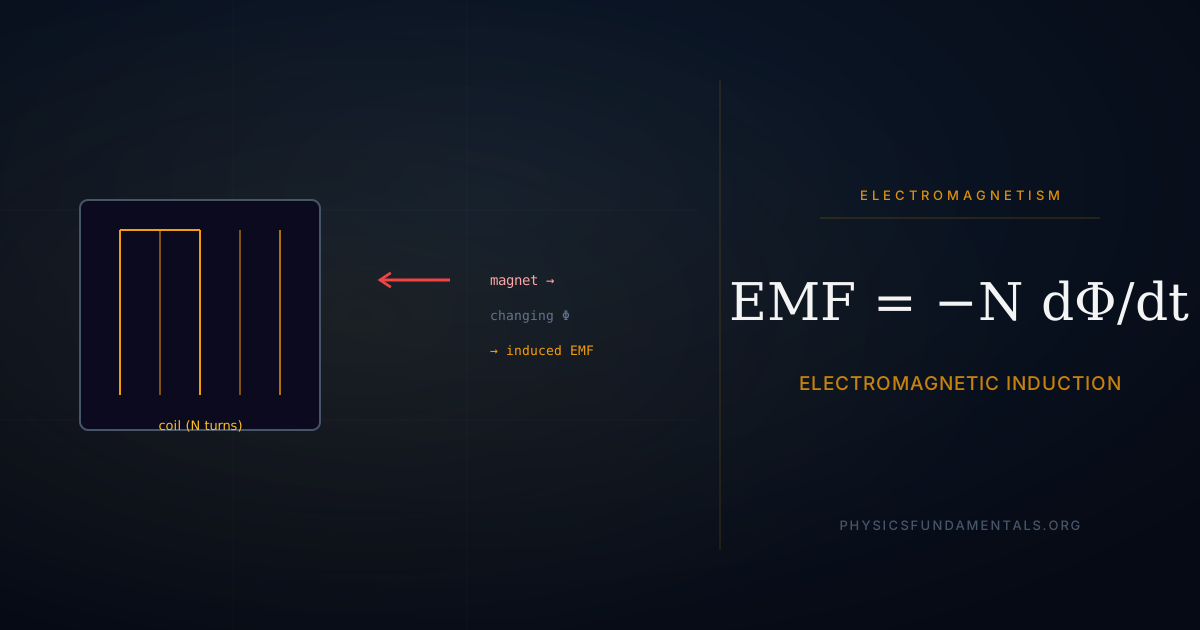
The induced EMF in a circuit is equal to the negative rate of change of magnetic flux through the circuit:
EMF = −dΦ/dt
For a coil of N turns: EMF = −N dΦ/dt
where Φ = BA cosθ is magnetic flux (Wb), B is flux density (T), A is the area (m²), and θ is the angle between B and the normal to the coil. The negative sign embodies Lenz's Law.
Magnetic Flux and Why Change Matters
Magnetic flux Φ = BA cosθ measures how much magnetic field passes through a loop. A static flux — no matter how large — induces no EMF. Only a changing flux induces an EMF. The flux can change because:
• B changes in magnitude (e.g. a magnet moving toward a coil)
• The area A changes (e.g. a coil being stretched)
• The angle θ changes (e.g. a coil rotating in a fixed field — the basis of generators)
Lenz's Law: The Direction of Induced Current
The negative sign in Faraday's law encodes Lenz's Law: the induced current flows in a direction such that its magnetic effect opposes the change in flux that caused it.
Practical rule: push a north pole into a coil → the induced current creates a north pole facing the approaching magnet (opposing the increase in flux). Pull the magnet away → the induced current creates a south pole, trying to maintain the flux as it decreases.
Lenz's Law is conservation of energy in action. If the induced current aided the flux change rather than opposing it, you could get a self-amplifying current from nothing — violating the first law of thermodynamics. The opposing force Lenz's Law creates is why generators require mechanical work to rotate against the magnetic braking effect.
EMF = N dΦ/dt — more turns N does increase EMF for the same rate of flux change. But the flux change matters as much as N. A coil rotating slowly in a strong field may induce less EMF than a coil rotating fast in a weaker field. Both N and dΦ/dt determine the output.
Worked Examples
Example 1: Flux change through a coil
A 200-turn coil of area 0.05 m² is in a uniform magnetic field. B increases from 0.2 T to 0.8 T in 0.4 s. Find the induced EMF.
Example 2: Rotating coil (generator)
A 100-turn coil of area 0.02 m² rotates at 50 Hz in a 0.3 T field. Find the peak EMF.
The instantaneous EMF varies sinusoidally: EMF(t) = 188.5 sin(2π × 50 × t) — this is how AC generators produce sinusoidal alternating current.
Generators: Mechanical Energy → Electrical Energy
An AC generator (alternator) converts mechanical rotation to electrical energy using electromagnetic induction. A coil rotates in a magnetic field — the angle θ between the coil normal and B changes continuously, so flux Φ = BA cosθ changes continuously, inducing a sinusoidal EMF.
In a power station, the mechanical rotation is provided by steam turbines (coal, gas, nuclear) or water turbines (hydroelectric) or wind (wind turbines). The rotating coil is the rotor; the stationary magnets or field coils form the stator. Slip rings (not a commutator) maintain continuous contact, allowing AC output.
In the UK, generators produce 50 Hz AC at ~25,000 V, which is stepped up to 275,000–400,000 V by transformers for transmission, then stepped back down for domestic use at 230 V.
Transformers: Changing Voltage Using Induction
A transformer uses mutual induction to change AC voltage. An alternating current in the primary coil (N_p turns) creates a changing magnetic flux in a soft iron core. This changing flux passes through the secondary coil (N_s turns), inducing an EMF in it.
For an ideal transformer, power is conserved: V_p I_p = V_s I_s. So:
A step-up transformer (N_s > N_p) increases voltage and decreases current. A step-down transformer (N_s < N_p) decreases voltage and increases current. National grids use step-up transformers to reduce transmission current — since power losses in cables are P_loss = I²R, reducing current dramatically reduces waste heat.
| Device | Principle | Energy conversion |
|---|---|---|
| Generator / alternator | Rotating coil in B field | Mechanical → electrical |
| Transformer | Mutual induction via iron core | AC voltage change (same frequency) |
| Electric motor | Force on current in B field | Electrical → mechanical |
| Induction charging | Mutual induction (no contact) | AC electrical → AC electrical (wireless) |
Self-Inductance and Inductors
When the current in a coil changes, the changing magnetic flux the coil itself creates induces an EMF in the same coil — opposing the change in current. This is self-inductance:
where L is the inductance (henries, H). An inductor opposes changes in current — it resists sudden increases or decreases, smoothing current flow. Inductors are used in power supplies to filter ripple, in tuned LC circuits (radios, TVs) to select frequencies, and in transformers.
Frequently Asked Questions
Faraday's Law of Electromagnetic Induction
A changing magnetic flux through a circuit induces an EMF (electromotive force). Faraday's Law:
where Φ = BA cos θ is the magnetic flux (webers, Wb = T·m²), B is flux density (T), A is the area (m²), θ is the angle between B and the normal to the coil, and N is the number of turns. The negative sign embodies Lenz's Law.
Lenz's Law
The induced EMF always drives a current that opposes the change in flux that caused it. If flux increases through a coil, the induced current creates a magnetic field opposing the increase (reduces flux). If flux decreases, the induced current creates a field to maintain it (opposes decrease). This is a consequence of energy conservation — if the induced current aided the change, it would create a runaway self-amplifying effect, generating energy from nothing.
Worked Example 1: EMF in a Rotating Coil
A 200-turn coil (A = 0.05 m²) rotates in a 0.3 T field at 50 rev/s. Find the peak EMF.
This is the principle of an AC generator — the coil flux varies as Φ = BA cos(ωt), giving ε = NBAω sin(ωt), a sinusoidal EMF.
Worked Example 2: EMF from Changing Field
A 100-turn coil (A = 0.01 m²) sits in a magnetic field increasing at 5 T/s. Find the induced EMF.
Applications
Generators: rotating coil in magnetic field → changing flux → AC EMF → electricity. UK power stations generate at 25 kV, stepped up to 400 kV for transmission, stepped down to 230 V for homes — all using electromagnetic induction via transformers. Transformers: V_s/V_p = N_s/N_p. An ideal transformer with 1000 primary turns and 100 secondary turns gives V_s = V_p/10 (step-down). Induction hob: high-frequency alternating current creates rapidly changing flux in a metal pan, inducing eddy currents that resistively heat the pan — no flame, no hot surface. MRI machines: rapidly changing magnetic fields induce EMFs in conducting loops within the bore, requiring careful shielding design. Wireless charging (Qi): phone charger coil creates alternating magnetic flux; phone's receiver coil has EMF induced — power transfer without physical contact.
The Transformer Equation
Power conservation: V_p I_p = V_s I_s. Step-up transformer (N_s > N_p): higher voltage, lower current. Step-down (N_s < N_p): lower voltage, higher current. High-voltage transmission minimises resistive losses (P_loss = I²R — lower current, same power, far less heat loss).
Frequently Asked Questions
What is electromagnetic induction?
Electromagnetic induction is the generation of an EMF (and hence current in a closed circuit) by a changing magnetic flux. Discovered by Michael Faraday in 1831, it is described by Faraday's Law: ε = −N dΦ/dt. The flux change can be caused by moving the conductor in a magnetic field, changing the field strength, or changing the area or orientation of the circuit. Electromagnetic induction is the principle behind electric generators, transformers, induction motors, wireless chargers, and most of modern electrical infrastructure.
What is Lenz's Law?
Lenz's Law states that the induced EMF drives a current that opposes the change in magnetic flux that caused it. If flux through a loop increases, the induced current creates a magnetic field opposing the increase (reducing the net flux change). If flux decreases, the induced current creates a field supporting the original field (opposing the decrease). The negative sign in Faraday's Law (ε = −dΦ/dt) represents Lenz's Law mathematically. It is a consequence of energy conservation — without opposition, the induced current would amplify the flux change, creating energy from nothing.
What is magnetic flux?
Magnetic flux Φ is the total magnetic field passing through a surface: Φ = BA cos θ, where B is flux density (T), A is area (m²), and θ is the angle between B and the normal to the surface. Units: webers (Wb = T·m²). Maximum flux when B is perpendicular to the surface (θ = 0°, cos θ = 1). Zero flux when B is parallel to the surface (θ = 90°, cos θ = 0). A rotating coil in a uniform field has sinusoidally varying flux — Φ = BA cos(ωt) — which produces the sinusoidal EMF that powers AC electrical systems.
How does a transformer work?
A transformer consists of two coils (primary and secondary) wound around a soft iron core. Alternating current in the primary coil creates a continuously changing magnetic flux in the core. By Faraday's Law, this changing flux induces an EMF in the secondary coil. The voltage ratio equals the turns ratio: V_s/V_p = N_s/N_p. A step-up transformer (more secondary turns) increases voltage and decreases current; step-down does the reverse. Transformers are near-perfect devices (95–99% efficient) — the small losses arise from eddy currents in the core (minimised by laminating the core) and resistive heating in the windings.
What are eddy currents?
Eddy currents are circulating currents induced in conducting materials by changing magnetic flux through the bulk of the material. They flow in closed loops perpendicular to the flux change, dissipating energy as heat (I²R). Eddy currents are unwanted in transformer cores (cause energy loss — minimised by using laminated cores of thin insulated sheets, breaking the current paths) but useful in induction hobs (heat the pan directly), eddy-current brakes (smooth, contactless braking in trains and rollercoasters), and electromagnetic damping (slowing the oscillation of galvanometer needles).
What is electromagnetic induction?
Electromagnetic induction is the production of an EMF (and hence a current, if the circuit is closed) by a changing magnetic flux through a conductor. Discovered by Michael Faraday in 1831. Described by Faraday's law: EMF = −N dΦ/dt. It is the basis of generators, transformers, and wireless charging.
What is Faraday's law?
Faraday's law states that the induced EMF equals the negative rate of change of magnetic flux: EMF = −N dΦ/dt. The negative sign (Lenz's law) means the induced current opposes the flux change. Larger N (more turns) or faster flux change gives larger EMF.
What is Lenz's law?
Lenz's law states that the induced current always flows in a direction to oppose the change in magnetic flux that caused it. It is a consequence of energy conservation — if the induced current aided the flux change, a self-amplifying current would violate the first law of thermodynamics. Lenz's law gives the negative sign in Faraday's law.
How does a generator work?
A generator rotates a coil in a magnetic field. The changing angle between the coil and field produces a sinusoidally varying flux, inducing a sinusoidal AC EMF: EMF = NBAω sin(ωt). Mechanical energy (from steam, water, or wind) drives the rotation; electrical energy is extracted. Peak EMF = NBAω.
How does a transformer work?
A transformer uses mutual induction. An AC current in the primary coil creates a changing flux in an iron core. This changing flux passes through the secondary coil, inducing an EMF proportional to the turns ratio: V_s/V_p = N_s/N_p. Step-up transformers increase voltage (and decrease current); step-down do the reverse. Transformers only work with AC — not DC.
Why do transformers only work with AC?
Transformers require a changing magnetic flux to induce an EMF. DC current creates a constant (non-changing) flux, inducing zero EMF in the secondary. AC current continuously changes, creating continuously changing flux, continuously inducing an EMF in the secondary. A DC source connected to a transformer primary simply produces a constant magnetic field — no output.
Share this article
Written by
Physics Fundamentals Editorial Team
Written and reviewed by our team of physics educators. Content is aligned with A-Level, GCSE, AP Physics, and undergraduate curricula.
About Physics Fundamentals →